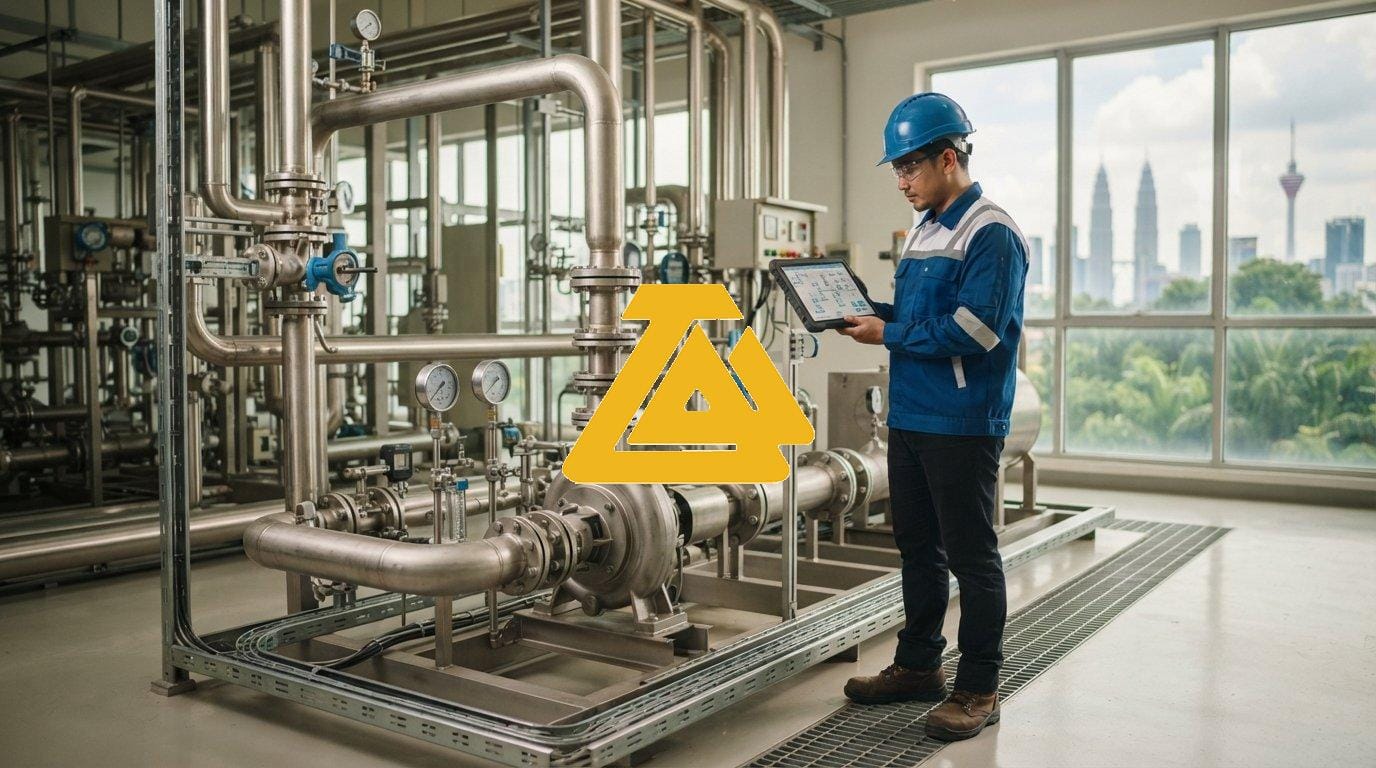
Process uptime rarely fails at the pump casting; it fails when vendor engineering support vanishes after delivery. For plant managers overseeing continuous processing lines, securing the right centrifugal pump supplier Selangor offers isn’t merely a routine hardware purchase. It is a vital operational safeguard against unexpected line halts, toxic chemical leaks, and severe regulatory exposure under Malaysia’s tightened environmental laws.
You already know the frustration of repeated mechanical seal failures, delayed replacement parts, and vendors who lack the engineering competence to calculate proper Net Positive Suction Head for volatile fluids. This 2026 industrial procurement guide shows you how to evaluate pump suppliers for demanding chemical, palm oil, and heavy manufacturing duties. We examine essential criteria for selecting certified ANSI and API pumps, lifecycle cost management, and why established technical partners like Totalmas deliver the responsive engineering assistance needed across Peninsular Malaysia, Sabah, and Sarawak.
Key Takeaways
- Selecting the right centrifugal pump supplier Selangor operations depend on requires vetting vendor engineering proficiency in Net Positive Suction Head and system curve modeling.
- Distinguishing between ANSI B73.1 dimensional interchangeability and API 610 heavy-duty construction protects plants handling corrosive chemicals or high-temperature palm oil fractions.
- Accounting for Selangor’s tropical operating conditions, where ambient factory temperatures regularly exceed 35 Celsius, is critical for mechanical seal longevity and motor reliability.
- Pairing rotating pumps with in-line process instrumentation, such as differential pressure transmitters and flow meters, enables proactive monitoring before costly mechanical failures occur.
- Partnering with established engineering distributors like Totalmas ensures access to ANSI and API centrifugal pumps, backed by responsive technical support across Peninsular Malaysia, Sabah, and Sarawak.
Industrial Fluid Transfer Demands in Selangor Manufacturing and Processing
Selangor stands as Malaysia’s primary industrial engine, housing dense manufacturing belts across Shah Alam, Klang, and Banting. These zones concentrate massive oleochemical refineries, specialty chemical plants, and heavy industrial processors. Within these sites, Centrifugal pumps operate continuously, shifting aggressive acids, spent wash waters, and crude palm oil fractions. When process machinery fails, entire downstream refining operations halt immediately. For local plant engineers, sourcing rotating equipment through an experienced centrifugal pump supplier Selangor operations trust is essential to maintain steady production schedules.
Operating Conditions in Local Industrial Estates
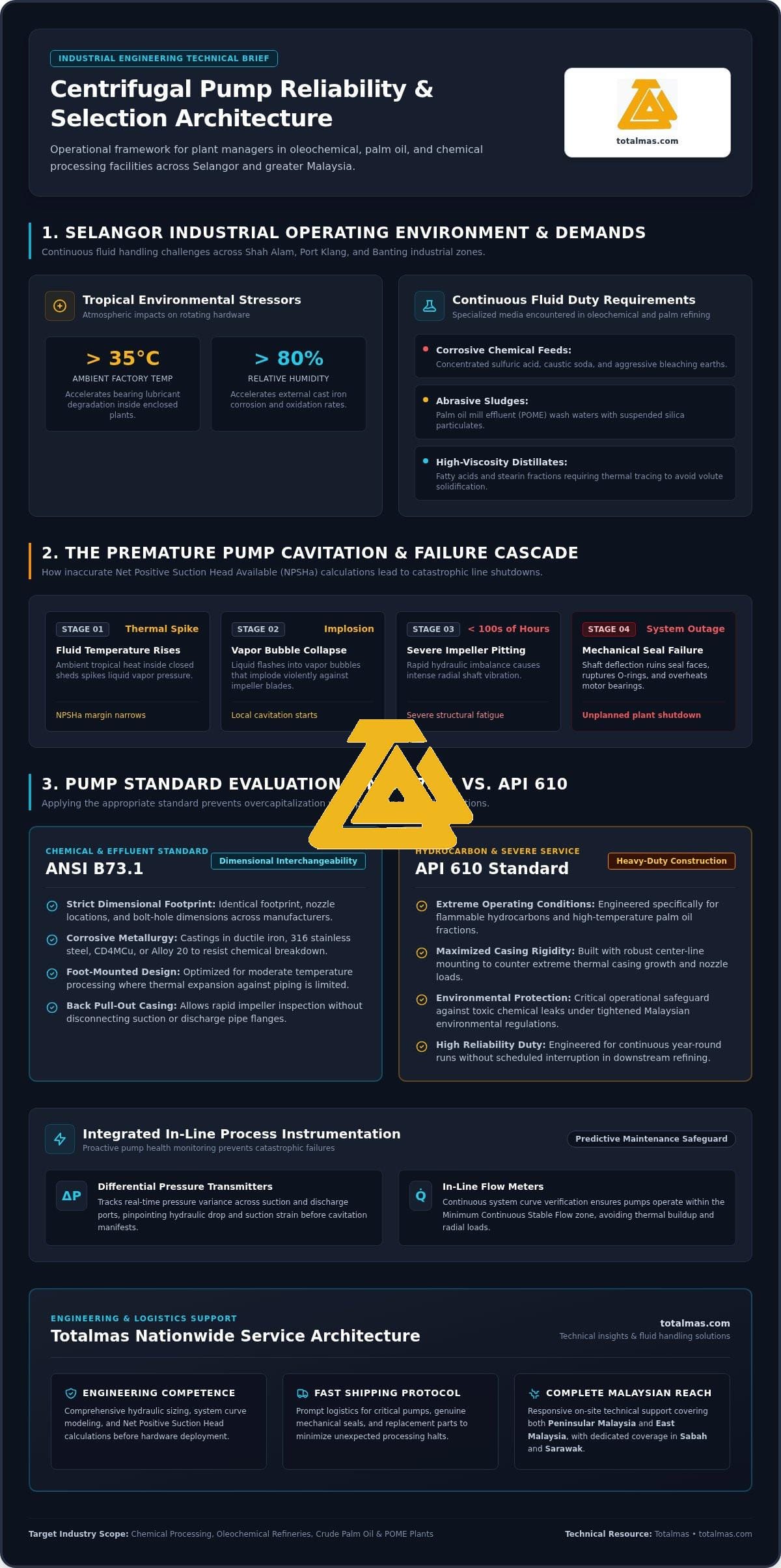
Facilities across Port Klang and Shah Alam encounter severe atmospheric and process challenges daily. Tropical plant conditions frequently exceed 35 Celsius in ambient temperature, combined with relative humidity levels reaching past 80 percent. These ambient factors accelerate external corrosion on cast iron frames and degrade bearing lubricants rapidly.
Internally, continuous processes demand pumps capable of transferring:
- Corrosive chemical feeds: Concentrated sulfuric acid, caustic soda, and aggressive bleaching earths used in oleochemical purification.
- Abrasive sludges: Palm oil mill effluent (POME) wash waters and wastewater laden with suspended silica particulates that wear down internal impellers.
- High-viscosity distillates: Fatty acids and stearin fractions requiring precise thermal tracing to prevent fluid solidification within the pump volute.
The Consequences of Premature Pump Cavitation
Premature pump failure in Selangor processing plants often traces back to inaccurate Net Positive Suction Head Available (NPSHa) calculations. When fluid temperature rises inside closed factory sheds, vapor pressure spikes. If the suction margin narrows, liquid flashes into vapor bubbles that implode violently against the pump impeller blades.
This localized cavitation causes severe impeller pitting within hundreds of operational hours. The resulting hydraulic imbalance triggers intense radial vibration. Shaft deflections quickly ruin mechanical seal faces, rupture elastomeric O-rings, and overheat electric motor bearings. Unplanned outages follow, forcing maintenance crews to cycle offline units and disrupting targeted factory outputs. Sourcing fluid-handling hardware from a knowledgeable centrifugal pump supplier Selangor facilities rely on ensures proper hydraulic sizing before machinery ever touches the factory floor.
Evaluating Pump Standards: ANSI versus API 610 Centrifugal Pumps
Selecting rotating equipment begins with standard classification. For Malaysian plant engineers, applying the wrong design standard to an aggressive fluid stream creates continuous maintenance nightmares. ANSI B73.1 and API 610 represent two fundamentally different engineering philosophies. Understanding where these boundaries lie prevents overspending on capital equipment while ensuring plant safety. Consulting a knowledgeable centrifugal pump supplier Selangor operations depend on helps balance these structural requirements against actual process demands.
ANSI B73.1 Specifications for Chemical Manufacturing
The ASME B73.1 standard governs horizontal end-suction centrifugal pumps widely used across chemical processing and industrial effluent plants. Its primary operational advantage lies in strict dimensional interchangeability. Pumps sharing an ANSI size designation possess identical footprint, nozzle location, and bolt hole dimensions regardless of the manufacturer, simplifying plant piping modifications.
Key design attributes include:
- Corrosive fluid handling: Available in ductile iron, 316 stainless steel, and exotic alloys like CD4MCu or Alloy 20 to resist chemical breakdown.
- Foot-mounted casing design: Well-suited for moderate temperatures where severe thermal expansion against connected pipework is limited.
- Maintenance efficiency: Back pull-out designs allow rapid impeller inspection without disturbing suction or discharge flanges.
API 610 Standards for Severe Hydrocarbon Services
Where processing conditions involve flammable hydrocarbons, extreme operating pressures, or temperatures soaring above 150 Celsius, API 610 standards take precedence. These pumps target refineries, gas processing units, and high-temperature palm oil fractionation lines. API 610 specifies a minimum 20-year design life with at least three years of continuous, uninterrupted operation.
Casings feature robust centerline mounting rather than foot mounts. This design permits thermal growth symmetrically around the shaft axis without inducing extreme nozzle loads or shaft misalignment. Heavy-wall casings resist elevated internal pressures, while strict seal chamber dimensions accommodate standardized API 682 mechanical seal arrangements. These dual pressurized seals and complex flush plans contain hazardous emissions, keeping plants compliant with local environmental laws.
Balancing capital costs with process safety demands verified engineering advice. You can consult the rotating equipment specialists at Totalmas to match specific duty conditions with either ANSI or API centrifugal pump configurations.
Working alongside an established centrifugal pump supplier Selangor processors rely on ensures your plant procures machinery built to exact fluid dynamics and metallurgical requirements.
5-Step Selection Framework for Choosing a Pump Supplier
Procuring rotating machinery without a structured vetting process exposes industrial plants to frequent mechanical breakdowns. Factory procurement teams often evaluate vendors based solely on hardware unit costs, overlooking long-term operating reliability. A capable centrifugal pump supplier Selangor plants rely on must demonstrate verifiable technical competence, rigorous documentation, and structured parts support.
Use this five-step auditing framework before issuing procurement contracts:
- Audit Hydraulic Sizing Capabilities: Require your vendor to provide comprehensive system head calculations, NPSH margin verification, and pump performance curves tailored to your exact operating liquid.
- Inspect Critical Spares Inventory: Check physical warehouse availability for high-wear components, including mechanical seal cartridges, shaft sleeves, wear rings, and balanced impellers.
- Validate Compliance Documentation: Demand factory hydrostatic pressure test certificates, dynamic balancing reports, and certified material test reports (MTRs) to confirm casting metallurgy.
- Assess Monitoring Instrumentation: Verify whether the supplier provides matched process sensors, such as differential pressure transmitters and flow meters, to monitor pump operational health in real time.
- Review Regional Field Support: Confirm that the distributor provides responsive engineering assistance and fast shipping options capable of reaching continuous processing lines across Malaysia.
Technical Sizing Verification and Hydraulic Matching
A reliable supplier doesn’t just pull pump models from a catalog. They calculate where your specific operating point sits relative to the pump’s Best Efficiency Point (BEP). Operating consistently outside 80 to 110 percent of the BEP leads to severe internal recirculation, radial shaft deflection, and excessive bearing temperature.
Competent distributors confirm precise impeller diameter trimming to fit your specific motor speed curves. They also evaluate electric motor nameplate power margins, ensuring adequate kilowatts to prevent motor overloads during startup fluid surges.
Local Inventory and Replacement Parts Availability
Unplanned downtime quickly erodes factory profits. When a mechanical seal fails in an active chemical line, waiting weeks for overseas freight halts downstream processing entirely. Partnering with a centrifugal pump supplier Selangor industrial hubs can access directly ensures rapid delivery of essential wear parts across the Klang Valley.
Experienced distributors maintain local inventory buffers in centralized warehouses. This proximity allows engineering teams to source replacement mechanical seals, shaft sleeves, and elastomeric packing within hours. Reliable local parts availability transforms maintenance operations from chaotic emergency scrambles into predictable, scheduled overhauls.
Integrating Process Instrumentation for Predictive Pump Monitoring
Mechanical reliability rarely depends on pump metallurgy alone. Even the heaviest API 610 casing can’t withstand continuous dry running or extreme thermal spikes. Pairing rotating machinery with real-time process instrumentation transforms passive fluid machinery into an automated, self-protecting system. When evaluating a centrifugal pump supplier Selangor factory managers should look for vendors capable of integrating both mechanical pumps and matched electronic monitoring hardware.
Pressure Transmitters for Cavitation and Dead-Head Protection
Installing differential pressure transmitters across suction strainers provides early warning before particulate accumulation chokes incoming fluid flow. When inlet pressure drops near vapor pressure thresholds, the system flags cavitation risks before impellers pit.
Discharge pressure transmitters protect against dead-head conditions caused by closed downstream valves or line blockages. Without flow to dissipate energy, churning fluid quickly exceeds 100 Celsius, destroying mechanical seals and warping shafts. Matched pressure transmitters communicate directly with control displays to trigger automated pump shutdowns before thermal damage spreads.
Flow Meters for System Efficiency Optimization
Inline flow meters establish a clear baseline of actual fluid transfer against engineering pump curves. Comparing continuous flow data against discharge head allows maintenance teams to track performance loss systematically.
Key operational benefits include:
- Early wear detection: Identifying gradual flow loss indicates internal wear ring clearance expansion before catastrophic failure occurs.
- Dry-run prevention: Instantaneous flow loss alerts shut down motors immediately, preserving expensive silicon carbide seal faces.
- Process automation: Transmitting volumetric data into plant supervisory systems balances chemical dosing and refining processes accurately.
Integrating mechanical pumps with digital monitoring ensures long-term operational integrity across chemical, wastewater, and palm oil processing lines. Connect with Totalmas to integrate instrumentation with your centrifugal pumps and protect your processing assets with comprehensive technical support spanning Peninsular Malaysia, Sabah, and Sarawak.
Partnering with Totalmas for Heavy-Duty Pumping Solutions
Plant managers seeking an established centrifugal pump supplier Selangor processors can depend on require more than a catalog distributor. Process machinery requires deep engineering support, verified fluid compatibility, and dependable logistics. Operating from Wangsa Melawati, Kuala Lumpur, Totalmas Sdn Bhd brings over 33 years of specialized industrial distribution and process instrumentation experience to Malaysian industry.
Totalmas supports demanding fluid transfer operations across the chemical, oleochemical, wastewater, and oil and gas sectors. Our rotating equipment portfolio centers on rugged ANSI and API centrifugal pumps engineered to withstand high temperatures, abrasive slurries, and aggressive chemical feedstocks.
Nationwide Logistics and Responsive Technical Support
Operational continuity depends heavily on component availability. Positioned near primary transport corridors in the Klang Valley, Totalmas maintains fast shipping networks that supply manufacturing facilities across Shah Alam, Klang, and Banting without costly shipping delays.
Logistics capabilities extend well beyond central Selangor. Totalmas operates an established distribution network providing complete technical support and fast freight delivery across both Peninsular Malaysia and East Malaysia. Palm oil mills, downstream refineries, and industrial processing sites across Sabah and Sarawak receive the same direct technical guidance and rapid spare parts access as plants located within the capital region.
End-to-End Fluid Handling and Automation Solutions
Pumps perform best when backed by integrated process controls. Totalmas provides comprehensive industrial solutions, bridging heavy-duty rotating machinery with high-precision process instrumentation. Rather than managing fragmented vendor contracts, engineering teams can source compatible fluid transfer systems from a single technical partner.
Our complete fluid handling portfolio includes:
- ANSI and API Centrifugal Pumps: Heavy-duty bare-shaft and skid-mounted pumping units matched to continuous operational profiles.
- Process Instrumentation: In-line flow meters and differential pressure transmitters designed for real-time monitoring and cavitation prevention.
- Control and Monitoring Displays: Rugged Murphy displays and Enovation Controls for clear operator feedback and automated system shutdown.
- Specialized Flow Hardware: Engineered orifice plates, flanges, and complete wastewater treatment plant solutions.
Choosing Totalmas as your centrifugal pump supplier Selangor partner guarantees decades of technical expertise, tailored equipment selection, and responsive engineering assistance throughout Malaysia.
Strengthen Your Processing Lines with Engineered Pumping Solutions
Sustained plant productivity in chemical, oleochemical, and palm oil refining relies on sound engineering choices from day one. Choosing between ANSI B73.1 dimensional interchangeability and API 610 continuous-duty construction requires careful hydraulic evaluation. When you evaluate your next centrifugal pump supplier Selangor operations require, prioritize deep engineering capabilities over simple equipment broking.
Backed by over 33 years of specialized industrial distribution experience, Totalmas delivers comprehensive fluid handling packages. We pair heavy-duty ANSI and API centrifugal pumps with precision flow meters and rugged Enovation Controls displays to safeguard your rotating machinery against cavitation and thermal shock. With dedicated technical assistance and fast shipping spanning Peninsular Malaysia, Sabah, and Sarawak, you can protect your plant against unexpected downtime and maintain strict operational safety with confidence. Consult Totalmas for Heavy-Duty Centrifugal Pumps to optimize your processing operations today.
Frequently Asked Questions
What is the difference between ANSI and API centrifugal pumps for industrial plants?
ANSI B73.1 pumps feature foot-mounted casings and standardized dimensions for interchangeability across chemical processing plants. In contrast, API 610 pumps feature heavy centerline-supported casings engineered for severe high-pressure and high-temperature hydrocarbons. API standards require a minimum 20-year design life and advanced API 682 mechanical seal arrangements. Selecting the right model through a qualified centrifugal pump supplier Selangor plants rely on ensures proper compliance with your plant’s specific safety margins.
How do I choose the correct impeller material for corrosive chemical processing?
Impeller metallurgy selection depends directly on fluid acidity, chloride concentration, operating temperature, and entrained solids. While 316 stainless steel suits moderate caustics and mild acids, highly aggressive chemical streams like concentrated sulfuric acid or bleaching agents demand duplex stainless steel, CD4MCu, or nickel-based alloys. Evaluating chemical compatibility charts alongside your equipment distributor prevents premature erosion-corrosion, pitting, and catastrophic hydraulic failure within corrosive processing environments.
Can Totalmas deliver industrial centrifugal pumps and spare parts to Sabah and Sarawak?
Yes, Totalmas provides established logistics and technical support across both Peninsular Malaysia and East Malaysia. Palm oil mills, downstream processing refineries, and industrial plants across Sabah and Sarawak receive fast freight shipping for ANSI and API centrifugal pumps, flow meters, and replacement wear parts. In addition, Totalmas engineers provide direct remote and on-site technical guidance to ensure reliable commissioning and continuous operation.
What parameters are required to properly size an industrial centrifugal pump?
Sizing an industrial pump accurately requires several key parameters: normal and maximum volumetric flow rate, total dynamic head (TDH), fluid operating temperature, specific gravity, and dynamic viscosity. Additionally, engineering teams must supply accurate Net Positive Suction Head Available (NPSHa) calculations to prevent cavitation. Providing comprehensive fluid properties to an experienced centrifugal pump supplier Selangor engineers trust ensures proper impeller trimming and optimal motor power selection.
How does integrating pressure transmitters prevent centrifugal pump mechanical failure?
Pressure transmitters act as an early-warning safeguard by monitoring suction and discharge pressures in real time. A suction transmitter detects pressure drops below vapor pressure, signaling cavitation risks before impellers pit. Meanwhile, discharge pressure transmitters identify dead-head conditions caused by closed valves or blocked lines, triggering automated pump shutoff via control displays before fluid boiling damages mechanical seals and warps shafts.
Which industries in Selangor typically require heavy-duty API 610 centrifugal pumps?
API 610 centrifugal pumps are primarily required by oil and gas refineries, petrochemical complexes, and high-temperature oleochemical fractionation plants located around Port Klang, Shah Alam, and Banting. These facilities routinely transfer flammable hydrocarbons, solvent extractions, and high-temperature fatty acids exceeding 150 Celsius. The centerline casing support, robust wall thickness, and mandated API seal piping plans provide the containment required under Malaysian industrial and environmental safety regulations.