
What determines whether a WHRU for cement industry Malaysia operations is a practical fit: available waste heat, or the conditions needed to recover it without compromising kiln stability? For Malaysian cement-plant managers, the answer depends on site-specific operating data, not a generic equipment comparison. Kiln exhaust and cooler vent streams may merit assessment, but temperature, flow, dust loading and operating variability all affect their suitability.
Operational risk belongs in the evaluation from the start. Recovery equipment must integrate with existing systems and support reliable production. To compare supplier proposals fairly, give each supplier the same plant data and ask them to state the assumptions behind their design. These priorities are familiar across Malaysia’s industrial sector, including oil and gas and palm oil operations.
This guide explains how to screen potential heat sources, assess integration and operating requirements, and compare WHRU proposals before procurement. Totalmas supplies waste heat recovery units and provides further insights into industrial solutions in Malaysia, with fast shipping and comprehensive technical support across Peninsular Malaysia, Sabah and Sarawak.
Key Takeaways
- Assess kiln exhaust and clinker-cooler heat separately. Their operating conditions can lead to different WHRU design and integration requirements.
- For a WHRU for cement industry Malaysia project, use plant-specific operating data to judge heat-source suitability rather than relying on generic comparisons.
- Compare proposals by their design assumptions, plant interfaces, maintenance needs and technical support. Trace each assumption back to its source data.
- Prepare measured process information, production patterns and plant constraints before advancing to internal project review.
- Totalmas supplies WHRUs and offers fast shipping and comprehensive technical support across Peninsular Malaysia, Sabah and Sarawak.
Why consider a WHRU for a cement plant in Malaysia?
A waste heat recovery unit (WHRU) captures heat from an industrial process exhaust stream for potential reuse or energy conversion. In short, a WHRU recovers usable heat from an exhaust stream that would otherwise leave the process. The Waste Heat Recovery Unit (WHRU) overview describes common recovery approaches, but plant-specific process data must determine whether a particular application is practical.
For Malaysian cement producers, the first question is not simply whether a process releases heat. The team needs to establish whether a suitable stream is available under actual operating conditions and whether recovery can be integrated without interfering with production. A WHRU for cement industry Malaysia should be assessed as a site-specific project, not a standard add-on with assumed results.
Where waste heat may arise in cement production
Kiln exhaust and clinker-cooler exhaust are common candidate streams for preliminary assessment. Evaluate them separately: each has its own process role, operating pattern and potential interface with recovery equipment. Conditions can also change with production, so a stream that appears suitable at one point in the operating cycle may not represent the full range.
Start by identifying the measurement point and gathering representative records for temperature, flow and operating pattern. Review how readings change across relevant production conditions rather than relying on a single observation or nominal value. Dust loading and other stream characteristics also affect how recovery equipment may interact with the process. Not every line will provide heat at conditions that make recovery useful.
What a WHRU project is intended to achieve
A project may investigate whether recovered heat can be reused in a process or converted into another useful energy output. These are objectives to evaluate, not guaranteed outcomes. The available heat, the plant’s demand for it, integration requirements and operating profile all influence what a project could deliver.
Keep three decisions distinct: whether a candidate stream exists, whether it can be recovered without undermining stable operation, and whether the resulting energy use can support a sound business case. A technical opportunity alone does not establish savings. Base financial claims on measured site data, stated assumptions and a clear account of how the proposed system would operate.
In Malaysia, site conditions and continuity requirements should shape early planning. Consider the plant layout, equipment and maintenance access, production schedule, and procedures for managing interfaces with the kiln or cooler. These factors help determine whether a potential recovery project fits the site before the team advances to detailed evaluation.
How cement-plant heat sources shape WHRU design and integration
A WHRU’s design basis starts with the exhaust stream and the process around it. Temperature, flow, composition, dust loading and operating variation help engineers assess feasibility and identify appropriate equipment and interfaces. For a WHRU for cement industry Malaysia, kiln exhaust and clinker-cooler exhaust should be examined separately, not treated as interchangeable streams.
Malaysia’s oil and gas and palm oil operations also make process heat management a familiar industrial consideration, but their streams and operating constraints differ from those in cement production. Ground a cement-plant assessment in kiln or cooler data rather than transferring assumptions from another sector.
Assessing kiln and clinker-cooler exhaust
Build an evidence base for each candidate stream. Useful initial records include:
- Measured exhaust temperature and flow, including how each changes during production.
- Gas composition and dust characteristics, based on available plant measurements.
- Production-state and operating records showing normal variation, interruptions and relevant process changes.
- The measurement location, method and period represented by each data set.
These details inform heat-transfer assessment, equipment selection and maintenance planning. Dust can affect system configuration and servicing requirements, while fluctuations in temperature or flow can change operating conditions. Kiln and cooler streams may differ in both characteristics and process role, so do not apply the engineering basis for one directly to the other.
If records are incomplete, identify missing measurements for engineering verification instead of substituting generic design values. This is particularly important when readings come from different operating periods or measurement points. For local context, YTL Cement’s Green Enable Technologies describes its experience with residual heat power plants in Malaysia. That example does not establish suitability or performance at another site.
Planning process integration without disrupting operations
Even a promising heat source needs a practical integration review. Map potential tie-in points and examine available space, access routes, structural constraints and clearances for inspection and maintenance. Consider how proposed connections could affect existing process equipment and kiln operation, including any work required for installation and ongoing maintenance. These are project-specific engineering questions, not assumed WHRU features.
Assess a WHRU against both the exhaust source and the plant interfaces it will depend on. This keeps source suitability and operational impact in view before equipment selection advances. The broader guide to Waste Heat Recovery Unit Malaysia: The Complete Industrial Guide for 2026 can support this evaluation; apply its general guidance to measured site conditions and constraints.
For Malaysian plants, review the actual layout, production practices and maintenance access rather than relying on assumptions from another facility. Totalmas offers further insights on industrial solutions to help teams structure a focused technical discussion around their WHRU requirements.
How to compare WHRU proposals for a Malaysian cement plant
Compare proposals against one shared set of site data and operating assumptions. A clear evaluation separates measured plant conditions from supplier assumptions, then shows how each affects the proposed design, expected output and operating requirements. This makes differences easier to explain to engineering, operations and finance teams before taking a preferred option forward.
For a WHRU for cement industry Malaysia project, ask each supplier to identify the measurements and records used as its design basis. If proposals use different production conditions or heat-source data, their output estimates and financial calculations may not be directly comparable.
Technical and operational criteria to compare
Use the same evaluation headings for every proposal. Record where information is measured, whether it is verified or assumed, and what requires further engineering review. This creates a practical comparison, rather than a ranking based on headline output alone.
| Criterion | What to compare |
|---|---|
| Heat source | Whether the proposal addresses kiln exhaust or clinker-cooler exhaust, and how its design basis relates to plant measurements. |
| Operating envelope | Temperature, flow, composition, dust loading and operating variation used in the assessment. Note gaps that still need site verification. |
| Interfaces | Proposed tie-in points and any required connections to existing plant systems. Separate defined scope from items awaiting engineering review. |
| Maintenance | Access for inspection and servicing, anticipated maintenance tasks, and how the proposal accounts for dust and operating conditions. |
| Support and documentation | Technical documents, scope boundaries, support arrangements and responsibilities stated for the project. |
Check that confirmed equipment specifications are clearly distinguished from assumptions or preliminary values. Review plant access, installation constraints and any shutdown requirements as site-specific planning items. A proposal should let the team trace each design choice to the data and operating condition behind it.
Commercial and supplier-support criteria
Compare commercial scope on a like-for-like basis. Check what each proposal includes, what falls outside its stated scope, what technical documentation is supplied, and how support is arranged for the plant’s location. Focus on stated commitments and project requirements. Do not infer delivery timing, guarantees or performance obligations that are not written into the proposal.
Expected outputs are useful only when the calculation method and input conditions are stated. Review how each estimate treats production patterns, stream variability and the intended use of recovered energy. Payback comparisons also need consistent assumptions for production, energy use and operating conditions. If one estimate assumes continuous operation while another reflects actual plant patterns, the results are not a fair comparison.
Use the comparison to identify unresolved questions before procurement: missing site data, unexamined interfaces, unclear maintenance provisions or differing calculation bases. Resolving these items gives the team a more reliable foundation for internal review and reduces the risk of comparing proposals with different project scopes.
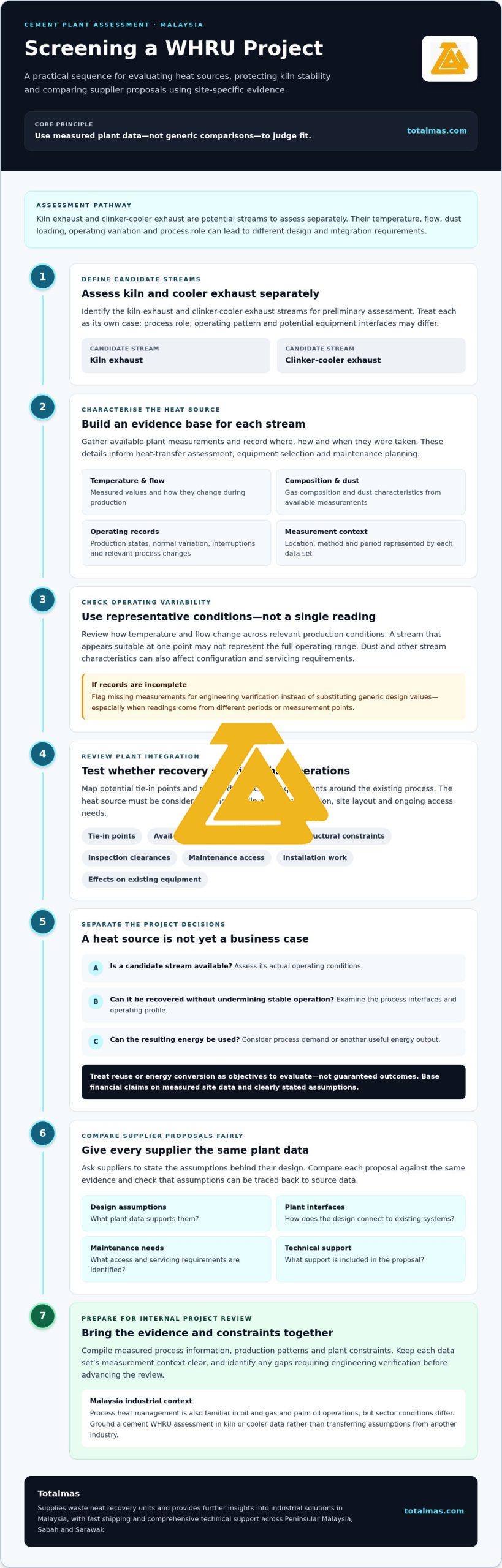
What cement-plant teams should prepare before selecting a WHRU
A disciplined readiness process helps a plant team move from a possible heat source to a well-supported project decision. For a WHRU for cement industry Malaysia, measured process evidence and site constraints should guide the evaluation, not a generic equipment comparison. Bring maintenance, operations, engineering and procurement into the review early so technical requirements and practical responsibilities are considered together.
Build a reliable site-data package
Assemble records that describe the candidate stream and the production context. Keep units consistent across documents, using Celsius for temperature and metric units for flow, mass and other measurements. Record the source, date and operating state for each measurement. Flag missing or inconsistent information for site measurement or engineering validation before relying on it for a design decision.
- Screen candidate sources. Identify the kiln-exhaust and clinker-cooler streams for preliminary review. Note which source has usable records and who is responsible for verifying data gaps.
- Compile process evidence. Gather available exhaust measurements, operating logs, process diagrams and planned production schedules. Preserve the measurement location and context so the design team can interpret each value correctly.
- Map operating patterns. Summarise how production conditions change across the operating schedule, including relevant variations or planned changes. This gives the team a more useful basis than a single snapshot.
- Document site constraints. Record potential installation space, access routes, maintenance requirements and possible shutdown windows. Include relevant plant interfaces and note constraints that could affect installation or routine work.
- Set review criteria. Agree how the project will be assessed, including what operational performance means for the plant and which assumptions need validation before procurement review.
Assess project readiness and operating constraints
Use the package to align the people who will own or influence the decision. Operations can identify production priorities and acceptable constraints. Maintenance can assess access and servicing implications. Engineering can review measurements, diagrams and interfaces. Procurement can check that proposals use a consistent scope and comparison basis. Assign an owner to each unresolved data or design question.
For Malaysian sites, logistics and support planning should reflect the actual plant location, access conditions and project schedule. Requirements at a site in Peninsular Malaysia may differ from those in Sabah or Sarawak, so avoid treating locations as operationally identical. Document how equipment movement, site access and technical coordination will fit the project plan.
With the readiness package in place, the next discussion can focus on the plant’s evidence and priorities. Explore Totalmas WHRU solutions as part of preparing a focused technical discussion for your cement-plant requirements.
Source a cement-industry WHRU in Malaysia with Totalmas
Moving from assessment to procurement is easier when the technical discussion starts with the plant’s evidence, not a generic equipment request. Totalmas is a Malaysia-based supplier of waste heat recovery units and a source of further insights on industrial solutions. The assessment prepared by your team gives the discussion a clear basis for deciding whether the project merits further development.
Connect plant requirements to a practical WHRU discussion
Bring together the information that explains the opportunity and its limits. A focused project summary should identify:
- The candidate source, such as kiln exhaust or clinker-cooler exhaust, and the measurements available.
- The operating profile, including production patterns and relevant variations in stream conditions.
- Site constraints, including potential tie-in locations, installation space, access and maintenance requirements.
- Data gaps or design assumptions that still need measurement or engineering validation.
This summary helps distinguish confirmed plant information from estimates. A recorded exhaust measurement, for example, is different from a value assumed for preliminary calculations. Similarly, a potential connection point is not a completed integration plan. Keeping these distinctions visible supports a focused discussion of scope, operating needs and the information required for a sound technical decision.
For a WHRU for cement industry Malaysia project, Totalmas can discuss the WHRU requirement in the context of the information the plant team has assembled. Operations, maintenance, engineering and procurement can use the same summary to align priorities and identify questions for the next stage. Keep any expected output or financial case tied to stated assumptions and site-specific evidence, rather than treating it as a confirmed result before engineering review.
Plan project coordination across Malaysia
Include the plant’s location, site access conditions and project schedule in the requirements summary. These details help frame the discussion around the actual site rather than assuming that cement plants in Peninsular Malaysia, Sabah and Sarawak have identical project conditions. The team can also identify location-specific coordination needs alongside the technical requirements.
A useful starting package does not need to answer every engineering question. It should show what the plant has measured, how the process operates, which constraints matter and which points remain open. That gives the next conversation a practical focus and helps the team advance at a pace supported by its data and internal review.
To discuss your plant’s heat source, operating profile and project requirements, discuss your cement-plant WHRU requirements with Totalmas.
Move from assessment to a clear project decision
The next step is to turn a WHRU opportunity into a decision your plant can stand behind. Set a clear internal gate for moving from preliminary assessment to engineering review, and agree who owns the remaining questions. This gives management a practical basis to decide whether to proceed, gather more evidence or pause until operating conditions change.
A WHRU for cement industry Malaysia project should advance at the pace of its evidence. Keep assumptions visible, document the basis for decisions and involve the teams responsible for production and maintenance before making commitments. A measured, staged approach helps protect operational priorities while keeping a potential recovery opportunity under consideration.
Totalmas supplies waste heat recovery units in Malaysia. Discuss your cement-plant WHRU requirements with Totalmas and take the next step with a focused conversation about your plant’s needs. A sound project begins with the right questions and a clear path forward.
Frequently Asked Questions
Can a WHRU be retrofitted to an existing cement plant?
Yes, a WHRU can be considered for a retrofit, but feasibility depends on the plant’s layout, exhaust conditions and process interfaces. For example, an existing duct route may leave limited room for equipment or maintenance access. Review current drawings against site conditions, identify possible tie-in points and assess effects on connected equipment. The retrofit design must account for the operating plant, not just the available heat stream.
Does WHRU installation require a cement kiln shutdown?
Not necessarily. The shutdown requirement depends on the installation scope and the connections needed to integrate the unit. Some preparation may be possible while the plant is operating, while work on a kiln exhaust path or connected process equipment may require a planned outage. The engineering and installation plan should identify which tasks affect production, their sequence and the operating conditions needed before work begins.
How can dust in cement-kiln exhaust affect a WHRU project?
Dust can affect heat-transfer surfaces and may influence inspection, cleaning and maintenance requirements. Include its characteristics and loading in the project’s source assessment, using plant information rather than assumed values. The engineering review can then consider how the selected recovery approach responds to the actual exhaust stream. Maintenance teams should also assess whether inspection points and access are practical within the plant layout.
What should a plant monitor after a WHRU is commissioned?
Monitor the indicators agreed in the commissioning and operating documentation, including relevant exhaust conditions, the unit’s operating status and the useful heat or energy output being delivered. Track changes alongside kiln or cooler production conditions so operators can distinguish normal process variation from an issue requiring investigation. Record alarms, maintenance observations and any effects on connected equipment, then review trends with operations and maintenance personnel.
Can one WHRU recover heat from both kiln and clinker-cooler exhaust?
Possibly, but it depends on the streams’ characteristics, operating patterns and the proposed system arrangement. Do not assume that a shared recovery approach suits both sources simply because they are in the same plant. Engineering should assess each stream and its process interfaces, then evaluate whether combining them is technically appropriate. The design basis should state how varying or simultaneous operating conditions are handled.
Which Malaysian cement-plant teams should be involved in WHRU evaluation?
Involve operations, maintenance, engineering and procurement, with plant management included in the project decision. Operations can explain production priorities; maintenance can assess access and servicing implications; engineering can review process interfaces and design information; procurement can align proposal scope and documentation. Include finance when evaluating project economics. This cross-functional review helps ensure a proposal reflects both site needs and internal decision criteria.
How should a cement plant assess WHRU value when operating conditions vary?
Assess value using operating scenarios that reflect the plant’s production patterns rather than a single assumed condition. Compare expected output only when proposals use clearly stated input data and calculation methods. Consider how often the relevant operating states occur and whether the recovered energy can be used under those conditions. For a WHRU for cement industry Malaysia assessment, keep production, energy and operating assumptions consistent across alternatives.