
When selecting a pressure transmitter for hazardous areas, start with the approved site classification, then check that the transmitter, process conditions and connected equipment meet the project requirements. For Malaysian factory managers, that means accounting for oil and gas, offshore operations and palm oil processing, where a specification gap can complicate procurement and commissioning.
The Ex marking is an important starting point, but it does not establish whether a transmitter suits the measurement loop. Use a consistent review process to connect the area classification and protection concept with pressure range, process connection, materials, output and supporting documents. This guide sets out practical checks for comparing options and explains why certification for one component does not establish suitability for the complete installation.
Totalmas supplies industrial instrumentation, including pressure transmitters, and provides technical support and fast shipping across Peninsular Malaysia and East Malaysia, including Sabah and Sarawak.
Key Takeaways
- Begin selecting a pressure transmitter for hazardous areas with the approved site classification and project design basis, not the product label alone.
- Record the measurement purpose, pressure type, operating range and process conditions before comparing transmitter options.
- Assess the protection concept alongside the installation interfaces. A transmitter certificate alone does not establish suitability for the complete measurement loop.
- Compare certificates and technical documents against the same project requirements so procurement decisions are easier to review.
- Coordinate instrumentation, process, electrical, operations and procurement teams to resolve specification gaps before commissioning.
What makes a pressure transmitter suitable for a hazardous area?
A pressure transmitter measures process pressure and converts it into an output for monitoring or control. That measurement function is separate from suitability for the surrounding atmosphere. In a classified location, the equipment must also meet the protection requirements established for that area. A suitable choice must therefore match both the process duty and the approved hazardous-area design basis.
This distinction matters in Malaysian oil and gas facilities, offshore operations and palm oil plants. The process connection and measurement range relate to the pressure being monitored. The protection marking and supporting documentation relate to ignition risk in the surrounding atmosphere. Neither replaces the other: a transmitter that measures accurately may still be unsuitable for a particular classified location.
How area classification affects transmitter selection
Area classification describes the hazardous-atmosphere conditions relevant to equipment selection. For gas or vapour, Zone 0 indicates an atmosphere that is present continuously or for long periods, Zone 1 indicates that it is likely to occur during normal operation, and Zone 2 indicates that it is unlikely during normal operation and, if it occurs, is present for a short time. These terms describe classification conditions, not a default rating for a type of plant.
Do not infer a zone from the industry, equipment or process name. Use the approved site classification and project records for the transmitter’s exact location. These documents establish the basis for determining applicable protection requirements. If the location or classification information is unclear, resolve that design input before comparing equipment options rather than assuming a familiar zone is adequate.
What protection markings and documents tell the buyer
Equipment markings identify the protection concept and other applicable hazardous-area characteristics. Depending on the equipment and design basis, these may include an Ex protection method, gas group and temperature class. The marking helps reviewers assess suitability, but it does not replace the certificate and product documentation supporting the stated approval.
ATEX and IECEx are certification frameworks commonly encountered in international equipment documentation. Treat them as evidence for review, not automatic proof that a transmitter meets every Malaysian project’s acceptance criteria. Requirements depend on the approved project basis and applicable site documentation.
Compare the certificate and marking with the proposed equipment. Confirm that the certificate scope covers the transmitter type and configuration, and that the equipment identity in the documents matches the offered unit. Then assess both against the project acceptance criteria. A certificate for a related model or component does not establish suitability for the selected transmitter or complete installation.
Keep the classification record, equipment marking, certificate and relevant product documents together for a traceable review. For Malaysian oil and gas projects, Totalmas supplies pressure transmitters and industrial instrumentation. A document-led approach gives engineering and procurement teams a clear basis for selecting a pressure transmitter for hazardous areas, without relying on a label alone.
How to specify a hazardous-area pressure transmitter step by step
A procurement-ready specification connects the measurement duty to the classified location, then checks the proposed instrument and its documentation against the project basis. This sequence helps teams avoid selecting by product category or familiar features alone. For Malaysian oil and gas, offshore and palm oil projects, use approved project records as the source for process requirements and area classification.
Selection sequence: confirm the site classification, define the process duty, specify instrument and loop interfaces, then verify the proposed equipment against its certificates and project documents.
Start with the process and measurement duty
Begin with the approved process documents and instrument data. Identify whether the application requires gauge, absolute or differential pressure measurement. Record the measurement purpose, normal and applicable operating conditions, and any stated process connection or material requirements. Establish whether the signal is intended for monitoring, control or a documented safety function.
- Confirm the location. Match the instrument location to the approved hazardous-area classification and project design basis. Do not infer a zone from the facility type or process name.
- Define the pressure duty. Record the measurement type, operating range and relevant process conditions from the approved documents. For differential measurement, use the specified points and duty rather than treating it as a standard pressure measurement.
- State the instrument requirements. Include the required process connection, wetted materials and other project-defined characteristics. Check each against product-specific documentation instead of assuming category norms.
- Check the loop interface. Compare the required output, power and interface with the existing control or monitoring system and loop documentation. Confirm how the transmitter fits into the defined signal path.
- Review hazardous-area evidence. Compare the equipment marking and certificate scope with the approved classification basis and project acceptance criteria. Confirm that the documents identify the proposed equipment and configuration.
- Resolve gaps before commitment. Refer mismatches between the process specification, loop documents, markings or certificates for technical review before purchase or installation.
Check the instrument and loop documentation
Documentation review should connect the instrument to the installed loop, not stop at a certificate. Check the proposed transmitter’s identity and markings against its product documents, then compare output, power and interface details with plant records. OSHA’s hazardous-location regulations describe the United States’ Class and Division system. Use them as a reference, not as a substitute for the project’s Malaysian design basis.
Keep the approved process data, area records, loop information and equipment documents together in the procurement file. This supports consistent design review and gives commissioning teams a traceable basis for checking the installed instrument. Totalmas provides technical support for industrial instrumentation selection for Malaysian onshore and offshore applications.
How to compare protection concepts without overlooking the installation
Protection concepts describe how equipment is designed to reduce ignition risk, but a pressure transmitter’s marking is only one part of the review. Compare the documented concept with the approved area classification, project specification and installation design. The choice depends on the requirements for the specific location and measurement loop, not on an assumption that one concept suits every oil and gas, offshore or palm oil application.
Use the table to structure a technical review. These descriptions explain each concept at a high level; they do not establish that a particular transmitter or installation is suitable.
| Protection concept | What it indicates | Evidence and project review questions |
|---|---|---|
| Ex d, flameproof | An enclosure is designed to contain an internal explosion and prevent ignition of the surrounding atmosphere. | Does the equipment marking and certificate scope match the proposed transmitter and the project’s acceptance criteria? |
| Ex i, intrinsic safety | Electrical and thermal energy in the circuit is limited below a level that could cause ignition. | Does the review cover the transmitter, associated equipment and documented loop design, rather than the instrument alone? |
| Ex e, increased safety | Additional measures are used to prevent sparks or high temperatures during normal operation. | Does the documented protection concept apply to the equipment and installation arrangement under review? |
| Ex p, pressurization | Protective gas inside an enclosure is used to prevent the explosive atmosphere from entering. | Does the project documentation address the equipment arrangement and its associated installation requirements? |
Device certification versus complete loop suitability
A transmitter certificate provides evidence about the equipment within its stated scope. It does not automatically approve associated equipment, wiring or installation. For an intrinsic safety design, for example, the loop review must consider the documented relationship between the transmitter and associated equipment. Include applicable cable and installation documents in the review file, and refer gaps to the responsible technical reviewers. Do not declare the loop acceptable based on a transmitter marking alone.
Compare options against the actual process environment
Apply the same questions to each option: does the evidence match the classified atmosphere, project design basis and documented process conditions? In oil and gas or offshore service, use the approved site classification and project specification for the instrument location. For palm oil operations, rely on the facility’s documented area assessment rather than assuming a hazard category from the industry or process name.
Keep the transmitter, associated equipment and installation documents within one coordinated review. This helps instrumentation and electrical teams identify mismatches before purchase or commissioning, while procurement compares options against consistent evidence. Totalmas supplies pressure transmitters and industrial instrumentation for Malaysian projects.
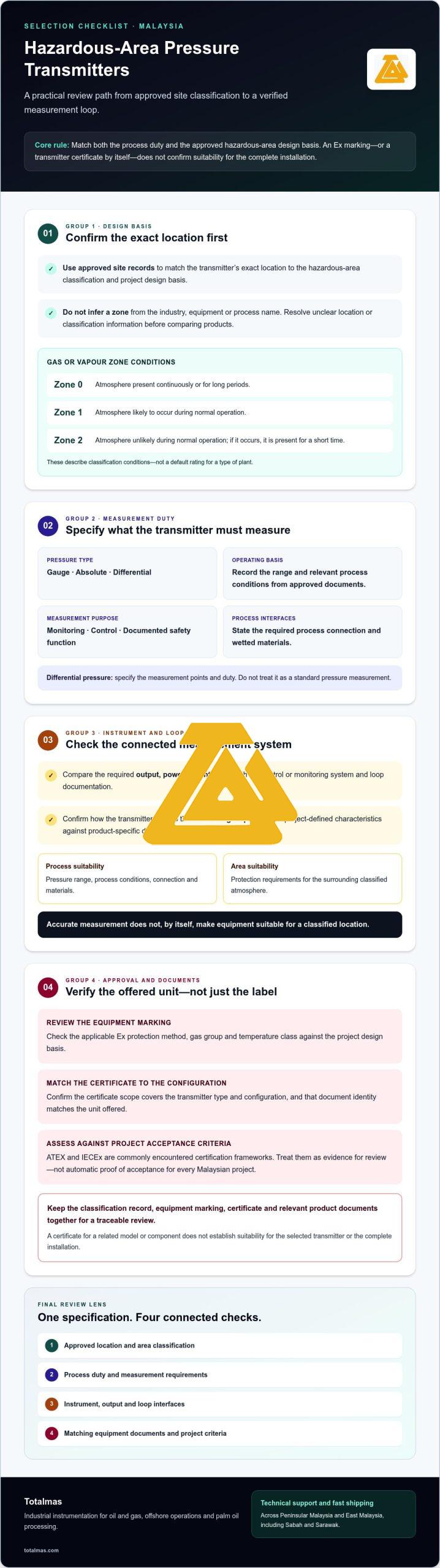
What to include in a Malaysian hazardous-area transmitter procurement checklist
A consistent checklist helps Malaysian project teams compare quotations against the same technical and documentary requirements. This is useful for onshore and offshore oil and gas, palm oil processing and other industrial facilities, where project records and operating conditions should guide the specification rather than assumptions based on the sector.
Before accepting an option, reconcile the instrument data sheet, certificate and site classification. This creates a traceable basis for technical review and helps teams identify missing information before purchase or installation.
Documents to assemble before comparing quotations
Gather the approved area-classification basis and current instrument data sheet first. Include the project specification, loop or interface requirements, and applicable acceptance criteria so every quotation is assessed against the same design inputs. Request product-specific technical documentation and certificate information for the exact proposed transmitter, then compare its identity and stated details with the procurement documents.
- Process duty: Measurement purpose, pressure type, operating range and relevant process conditions from approved project information.
- Classification evidence: The approved area record for the instrument location and any project-specific hazardous-area requirements.
- Product documents: Transmitter data, equipment marking and certificate documents corresponding to the proposed equipment.
- Interfaces: Required output, power, process connection and control or monitoring system interfaces as defined by project records.
- Acceptance basis: Applicable project criteria and installation documents needed for technical evaluation.
If process temperature also affects the instrument choice, include it in the technical comparison and consult this high-temperature pressure transmitter guide as a related selection reference.
Assign review responsibilities clearly
Procurement can coordinate the review, with technical acceptance informed by the relevant disciplines. Process engineers validate the measurement duty and operating conditions. Instrumentation engineers review the data sheet, measurement range and loop interfaces. Electrical and hazardous-area reviewers assess classification evidence, markings and relevant installation documents. Operations provides site context, while procurement ensures quotation documents are complete and comparable.
Record decisions and unresolved differences in the project review file. A certificate that does not match the proposed transmitter, or an interface that conflicts with the loop documentation, needs technical resolution rather than being treated as an administrative detail.
Account for Malaysian project and support requirements
Plan procurement around the project’s location and operating context, whether it is an offshore oil and gas installation, an onshore processing site or a palm oil plant. Totalmas provides comprehensive technical support and fast shipping across Peninsular Malaysia and East Malaysia, including Sabah and Sarawak. Consider these requirements when planning instrumentation supply and coordinating with site teams.
For further insight while preparing an instrumentation specification, discuss your project requirements with Totalmas. Totalmas supplies industrial instrumentation to Malaysian oil and gas and other industrial sectors.
How Totalmas supports pressure transmitter selection for industrial projects
Totalmas Sdn Bhd supplies industrial instrumentation and equipment in Malaysia, including pressure transmitters. Its work spans onshore and offshore oil and gas, FPSO operations and other industrial sectors. For factory managers and engineering teams, a practical selection discussion starts with the measurement duty, location and project documentation, not assumptions based on a transmitter category or industry label.
Turn the specification into a practical supply discussion
Bring the current instrument data sheet and records that define the application. These give the discussion a shared technical basis and keep the selection tied to project requirements. Useful inputs include:
- The approved area-classification records and applicable project acceptance criteria.
- The measurement purpose, pressure type, operating range and documented process conditions.
- Required process connections, materials, output and interfaces stated in the project documents.
- The proposed equipment’s product-specific technical information and certificate documents.
This approach supports a focused review of how a proposed transmitter relates to the defined duty and installation. Assess product range, connection, materials, output and certification against the relevant documents for the specific option. Do not infer these details from general descriptions or assume they apply across a product category. For oil and gas, offshore or palm oil applications, the project’s own records remain the basis for the discussion.
Clear documentation also helps teams identify gaps early. If a proposed instrument’s details do not align with the data sheet, loop requirements or project acceptance criteria, raise the difference for technical review before procurement decisions advance.
Plan support and delivery across Malaysia
Totalmas has its headquarters in Kuala Lumpur and a product service centre in Kemaman, Terengganu. The company provides comprehensive technical support and fast shipping across Peninsular Malaysia and East Malaysia, including Sabah and Sarawak. This support serves teams coordinating instrumentation supply to onshore facilities, offshore operations and palm oil sites.
Before discussing an application, organise the classification records, instrument data sheet and loop requirements alongside the process information. This gives the technical discussion a practical focus and connects the project specification to the supply requirements. Totalmas can provide further insight on industrial instrumentation requirements in Malaysia while the project team completes its engineering and acceptance review.
For a technical discussion grounded in your project documents, discuss industrial instrumentation requirements with Totalmas.
Move your transmitter specification toward approval
Turn the selection work into a clear project record before procurement advances. Keep the approved classification basis, instrument data sheet, process requirements and review decisions connected so engineering, operations and purchasing teams work from the same documented requirements. This gives the team a practical reference for evaluating changes and preparing for the next project stage.
A disciplined approach to selecting a pressure transmitter for hazardous areas makes technical decisions easier to explain across project teams. Where a requirement remains unresolved, record it and route it for the appropriate review instead of relying on an assumption. This supports a traceable handover from specification to procurement and commissioning.
Totalmas is registered and licensed by Petronas and various Malaysian government sectors, and supplies industrial instrumentation in Malaysia. For a project-focused discussion, share your transmitter project requirements with Totalmas. Contact Totalmas to discuss your instrumentation requirements and supply needs.
Frequently Asked Questions
What is a hazardous-area pressure transmitter?
A hazardous-area pressure transmitter measures process pressure at a location classified for a potentially explosive atmosphere. Its measurement task may support an operator display or a control system, but that function alone does not establish suitability for the location. Assess a transmitter for a process line against the classification and project requirements for its actual installation point, not just the general conditions of the facility.
How do I choose a pressure transmitter for Zone 0, Zone 1, or Zone 2?
Start with the approved classification record for the transmitter’s exact location. Then compare the proposed equipment’s documentation with project requirements and confirm that its measurement duty fits the process. When selecting a pressure transmitter for hazardous areas, do not use a zone label as a shortcut. Separate points within one facility may have different documented classifications, so a choice made for one location should not automatically be applied elsewhere.
Is an intrinsically safe pressure transmitter suitable for every hazardous area?
No. Intrinsic safety is a protection concept, not a universal approval for every transmitter, location or circuit. A project review should consider the specific equipment and the connected circuit design, including associated equipment identified in the documentation. Replacing a transmitter in an existing loop, for example, means reviewing the replacement against that loop’s records rather than assuming the same protection description makes the configuration suitable.
What is the difference between ATEX and IECEx for pressure transmitters?
ATEX and IECEx are distinct certification frameworks that may appear in equipment documentation. Their names alone do not determine project acceptance in Malaysia. Review the certificate for the exact proposed equipment, including its stated scope, and compare it with the project’s acceptance basis. If documents use different framework terminology, record the difference for technical review rather than treating the labels as interchangeable or assuming either one settles every site requirement.
Can a certified pressure transmitter still be unsuitable for an installation?
Yes. A certificate supports review of the equipment within its stated scope, but the application may impose requirements beyond that document. The transmitter’s process duty or connection to the existing monitoring system, for instance, may not match the project specification even if the equipment has hazardous-area documentation. Treat a proposed replacement as a change to a defined instrument loop and review the relevant records before approving installation.
What documents should I review before buying a hazardous-area pressure transmitter?
Assemble the current instrument data sheet, approved area records, project specification and relevant loop information before assessing a quotation. Add the technical documents and certificate for the exact proposed equipment, then record any differences from the project requirements. This helps instrumentation, process, electrical, operations and procurement reviewers work from the same revision set. In Malaysia, use the project’s approved basis rather than treating a general product document as a site-specific decision.
Are hazardous-area pressure transmitter requirements different for offshore and palm oil facilities?
Facility context can affect process conditions, installation details and project documentation, but it does not determine the area classification by itself. An offshore oil and gas installation and a palm oil processing facility each need decisions based on their own approved records. Do not transfer a transmitter selection between sites solely because both monitor a similar process. Compare each location’s documented duty and project criteria independently.