
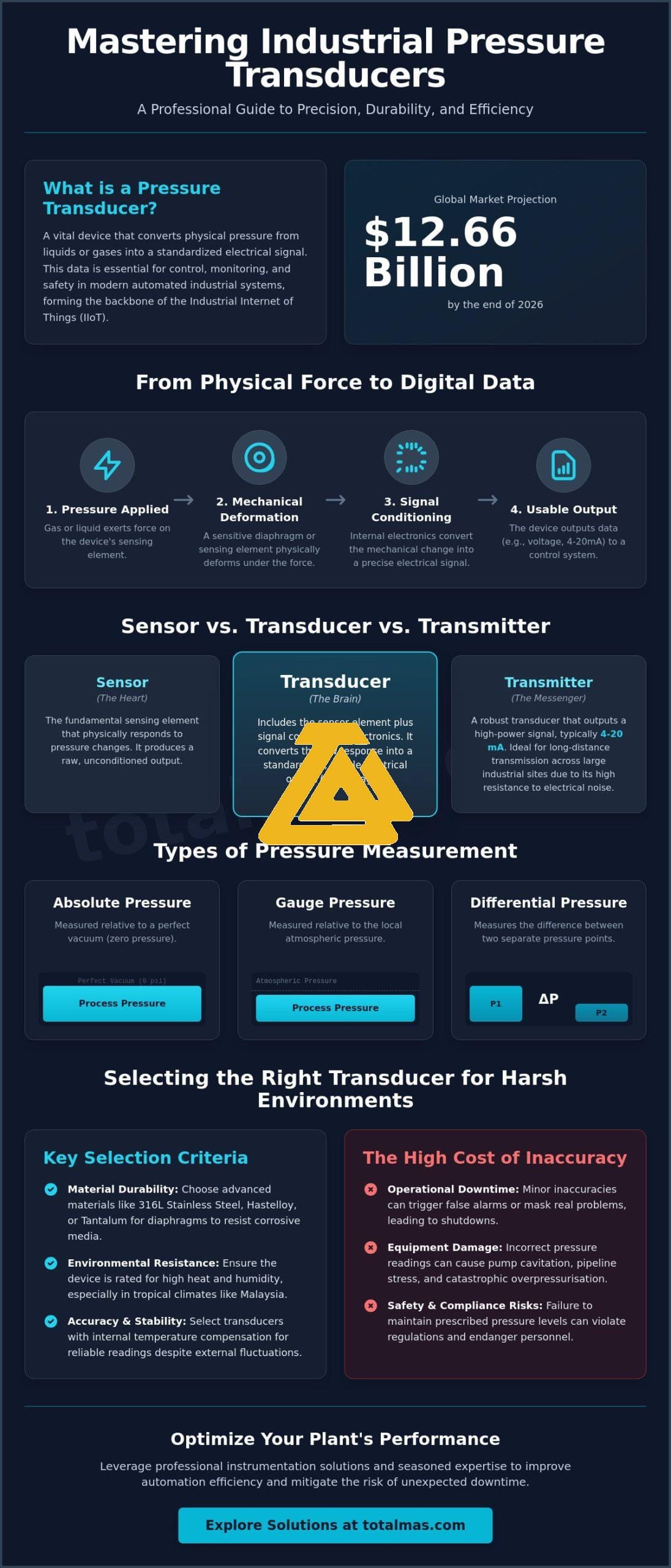
With the global pressure transducer market projected to reach up to $12.66 billion by the end of 2026, it’s clear that precision measurement remains the backbone of modern industrial automation. You likely recognize that even a minor inaccuracy in readings can trigger significant operational downtime or costly equipment damage. In demanding environments like those found across Malaysia, the heat and humidity often turn a simple hardware choice into a critical point of failure. Distinguishing between a basic sensor and a robust pressure transducer is no longer just a technicality; it’s a necessity for maintaining long-term plant safety and efficiency.
This guide provides a professional framework to help you master the technical mechanisms of these devices and navigate the latest industry requirements, such as the June 2026 standards for high-precision industrial transmitters. You’ll learn how to select equipment that survives corrosive media through the use of advanced materials like Hastelloy and tantalum diaphragms. We’ll examine the core principles of transducer mechanics, clarify the differences between transmitters and sensors, and establish a clear criteria for choosing the right components for your specific industrial applications.
Key Takeaways
- Understand the core mechanics of how a pressure transducer converts physical force into precise electrical signals to maintain industrial safety and system integrity.
- Learn to distinguish between absolute, gauge, and differential pressure types to ensure your instrumentation is correctly referenced for your specific process requirements.
- Establish a technical selection framework that prioritizes equipment durability in harsh environments, specifically addressing the heat and humidity challenges common in the Malaysian region.
- Gain insights into how professional instrumentation solutions and seasoned expertise can improve plant automation efficiency while reducing the risk of unexpected operational downtime.
Understanding the Pressure Transducer: Definition and Industrial Significance
A pressure transducer serves as the vital sensory link between mechanical fluid dynamics and digital control architecture. It’s a specialized device that converts physical pressure into a measurable electrical signal, typically voltage or frequency. While traditional mechanical gauges provided a visual reference for operators, the industrial landscape of 2026 demands the high-speed, high-resolution data that only digital instrumentation can provide. This transition is driven by the need for deeper integration into Industrial Internet of Things (IIoT) platforms where every data point influences plant-wide efficiency.
Within industrial fluid and gas systems, the role of these devices extends far beyond simple measurement. They are essential for maintaining safety and preventing the costly downtime associated with system failures. By applying foundational pressure measurement principles, these transducers allow for the continuous monitoring of pipelines, tanks, and processing units. In Malaysia, where environmental factors like high humidity and ambient heat can compromise equipment, precise pressure monitoring is a strict requirement for regulatory compliance. It ensures that operations remain within the safety parameters set by local authorities, protecting both the workforce and the surrounding environment.
Transducer vs. Sensor vs. Transmitter: Clearing the Confusion
Understanding the distinction between these components is necessary for proper system design. A pressure sensor is the fundamental sensing element, the “heart” that physically responds to pressure changes. A pressure transducer takes that raw response and adds signal conditioning electronics to produce a standardized electrical output. A pressure transmitter is a more robust version of a transducer, typically outputting a 4-20 mA signal. This high-power signal is specifically designed for long-distance transmission across large industrial sites, as it’s highly resistant to electrical noise and signal degradation.
Why Accuracy is Critical in 2026 Industrial Environments
The modern industrial sector operates on thin margins where precision equals profitability. In chemical processing and oil and gas, accurate pressure data minimizes raw material waste and ensures product consistency. This precision also safeguards the mechanical integrity of your hardware. For instance, the operational lifespan of ANSI or API centrifugal pumps is heavily dependent on maintaining specific suction and discharge pressures. Inaccurate readings can cause these pumps to run dry or experience cavitation, leading to expensive repairs. Ultimately, high-accuracy data prevents catastrophic overpressurisation events, providing a secure operational environment where risks are managed through data rather than guesswork.
The Mechanics of Measurement: How Pressure Transducers Convert Force to Data
Every pressure transducer operates on a fundamental physical principle: the conversion of mechanical force into an electrical output. When a pressurized medium, such as gas or liquid, enters the device, it exerts force against a sensing element, typically a diaphragm. This force causes a microscopic physical deformation. This movement is the critical first step in the various industrial applications of pressure transducers, where physical stress must be translated into a digital or analog signal that a control system can interpret. Without this precise mechanical response, automated plant management would be impossible.
The integrity of this conversion depends heavily on material science. High-quality transducers often utilize 316L stainless steel for the sensing element and housing. This material is selected for its excellent corrosion resistance and mechanical stability over millions of pressure cycles. In industrial environments, the internal electronics must also account for external variables. Temperature fluctuations and atmospheric pressure changes can influence the sensing element’s behavior. To maintain accuracy, modern devices include internal compensation circuits that adjust the output signal in real-time, ensuring the data remains reliable even when ambient conditions shift.
Piezoresistive vs. Capacitive Sensing Technologies
Piezoresistive technology is the most common method used in a pressure transducer today. It employs strain gauges bonded to a diaphragm; as the diaphragm flexes, the electrical resistance of the gauge changes. This method offers high sensitivity and is exceptionally robust in high-vibration environments. Conversely, capacitive sensing measures the change in electrical charge between two plates as they move closer together. Capacitive sensors are often preferred for low-pressure applications because they can detect even minute changes in force with high repeatability.
The Role of the Sensing Diaphragm
The diaphragm acts as the primary interface between the process media and the sensitive internal electronics. In standard applications, the diaphragm is recessed, but for viscous, pulpy, or clogging fluids, a “flush” diaphragm is used. This design prevents media from becoming trapped and hardening inside the port, which would otherwise lead to inaccurate readings or sensor failure. For hazardous or highly corrosive media, all-metal sealed systems provide a leak-proof barrier, ensuring that the process remains contained while the electronics stay protected. If you’re managing complex fluid systems, selecting the right instrumentation from a trusted technical partner ensures your hardware remains resilient under pressure.
Categorising Pressure Transducers: Absolute, Gauge, and Differential
Selecting a pressure transducer requires more than just knowing the maximum pressure of a system; it involves choosing the correct reference point. This reference determines whether you’re measuring pressure relative to a perfect vacuum, the current atmosphere, or another specific point within the process. Misunderstanding these pressure measurement principles often leads to significant calibration errors. Such mistakes can disrupt plant automation and compromise safety protocols in high-stakes environments.
Absolute, Gauge, and Sealed Gauge Pressure
Absolute pressure transducers use a perfect vacuum as their zero point. They’re indispensable for processes sensitive to altitude or barometric changes, such as weather monitoring or vacuum packaging. Most standard industrial tanks, however, utilize gauge pressure. This format references the local atmospheric pressure as zero, making it ideal for vented systems where the internal pressure is relative to the outside air. For high-pressure environments where venting the sensor to the atmosphere isn’t feasible, sealed gauge transducers provide a fixed reference point. This design protects the internal electronics from environmental ingress while maintaining a stable baseline.
The Utility of Differential Pressure Transducers
These specialized devices measure the difference between two distinct pressure points rather than a single point against a reference. This capability is vital for calculating the “drop” across a specific component. In filtration systems, a sudden increase in differential pressure signals that a filter is clogged and requires maintenance. This technology is also a cornerstone of flow calculation. For example, a differential pressure transmitter works alongside orifice plates to provide precise flow data, ensuring that liquid and gas movement remains within optimized parameters across your pipeline network.
Electrical Output Options: Millivolt, Voltage, and 4-20 mA
The way a pressure transducer communicates with your control system is just as important as how it measures force. Millivolt outputs are cost-effective but limited to short distances because they’re susceptible to electrical interference. Voltage outputs offer a stronger signal for moderate distances but still face limitations in large-scale plants. The 4-20 mA loop remains the industrial standard for a reason. It’s exceptionally immune to electrical noise and can transmit data over long distances without signal loss. For facilities moving toward IIoT, digital outputs like Modbus or CANbus are becoming more common. These allow for advanced diagnostics and direct integration into smart displays and plant management software.
Selecting the Right Transducer for Demanding Industrial Applications
Selecting a pressure transducer is a strategic procurement decision that directly impacts long-term plant uptime. You must establish a clear selection framework that prioritizes the specific media, the external environment, and the required accuracy. It’s not enough to simply match the maximum pressure of your system. You must also ensure the device can handle the day-to-day fluctuations and potential overpressure events common in high-demand industrial cycles. A mismatched sensor often leads to premature failure or inaccurate data that compromises your entire automation chain.
In Malaysia, environmental factors play a disproportionate role in equipment failure. The combination of high ambient temperatures and tropical humidity can cause significant thermal drift or moisture ingress in lower-grade sensors. This is why localized expertise is vital. You need hardware that accounts for these conditions, ensuring that the internal electronics remain stable even when the mercury rises. Humidity can also lead to corrosion on external connectors, so choosing the right housing material and sealing is just as important as the internal sensing technology.
Chemical compatibility remains a primary concern for the longevity of the transducer port and housing. While 316L stainless steel is the standard for many applications, certain media require specialized alloys to prevent pitting or stress corrosion. Matching the transducer’s pressure range to your operating parameters is equally critical. Ideally, your operating pressure should fall within 50% to 75% of the transducer’s full-scale range. This provides a buffer for unexpected spikes while maintaining the device in its most accurate measurement zone.
Environmental Resilience: Temperature, Corrosion, and Vibration
For processes involving steam or oil refining, high temperature pressure transmitters are essential to prevent sensor fatigue. These units often feature cooling extensions or specialized diaphragms to isolate the electronics from extreme heat. As of June 2026, new technical standards like Q/YMCL 005-2024 have established rigorous benchmarks for Hastelloy and tantalum diaphragms in highly corrosive environments. Protecting these internal components from moisture requires a high IP rating, such as IP67 or IP68, which ensures the device remains sealed against dust and prolonged water immersion.
Integration with Plant Automation and Monitoring Systems
Physical installation requires matching the thread type, such as NPT or G-thread, to your existing orifice plates or flanges. Once installed, the pressure data feeds directly into PLC logic, allowing for real-time adjustments in pump speeds or valve positions. This is a core component of a pressure sensor for industrial automation strategy. By integrating these sensors with Murphy Displays or Enovation Controls, operators gain a clear window into system health. To find the right instrumentation for your specific facility, consult with the technical experts at Totalmas for a reliable solution.
Optimising Plant Performance with Totalmas Instrumentation Solutions
Totalmas Sdn Bhd stands as a specialist in high-reliability industrial instrumentation, offering over 33 years of established expertise in the sector. When you source a pressure transducer from an experienced provider, you gain more than just hardware; you secure a long-term technical partnership. This depth of experience is particularly valuable for businesses operating in Malaysia, where localized technical support in Kuala Lumpur ensures that maintenance and calibration requirements are met with precision. A holistic approach to instrumentation, where pressure, flow, and control systems work in unison, is the most effective way to optimize plant performance and minimize unexpected downtime.
Synergising Pressure Data with Murphy Displays
Enovation Controls and Murphy Displays provide a critical interface for your operational data. These systems transform the electrical signals from a pressure transducer into real-time visual insights, allowing operators to monitor system health at a glance. Beyond simple visualization, these controllers enable automated alarms and emergency shut-off sequences. If a pressure spike exceeds safe thresholds, the system can react instantly to protect centrifugal pumps or piping networks. The durability of Murphy instrumentation is well-documented. It’s a preferred choice for heavy-duty industrial sites across the region where environmental resilience is a priority.
Comprehensive Support for Flow and Pressure Systems
Effective fluid management requires the seamless integration of multiple data streams. Totalmas specializes in combining transducers with high accuracy flow meters to achieve total control over liquid and gas processes. This integrated strategy ensures that every component, from orifice plates to centrifugal pumps, operates within its peak efficiency range. By conducting thorough instrumentation audits, Totalmas helps businesses identify bottlenecks and replace aging mechanical gauges with modern digital solutions. This methodical approach to system design reinforces operational safety while improving the bottom line through reduced waste.
Ensuring your facility remains compliant and efficient requires a steady hand and proven hardware. If you’re ready to upgrade your monitoring capabilities or need a technical audit of your existing instrumentation, reach out to the specialists at Totalmas. Our team provides the professional guidance necessary to select and integrate the right solutions for your specific industrial requirements.
Securing Long-Term Reliability in Industrial Pressure Measurement
Mastering the nuances of industrial instrumentation is the first step toward a more resilient plant. You’ve seen how the correct selection of a pressure transducer, matched with durable materials and precise electrical outputs, prevents operational downtime. Whether you’re managing complex fluid systems or monitoring critical pipelines, the integration of high-quality sensing technology is essential for regulatory compliance and mechanical longevity. Choosing the right hardware today ensures your facility remains competitive and safe for years to come.
Totalmas Sdn Bhd offers over 33 years of industrial experience in Malaysia to help you navigate these technical challenges. As an authorized distributor of Enovation Controls and Murphy Displays, we specialize in delivering robust solutions for high temperature pressure transmitters and corrosive environments. Our team provides the technical expertise needed to optimize your plant’s sensory nervous system and improve overall automation efficiency. We’re committed to being a steady hand for your business as you implement advanced monitoring solutions.
Consult with Totalmas for Precision Pressure Instrumentation Solutions and ensure your operations remain steady under any conditions.
Frequently Asked Questions
What is the difference between a pressure transducer and a pressure transmitter?
A pressure transducer converts mechanical force into a standardized voltage or frequency signal, while a pressure transmitter specifically converts it into a 4-20 mA current loop. Transmitters are generally preferred for large-scale industrial sites because the current signal doesn’t degrade over long cable runs. Transducers are often used in smaller, localized equipment where high-power transmission isn’t necessary. Choosing the correct device depends on your control system’s distance from the sensing point.
How do I calibrate a pressure transducer in an industrial setting?
Industrial calibration involves applying a traceable, known pressure to the device using a deadweight tester or a digital pressure calibrator. You then compare the transducer’s electrical output to the reference value. Professional technicians typically adjust the “zero” point at no pressure and the “span” at full-scale pressure. Regular calibration is necessary to account for sensor drift and ensures your plant remains compliant with safety and quality standards.
What are the most common causes of pressure transducer failure?
The most frequent causes of failure include overpressure spikes that exceed the proof pressure and corrosive media that degrades the sensing diaphragm. Moisture ingress due to inadequate IP ratings also leads to short circuits in the internal electronics. High levels of mechanical vibration can fatigue the internal components over time. Selecting a pressure transducer with the correct material housing and environmental protection is the best way to prevent these common issues.
Can a pressure transducer be used for both liquid and gas media?
Most pressure transducers are designed to handle both liquid and gas media, provided the wetted parts are chemically compatible. For example, 316L stainless steel works well with water, air, and many oils. However, viscous liquids or slurries may require a flush diaphragm to prevent clogging. You should always verify that the internal seals and diaphragm material can withstand the specific temperature and chemical properties of your process fluid.
How do I choose the correct pressure range for my transducer?
You should select a pressure range where your typical operating pressure falls between 50% and 75% of the device’s full-scale capacity. This range provides the highest accuracy while leaving a sufficient buffer for unexpected pressure surges or spikes. If the range is too narrow, you risk damaging the sensor during an overpressure event. Conversely, a range that is too wide will result in lower resolution and less precise data for your control system.
What is a 4-20 mA output and why is it preferred in factories?
A 4-20 mA output is a robust current loop signal where 4 mA represents the zero point and 20 mA represents the full-scale pressure. It’s the industrial standard because current signals are immune to the electrical noise generated by large motors and power lines in factories. Additionally, because the signal never drops to zero during normal operation, a 0 mA reading immediately alerts the control system to a broken wire or power failure.
Are there wireless pressure transducers available for remote monitoring?
Wireless pressure transducers are increasingly common for remote monitoring in hazardous or difficult-to-access locations. These devices eliminate the need for expensive cabling and simplify installation on mobile assets or widely distributed pipeline networks. Many modern wireless units utilize IIoT protocols to transmit data directly to plant management software or Murphy Displays. This technology is particularly useful for temporary setups or sites where traditional wiring is logistically impossible.
How does ambient temperature affect pressure measurement accuracy?
Ambient temperature changes can cause the sensing element and internal fluids to expand or contract, leading to thermal drift in your readings. In a high-quality pressure transducer, internal electronics provide temperature compensation to correct these errors in real-time. Without this compensation, extreme heat or cold can significantly reduce measurement accuracy. This is a critical consideration for Malaysian industrial sites where high ambient temperatures and humidity are the standard operating environment.