
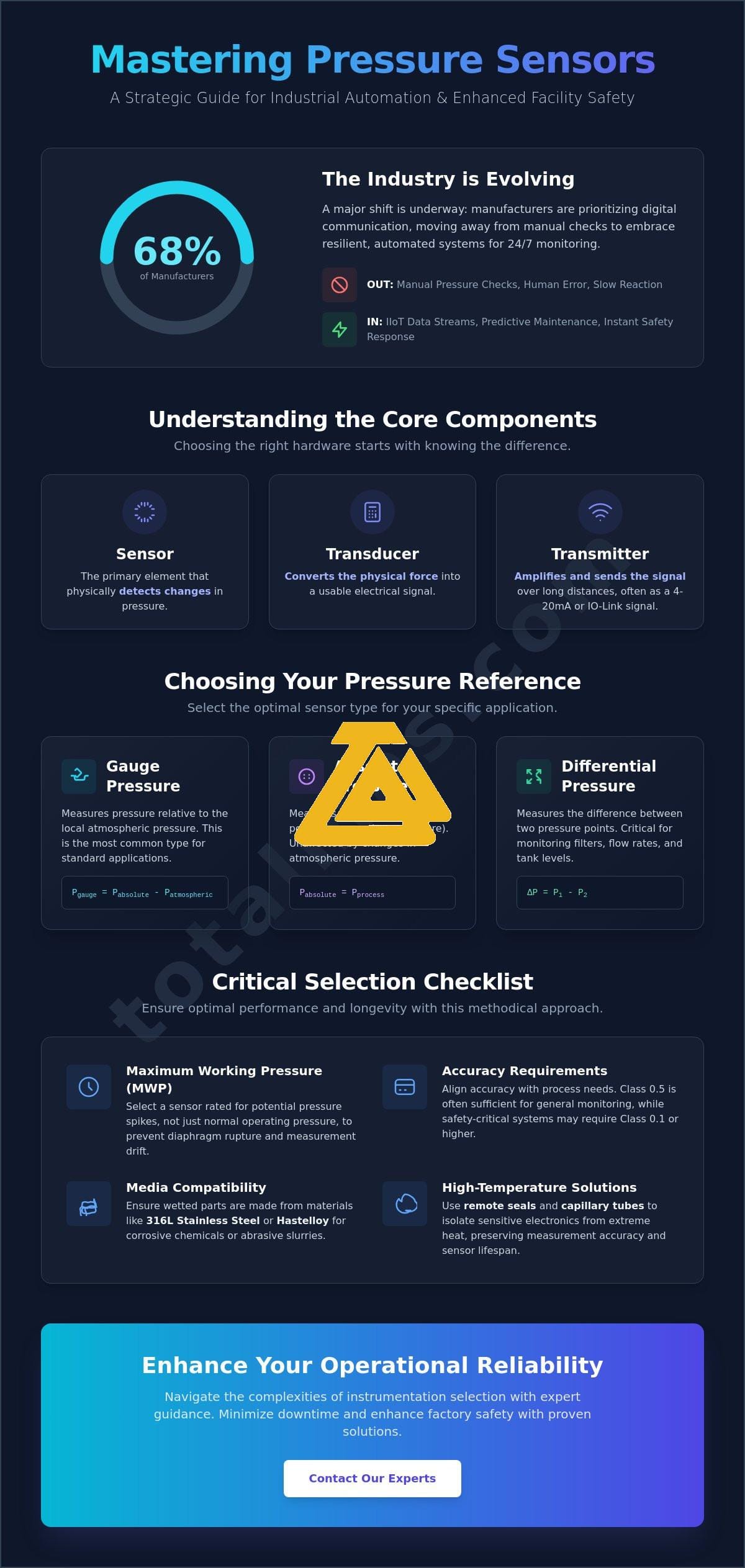
With 68% of manufacturers now prioritizing digital communication capabilities, the era of relying on manual pressure checks has officially ended. This shift reflects a broader industry move toward resilient, automated systems that can handle the rigors of modern production. Selecting the right pressure sensor for industrial automation is no longer just a technical checkbox. It’s a strategic decision that directly impacts your facility’s ability to maintain stability in high-heat environments and complex PLC configurations.
You likely recognize that a single inaccurate reading or a sensor failure often leads to expensive downtime and safety risks. We understand the need for reliable, long-term solutions that provide a sense of security for your operations. This guide provides a clear path to mastering sensor integration so you can achieve 24/7 automated monitoring and reduce manual inspection frequency. We will examine how to align your systems with the latest ISO 9001:2026 standards and ensure full compliance with Malaysian industrial safety regulations. By the end of this article, you’ll have the technical knowledge to optimize your plant’s efficiency and secure your operations against unexpected failures.
Key Takeaways
- Learn how to convert physical force into precise electrical signals to ensure your PLC logic gates receive accurate data for automated decision-making.
- Identify the critical differences between absolute, gauge, and differential pressure to select the optimal pressure sensor for industrial automation for your specific application.
- Follow a structured integration process that includes verifying 24V DC power compatibility and applying mechanical mounting techniques to prevent unnecessary stress on the sensor.
- Discover how to maintain measurement accuracy in extreme environments by using remote seals and capillary tubes to isolate sensitive components from high temperatures.
- Gain insights into how decades of industrial experience can help you navigate the complexities of instrumentation selection to minimize downtime and enhance factory safety.
Understanding the Role of Pressure Sensors in Industrial Automation
An industrial pressure sensor acts as the primary sensory organ for a factory’s nervous system. It’s technically a transducer that converts physical force into a standardized electrical signal. This conversion is the fundamental starting point for Understanding Pressure Measurement within a modern facility. Without this precise data, automated logic gates in Programmable Logic Controllers (PLCs) wouldn’t have the input needed to execute critical commands. In 2026, the reliance on these components has intensified as systems become more autonomous. Real-time monitoring is no longer a luxury; it’s a baseline requirement for preventing catastrophic equipment failure and ensuring operational continuity.
The industry is moving away from simple, isolated gauge readings that require physical inspection. We’re seeing a full transition to integrated Industrial Internet of Things (IIoT) data streams. This means a pressure sensor for industrial automation now does more than just report a number. It provides a continuous flow of high-resolution data that helps engineers identify subtle trends before they escalate into mechanical problems. This shift toward data-driven operations allows for a level of precision that was previously unattainable in traditional manufacturing environments.
Pressure Sensor vs. Transducer vs. Transmitter
Terminology often overlaps in technical discussions, but the distinctions matter for effective system design. A sensor detects the pressure; a pressure transducer converts that detection into an electrical signal; and a transmitter amplifies that signal for long-distance transmission. In large Malaysian factories, transmitters are the preferred choice. They’re designed to send signals across expansive floor plans without data degradation. Choosing the right pressure sensor for industrial automation requires understanding these hardware differences to ensure the signal reaches the control room clearly. Most systems rely on 4-20mA loops because of their high noise immunity, though digital protocols like IO-Link are increasingly common for applications requiring complex diagnostics.
Benefits of Automated Pressure Monitoring
Manual pressure logging is prone to human error and often misses fleeting pressure spikes that can damage hardware. Automation removes this risk by providing consistent, objective data every second of the day. This constant stream enables predictive maintenance, which is vital for extending the lifespan of high accuracy flow meters and other sensitive equipment. Safety also improves significantly when monitoring is automated. By linking sensors to emergency shut-off valves, systems can react to overpressure events in milliseconds. This is far faster than any human operator could respond. This proactive approach keeps your plant compliant with the latest safety standards while protecting your long-term capital investments.
Selection Criteria: Matching Sensors to Industrial Applications
Selecting the correct pressure sensor for industrial automation involves a methodical evaluation of your specific operational environment. It begins with identifying the pressure reference: absolute, gauge, or differential. Gauge sensors are standard for most atmospheric applications, while differential sensors are critical for monitoring pressure drops across filters or measuring flow in conjunction with orifice plates and flanges. Beyond the reference type, calculating the Maximum Working Pressure (MWP) is essential. If the sensor isn’t rated for potential pressure spikes, you risk diaphragm rupture or long-term fatigue that leads to measurement drift.
Accuracy requirements should align with your process needs rather than just seeking the highest possible specification. While recent advancements in MEMS pressure sensor technology have made high-precision units more accessible, a Class 0.5 sensor is often sufficient for general monitoring. For critical safety-critical applications, a Class 0.1 or higher might be necessary. You must also consider media compatibility. Corrosive chemicals or abrasive slurries require wetted parts made from specialized alloys like Hastelloy or 316L stainless steel to prevent premature failure. Choosing the right pressure sensor for industrial automation means balancing these technical needs with your facility’s budget.
Output Signals and Connectivity
The choice of output signal determines how easily the sensor integrates with your existing PLC. The 4-20 mA current loop remains the industry standard because it’s exceptionally reliable in electrically noisy environments. However, many modern facilities are transitioning to digital protocols like HART or IO-Link. These smart protocols allow for remote configuration and provide diagnostic data that can alert you to a failing sensor before it causes a shutdown. Wireless options are also becoming more viable for remote locations where running cables is cost-prohibitive, though they require a disciplined battery management strategy.
Environmental and Safety Ratings
Operating in Malaysia presents unique challenges, specifically high humidity and ambient heat. Sensors must have appropriate IP ratings, typically IP67 or higher, to prevent moisture ingress. For those working in the oil, gas, or chemical sectors, explosion-proof ratings such as ATEX or IECEx are non-negotiable. Additionally, if the sensor is mounted on heavy machinery like large centrifugal pumps, it needs high vibration and shock resistance. A sensor that isn’t built to withstand mechanical stress will quickly lose calibration. This leads to inaccurate data and potential safety hazards that could have been avoided with better hardware selection.
Step-by-Step Guide to Integrating Pressure Sensors into Automation Systems
Integrating a pressure sensor for industrial automation requires a methodical approach to ensure long-term reliability and data integrity. Before starting the installation, you must verify that your system’s power supply meets the standard requirements, which is typically a stable 24V DC. Inadequate or fluctuating power can lead to signal instability or intermittent data gaps that disrupt your PLC logic. Once the power environment is confirmed, the focus shifts to the physical installation. Proper mounting is essential; any mechanical stress applied to the sensor body during installation can cause a permanent offset in readings or lead to internal component failure over time.
After the physical and electrical connections are secure, you must perform calibration and scaling within your PLC software. This involves mapping the raw electrical signal, such as a 4-20mA output, to the corresponding physical units like bar or psi. Once scaled, the final phase is rigorous testing and validation. We recommend performing simulated pressure tests to confirm that your alarm thresholds and emergency control logic trigger exactly as intended. This validation step provides the security of knowing your system will react correctly during a real-world overpressure event, protecting both your personnel and your equipment.
Step 1: Mechanical Mounting and Porting
Reliable data starts with a secure and protected mechanical connection. Use snubbers if your process involves rapid pressure spikes, or install siphons to protect the sensor from high-temperature steam. These accessories act as a physical buffer, preserving the integrity of the sensing diaphragm. When making connections, select the correct thread sealant for your region, whether you’re using NPT or BSPP standards. Ensure the sensor remains accessible for future calibration cycles. A pressure sensor for industrial automation that is buried deep within a pipe network without a clear path for maintenance is a liability that will eventually cause operational delays.
Step 2: Wiring and Signal Conditioning
Electrical noise is the primary enemy of signal accuracy in a factory setting. Use shielded cables and establish proper grounding techniques to prevent electromagnetic interference from nearby motors or heavy machinery. It’s vital to correctly identify terminal assignments for your specific configuration, whether you’re using a two-wire current loop or a three-wire voltage setup. For complex environments like a waste heat recovery unit Malaysia, ensure your signal conditioning accounts for thermal variables to maintain temperature-compensated accuracy across all operating conditions.
Addressing Challenges: High-Temperature and High-Pressure Environments
Industrial environments rarely offer ideal operating conditions. When integrating a pressure sensor for industrial automation into high-temperature or high-pressure systems, standard installation methods often fall short. Thermal drift is a primary concern. It occurs when fluctuating temperatures cause the sensor’s zero point and span to shift, leading to inaccurate data that can disrupt your entire control loop. To mitigate this, engineers must look beyond simple accuracy ratings and examine the Total Error Band (TEB) in the sensor’s datasheet. This metric provides a more comprehensive view of how the sensor performs across its entire rated temperature range, ensuring that your data remains reliable even as conditions change.
In extreme cases where process temperatures exceed the sensor’s safe limits, remote seals and capillary tubes become necessary. These components isolate the sensitive electronics from the heat while still allowing the pressure to be transmitted through a specialized fill fluid. For high-pressure durability, material choice is non-negotiable. While 316L Stainless Steel is the standard for many applications, extreme pressures or corrosive media may require Inconel to prevent diaphragm failure. Maintaining signal integrity over long distances also remains a challenge. If your sensor is located far from the control room, ensure you use high-quality shielded cabling to prevent the signal from being drowned out by electromagnetic interference from nearby machinery.
Managing Thermal Drift
Understanding the Temperature Error Band (TEB) is crucial for maintaining process stability. Unlike simple accuracy specs, TEB accounts for all temperature-related errors, giving you a realistic expectation of performance in the field. Many modern controllers now use software compensation algorithms to adjust for environmental heat in real-time. High ambient humidity and sustained tropical temperatures in Malaysia can accelerate the degradation of internal seals and electronic components, significantly shortening the operational lifespan of a sensor. By proactively accounting for these factors, you ensure that your pressure sensor for industrial automation remains a dependable data source for your automated systems.
Protection from Pressure Surges
Rapid valve closures in liquid systems can trigger the “Water Hammer” effect, sending shock waves through the piping that can instantly destroy a sensitive sensor diaphragm. Implementing pulsation dampeners is an effective way to smooth out these erratic pressure spikes before they reach the sensing element. Additionally, setting up short software delays in your automation loops can prevent “nuisance trips.” These delays allow the system to ignore momentary, non-critical spikes while still reacting to genuine overpressure events. If you’re managing complex fluid systems, selecting robust technical instrumentation solutions is the best way to protect your infrastructure from these common industrial hazards.
Enhancing Operational Reliability with Totalmas Instrumentation Experts
Totalmas stands as a specialized partner for high-performance pressure transmitters and instrumentation throughout Malaysia. With 33+ years of industry experience, we understand the deep technical complexities involved in selecting the right hardware for demanding plant environments. Choosing a pressure sensor for industrial automation is a task that requires more than just looking at a datasheet. It demands a professional understanding of how that sensor will interact with your existing infrastructure, such as ANSI or API centrifugal pumps, over several years of continuous operation. Our role is to provide the technical expertise and quiet confidence you need to secure your facility’s long-term success. We offer access to world-class brands like Enovation Controls and Murphy, ensuring that your automation systems are built on a foundation of proven, rugged reliability.
Customised Instrumentation Solutions
Every industry has its own unique set of challenges. We specialize in tailoring pressure monitoring systems for the palm oil, oil & gas, and manufacturing sectors. Our approach isn’t about selling a single component; it’s about providing a reliable solution that improves your bottom line. We provide integrated solutions that often combine pressure monitoring with high-quality flow meters and orifice plates to create a comprehensive, real-time view of your process. This holistic perspective is essential for maintaining efficiency in complex systems like waste water treatment plant solutions or mec handling conveyors. We also ensure that all supplied equipment meets local Malaysian regulatory and safety standards, giving you the security of knowing your operations are fully compliant.
Your Partner in Industrial Excellence
Choosing a single-point-of-contact supplier significantly reduces procurement complexity and ensures that every component in your system works in harmony. Totalmas provides more than just hardware. We offer a long-term partnership that includes on-site technical support and training for factory engineering teams in Kuala Lumpur. This hands-on guidance helps your staff master the nuances of a new pressure sensor for industrial automation, from initial wiring to advanced software scaling. Whether you’re upgrading an existing line or designing a new facility, our team is ready to assist with professional consultation and post-installation troubleshooting. Contact Totalmas for your automation requirements to discuss how we can optimize your industrial performance and ensure your systems remain a steady hand for your business.
Securing Your Industrial Future through Precision Integration
Integrating a pressure sensor for industrial automation is a foundational step toward achieving a resilient, data-driven facility. By mastering the selection of wetted materials and implementing disciplined mounting techniques, you protect your infrastructure from the costly effects of thermal drift and pressure surges. These technical choices ensure that your real-time monitoring remains accurate and your safety protocols remain dependable. It’s a process that requires attention to detail to avoid the common pitfalls of integration and ensure long-term stability.
Reliability in automation requires more than just high-quality hardware; it requires a partner who understands the nuances of the Malaysian industrial sector. Totalmas brings 33+ years of industrial experience to every project, serving as an authorized distributor for world-class brands like Enovation Controls and Murphy. Based in Kuala Lumpur, our team provides nationwide technical support to ensure your instrumentation performs as expected from day one. We are committed to helping you achieve excellence in your operational performance. Consult with our instrumentation experts for your next automation project to discuss how we can support your success with proven technical solutions. We look forward to helping you build a more efficient and secure facility.
Frequently Asked Questions
What is the difference between a pressure sensor and a pressure transmitter?
A pressure sensor is the basic sensing element that detects physical force, while a pressure transmitter includes additional electronics to amplify and convert that detection into a standardized signal. Transmitters are the preferred choice for large factories because they can send data over long distances, typically via a 4-20mA loop, without signal degradation. In most automation contexts, the term transmitter is used to describe the complete assembly that interfaces with your control system.
How do I choose the right pressure range for my automation system?
You should select a range where your typical operating pressure sits between 50% and 75% of the sensor’s full scale. This provides enough headroom to handle unexpected pressure spikes without damaging the internal diaphragm or saturating the signal. Choosing a range that’s too high can reduce the resolution of your data, making it harder to detect subtle changes in your process.
Can I use a standard pressure sensor for corrosive chemical applications?
Standard sensors aren’t suitable for corrosive media because their wetted parts will eventually degrade and fail. You’ll need a pressure sensor for industrial automation that features specialized alloys like 316L stainless steel or Hastelloy. Alternatively, you can use a remote diaphragm seal to physically isolate the sensitive internal components from the aggressive chemicals while still maintaining accurate pressure transmission.
How often should industrial pressure sensors be calibrated?
Most industrial sensors require calibration every twelve months to ensure they remain within their specified accuracy class. If your process involves extreme temperatures, rapid pressure cycling, or high vibration, you should consider semi-annual checks to prevent measurement drift. Regular calibration is a fundamental part of maintaining compliance with local Malaysian safety standards and ensuring your automated logic remains reliable.
What are the most common causes of pressure sensor failure in factories?
Moisture ingress and pressure spikes, often called water hammer, are the most frequent causes of hardware failure. In facilities using heavy equipment like centrifugal pumps, sustained mechanical vibration can also lead to loosened connections or internal component wear. Using appropriate protection, such as snubbers and high IP-rated housings, helps mitigate these common industrial hazards.
How do I integrate a 4-20mA pressure sensor with a modern PLC?
To integrate the sensor, wire it to a compatible analog input module on your PLC using shielded twisted-pair cabling to minimize electrical noise. Once the physical connection is secure, you’ll need to scale the signal in your PLC software so the 4mA to 20mA range correctly represents your minimum and maximum pressure values. This scaling ensures the PLC logic can accurately interpret the data for automated control decisions.
Are wireless pressure sensors reliable enough for industrial automation?
Wireless technology is reliable for data logging and remote monitoring where running cables is physically or financially impractical. However, for critical safety shut-off loops that require millisecond response times, wired connections remain the industry standard. Wireless sensors are an excellent supplement for non-critical monitoring but shouldn’t replace wired hardware in safety-critical applications.
What IP rating do I need for a pressure sensor in a Malaysian outdoor plant?
An IP67 rating is the recommended minimum for outdoor plants in Malaysia to protect against heavy tropical rainfall and high humidity. This rating ensures the pressure sensor for industrial automation is dust-tight and can withstand temporary immersion in water. Without this level of protection, moisture buildup inside the electronic housing can lead to short circuits and permanent sensor failure. For a deeper understanding of how these devices function at a component level, our comprehensive guide to pressure transducers and their industrial principles provides detailed technical insight into the mechanisms that underpin reliable pressure measurement.