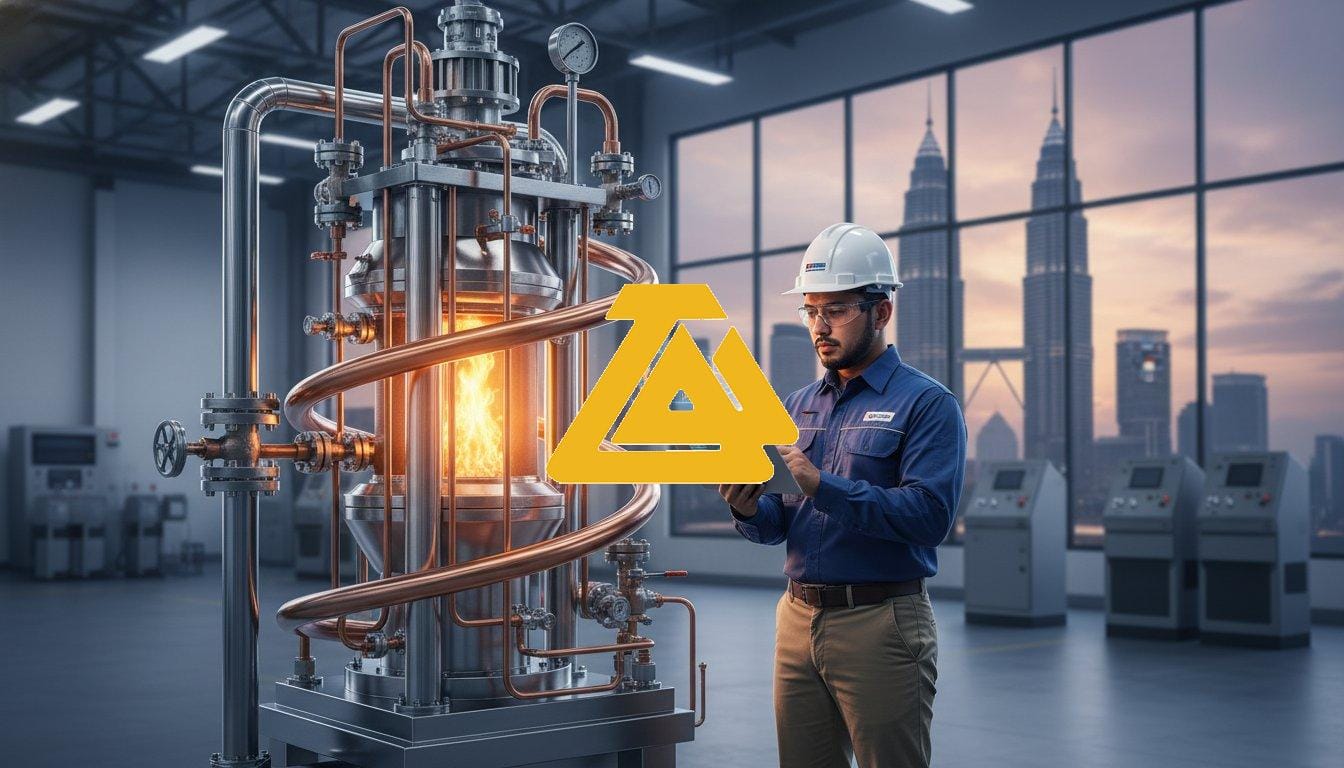
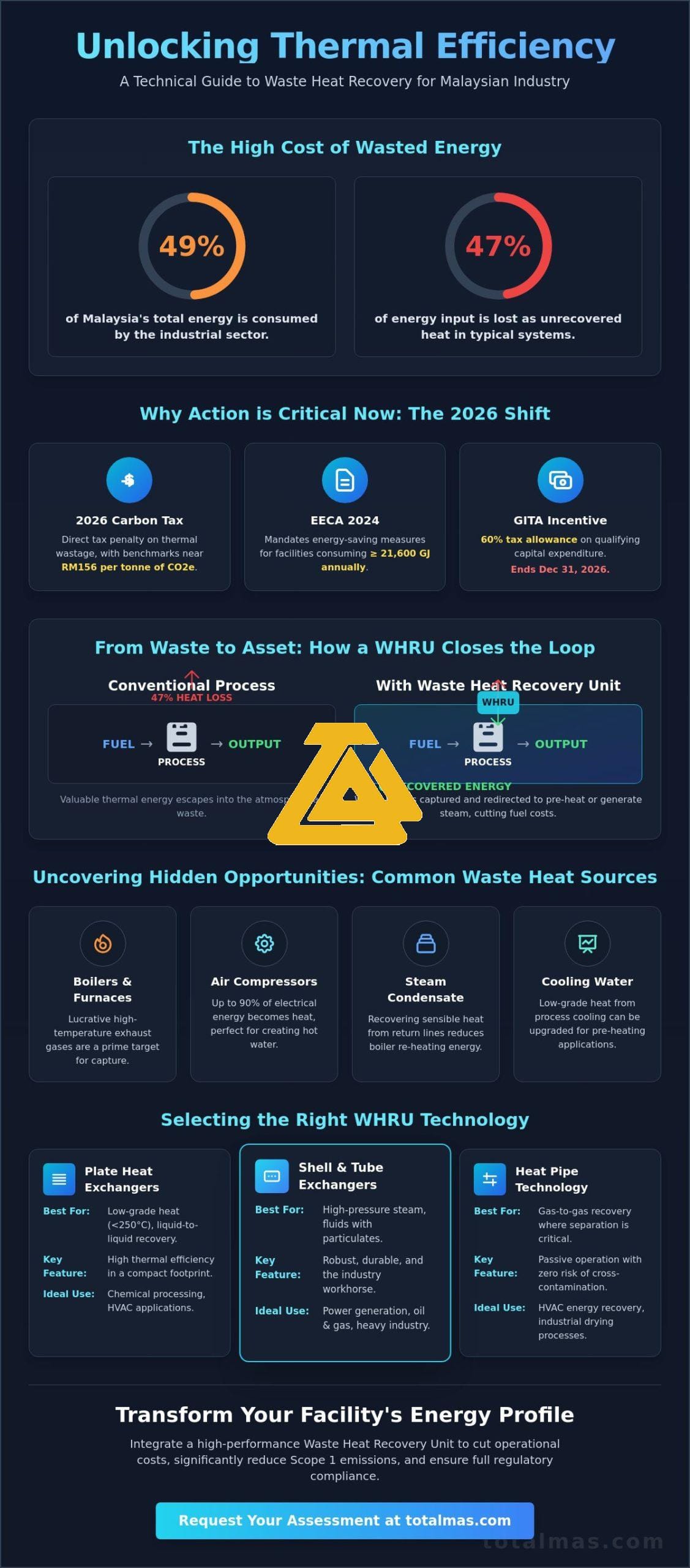
Did you know that the industrial sector accounts for 49% of Malaysia’s total energy consumption, yet nearly 47% of energy input in systems like biogas engines is often lost as unrecovered heat? With the 2026 carbon tax approaching and the Energy Efficiency and Conservation Act (EECA) 2024 already mandating strict energy-saving measures for large consumers, the cost of thermal wastage has become a direct threat to your bottom line. You likely understand that every degree of heat escaping your boiler or furnace represents lost revenue, but finding a reliable way to quantify and capture those savings remains a significant technical hurdle.
This guide provides the technical framework required to select and implement a high-performance waste heat recovery unit Malaysia to optimize your plant’s efficiency. You will learn how to calculate actual ROI while leveraging available incentives like the Green Investment Tax Allowance (GITA) which remains active until December 31, 2026. We will walk through the essential steps of industrial integration, from precise flow meter monitoring to selecting the right heat recovery steam generators for your specific operational needs. This structured approach ensures your facility moves toward a low-carbon model while maintaining peak functional success.
Key Takeaways
- Understand how the Energy Efficiency and Conservation Act (EECA) and the 2026 carbon tax mandate immediate improvements in industrial thermal management.
- Learn to select the most effective waste heat recovery unit Malaysia for your facility by comparing plate, shell and tube, and heat pipe technologies.
- Master the step-by-step framework for calculating Simple Payback Period (SPP) while maximizing Green Investment Tax Allowance (GITA) benefits.
- Discover how tropical climates and high humidity levels influence the efficiency and material selection of industrial heat exchangers.
- Explore how integrating precision instrumentation with high-quality recovery units ensures long-term operational stability and regulatory compliance.
The State of Industrial Waste Heat Recovery in Malaysia (2026)
The year 2026 marks a definitive shift in how Malaysian heavy industry manages thermal energy. A Waste Heat Recovery Unit (WHRU) is a specialized heat exchanger system designed to capture thermal energy from hot waste streams, such as exhaust gases or cooling water, and redirect it back into the production process. Instead of allowing valuable heat to escape into the atmosphere, these systems repurpose it to pre-heat boiler feed water, generate low-pressure steam, or provide space heating. For any waste heat recovery unit Malaysia installation, the primary goal is to close the loop on energy consumption, turning a byproduct into a functional asset.
This year is critical because of the convergence of new regulations and rising operational costs. The introduction of the Malaysian carbon tax in 2026, initially targeting the iron, steel, and energy sectors, has fundamentally changed the ROI calculation for green technology. With analysts suggesting benchmarks near RM156 per tonne of CO2 equivalent, thermal wastage now carries a direct tax penalty. When combined with the Energy Efficiency and Conservation Act (EECA) 2024, which mandates energy-saving measures for facilities consuming 21,600 GJ or more annually, the business case for heat recovery is no longer optional. It is a requirement for maintaining a competitive edge in a high-tariff environment.
Drivers for WHRU Adoption in the Malaysian Market
The push toward ‘Net Zero’ by 2050 has moved from a corporate social responsibility goal to a core operational strategy. Implementing a waste heat recovery unit Malaysia allows plants to achieve significant Scope 1 emission reductions by burning less fuel to achieve the same thermal output. We’ve observed a clear market shift from basic economisers to advanced heat-to-energy systems that integrate with existing plant instrumentation. This transition is supported by the Green Investment Tax Allowance (GITA), which provides a 60% tax allowance on qualifying capital expenditure through the end of 2026. This financial cushion helps offset the initial investment while the system works to lower long-term electricity and natural gas bills.
Identifying Overlooked Heat Sources in Your Facility
Many facilities focus only on the most obvious exhaust stacks, but significant recovery potential often lies in overlooked areas. Efficient thermal management requires a comprehensive audit of all energy exits. Typical sources include:
- Industrial Boilers and Furnaces: High-temperature exhaust gases are the most common and lucrative sources for heat capture.
- Air Compressors: Up to 90% of the electrical energy used by a compressor is converted into heat; capturing this can provide “free” hot water for cleaning or process needs.
- Cooling Water: Low-grade heat from chemical processes or power generation can be upgraded or used for pre-heating applications.
- Steam Condensate Return Lines: Recovering the sensible heat from condensate reduces the energy required to bring fresh makeup water to boiling point.
Core Technologies: Selecting the Right Waste Heat Recovery Unit
Selecting the right waste heat recovery unit Malaysia requires a deep understanding of your facility’s thermal profile. In Malaysia’s tropical climate, where ambient humidity is high, the choice of heat exchanger type significantly impacts both the longevity and the efficiency of the system. Engineers must categorize heat sources into low, medium, or high-grade thermal energy before selecting a recovery method. Low-grade heat (below 250°C) is often best captured via plate heat exchangers, while high-grade heat from furnaces may require robust shell and tube or radiant recuperator designs.
Plate heat exchangers offer high thermal efficiency in a compact footprint. They’re ideal for liquid-to-liquid recovery in chemical processing. In contrast, shell and tube exchangers are the preferred choice for high-pressure steam applications or where fluids contain significant particulates. For gas-to-gas recovery, heat pipe technology provides a passive solution with virtually no risk of cross-contamination. This technical alignment supports the Malaysian government’s WTE approach, which emphasizes resource optimization and the transition toward a circular economy.
Material selection is equally critical for operational reliability. Given the corrosive nature of many Malaysian industrial processes, especially in oleochemicals and palm oil milling, standard carbon steel is often insufficient. High-grade stainless steel or specialized alloys are necessary to resist pitting and stress corrosion cracking. Selecting the wrong material can lead to premature failure, negating any energy savings achieved. For a deeper look at how modern recovery strategies have evolved to address these challenges, the guide on energy efficient waste heat recovery industrial trends and solutions for 2026 outlines the essential technical developments shaping the sector this year.
Recuperators and Economisers: The Workhorses of Industry
Economisers are essential for preheating boiler feedwater, directly reducing the fuel required to generate steam. Recuperators serve a similar role by preheating combustion air, which improves the efficiency of furnaces and kilns. In high-fouling environments like biomass power plants, selecting equipment with accessible cleaning ports is a maintenance priority. This prevents efficiency degradation over time and ensures the waste heat recovery unit Malaysia continues to meet its performance targets despite heavy particulate loads.
The Role of Precision Instrumentation in WHRU Monitoring
A waste heat recovery system is only as effective as the data used to manage it. Without validation, it’s impossible to prove the ROI of your investment. Utilizing high accuracy flow meters is the only reliable way to measure precise steam and fluid flow rates. These instruments, paired with pressure transmitters, allow operators to monitor system health and detect early signs of leakage or fouling before they cause a shutdown.
Integrating Murphy Displays provides real-time thermal performance visualization, allowing for immediate adjustments to optimize output. For facilities seeking to maximize these technical capabilities, partnering with an experienced provider like Totalmas Sdn Bhd ensures that your instrumentation and recovery hardware work in perfect synchronization.
Industry-Specific Applications: From Palm Oil to Chemical Processing
Industrial operations in Malaysia face environmental challenges that aren’t present in temperate climates. High ambient temperatures, often exceeding 32°C, and relative humidity levels frequently above 80% reduce the effective temperature differential for air-cooled heat exchangers. This environmental reality means a waste heat recovery unit Malaysia must be specifically engineered with enhanced surface areas or liquid-coupled loops to achieve the same thermal transfer seen in cooler regions. In industrial hubs like the Klang Valley and Pasir Gudang, where manufacturing density is high, these design adjustments are the difference between a system that delivers a clear ROI and one that underperforms due to climate-induced efficiency loss.
A significant hurdle in Malaysian agricultural processing is the “fouling” of heat exchange surfaces. When capturing heat from the combustion of biomass like empty fruit bunches (EFB) or palm kernel shells (PKS), the exhaust is often laden with particulates and resins. Without specialized soot blowers or accessible cleaning ports, these deposits quickly insulate the heat transfer surfaces. This technical nuance is explored in this in-depth review of WTE technologies, which highlights how thermal management must adapt to the specific fuel characteristics of the region.
Heat Recovery in the Palm Oil Industry
The palm oil sector represents one of the largest opportunities for energy optimization. Recent studies of integrated palm oil mills with biogas power plants indicate that up to 3,491.66 kW of waste heat is available for recovery. This represents approximately 46.82% of the total biogas engine energy input. By implementing a waste heat recovery unit for palm oil industry applications, mills can redirect this energy to the sterilization and refining stages, significantly reducing the reliance on additional boiler fuel. This secondary heat loop not only improves boiler efficiency in biomass-fired systems but also helps mills manage the 39,123.49 tonnes of EFB typically generated per year by turning waste streams into a closed-loop energy source. Optimizing the movement of these solid biomass materials throughout the facility is equally important, and selecting the right bulk material handling equipment ensures that EFB and PKS are transported efficiently without creating bottlenecks that undermine the overall energy recovery process.
Oil, Gas, and Chemical Processing Solutions
In the heavy chemical corridors of Pasir Gudang, the focus shifts to managing high-temperature exhaust from gas turbines and crackers. These environments require corrosion-resistant WHRUs built from high-grade alloys to withstand aggressive chemical atmospheres. Safety is the primary concern here; therefore, instrumentation must meet stringent explosion-proof standards. Integrating Murphy Displays and high-accuracy flow meters allows operators to monitor thermal loads in real-time, ensuring that recovery processes don’t compromise the primary production line’s safety. For these high-stakes applications, using ANSI or API-rated centrifugal pumps for fluid transport ensures the system maintains the pressure integrity required for hazardous area compliance.
Calculating ROI and Navigating Malaysian Regulatory Standards
The financial viability of a waste heat recovery unit Malaysia has shifted from a long-term sustainability goal to a short-term fiscal necessity. With the Energy Efficiency and Conservation Act (EECA) 2024 now in full effect, industrial users consuming more than 21,600 gigajoules of energy annually face mandatory audits and efficiency requirements. For a facility with an annual natural gas bill exceeding RM1 million, the cost of inaction includes both wasted energy and potential regulatory penalties. Calculating the Simple Payback Period (SPP) requires a precise analysis of fuel savings, reduced electricity consumption, and the avoidance of the RM156 per tonne carbon tax benchmark expected in 2026. Understanding how energy efficient waste heat recovery integrates with precision flow meters and digital displays is essential for building an accurate and defensible ROI model.
The Malaysian government provides robust support for these transitions through the Green Investment Tax Allowance (GITA). Businesses investing in a waste heat recovery unit Malaysia can claim a 60% tax allowance on qualifying capital expenditure incurred until December 31, 2026. This allowance can offset up to 70% of your statutory income, significantly accelerating the project’s break-even point. When combined with the Green Technology Financing Scheme (GTFS 5.0), which offers government guarantees of up to 60% for manufacturing projects, the initial capital hurdle is substantially lowered for local enterprises.
The Financial Framework: Beyond the Purchase Price
A comprehensive ROI analysis must account for the total cost of ownership rather than just the initial procurement. Reduced fuel consumption is the primary driver, but you must also factor in the extended lifespan of primary boilers and furnaces that operate under reduced loads. Maintenance costs for the heat recovery core and the precision of your monitoring equipment are vital variables. In the Malaysian industrial context, a well-instrumented system typically achieves a full return on investment within 24 to 48 months depending on fuel prices and operational hours.
Compliance and Certification in Malaysia
Navigating the regulatory landscape requires strict adherence to local safety and quality standards. Pressure vessels and heat exchangers must meet SIRIM standards and receive the necessary approvals from the Department of Occupational Safety and Health (DOSH). To qualify for MIDA tax incentives, facilities must provide detailed documentation of energy savings and equipment specifications. Regular inspection protocols are necessary to maintain high-efficiency ratings and ensure that the captured data remains accurate for ESG reporting requirements. For a comprehensive assessment of your facility’s recovery potential, consult with Totalmas Sdn Bhd to integrate high-precision measurement with your thermal systems.
Totalmas Sdn Bhd: Engineering Reliable Heat Recovery Solutions
Totalmas Sdn Bhd stands as a cornerstone of the Malaysian industrial sector, offering more than three decades of technical expertise. Implementing a waste heat recovery unit Malaysia involves complex synchronization between thermal hardware and existing plant infrastructure. By serving as a single-source provider, we eliminate the common friction points that occur when multiple vendors are involved in a single project. Our presence in Kuala Lumpur ensures that local support and critical spare parts are always within reach, maintaining the operational continuity that heavy industry demands.
The advantage of a single-point contact extends beyond procurement to the very integrity of the system. We ensure that every component, from orifice plates to ANSI and API centrifugal pumps, is selected to meet the specific pressure and temperature requirements of the recovery loop. This steady, expert-led approach provides a level of security for businesses that can’t afford technical oversights or integration failures during their transition to higher efficiency standards. By consolidating the supply chain, we reduce the risk of component mismatch and ensure that the entire thermal system operates as a unified, high-performance asset.
Our Technical Advantage: The Totalmas Sdn Bhd Difference
Our engineers focus on the precise sizing and selection of recovery technology, ensuring that the hardware matches the specific thermal grade of your waste stream. We prioritize system transparency through the integration of Enovation Controls and Murphy Displays. These technologies allow for superior oversight, giving your team the ability to visualize performance data in real-time. This level of monitoring is essential for validating the energy savings discussed in previous sections and for ensuring that your facility remains compliant with local environmental regulations. Our proven track record with industrial instrumentation allows us to build systems that are as informative as they are efficient.
Ready to Optimize Your Plant’s Efficiency?
Every facility has unique spatial constraints that require a tailored approach. Totalmas Sdn Bhd provides custom fabrication and modular options for our waste heat recovery unit Malaysia projects, allowing for successful installation even in crowded plant environments. Taking the next step toward energy optimization begins with a professional assessment. We invite you to schedule a site visit and thermal audit with our team to pinpoint your most lucrative recovery opportunities. Consult with Totalmas Sdn Bhd for your Waste Heat Recovery project today to secure a resilient and high-performance energy future for your facility.
Securing Your Industrial Energy Future in 2026
Malaysia’s industrial landscape is undergoing a significant transition toward higher energy standards and carbon accountability. Implementing a high-performance waste heat recovery unit Malaysia is no longer just an efficiency upgrade; it’s a strategic response to the upcoming carbon tax and the stringent requirements of the Energy Efficiency and Conservation Act 2024. Success in these projects depends on more than just the heat exchanger itself. It requires the precise instrumentation and reliable pumping systems discussed throughout this guide to validate performance and ensure a rapid return on investment.
Totalmas brings over 33 years of industrial experience to your facility, serving as a steady partner in complex engineering projects. As an authorized distributor for Enovation Controls and precision flow meters, we provide the technical oversight necessary to turn thermal waste into a measurable asset. Our Kuala Lumpur-based support team is ready to assist you in navigating local regulations and technical challenges. Contact Totalmas for a Professional Waste Heat Recovery Audit and start your journey toward optimized plant performance today.
Frequently Asked Questions
What is the typical lifespan of a waste heat recovery unit in a tropical climate like Malaysia?
A high-quality waste heat recovery unit Malaysia typically has an operational lifespan of 10 to 15 years when properly maintained. In Malaysia’s tropical climate, high humidity and ambient temperatures can accelerate corrosion on external surfaces. Using corrosion-resistant materials and ensuring regular maintenance of the heat exchange core are essential practices to reach the upper end of this lifespan.
How much can a WHRU realistically reduce my factory’s fuel consumption?
Most industrial facilities can realistically expect a 5% to 15% reduction in fuel consumption after implementing a recovery system. The exact savings depend on the temperature of the waste stream and the efficiency of the heat exchanger. For instance, preheating boiler feedwater using exhaust gases can significantly lower the amount of natural gas or biomass required to maintain steam production.
Does a waste heat recovery unit require a lot of maintenance?
Maintenance is not excessive but must be consistent to prevent fouling and efficiency loss. The primary tasks involve periodic cleaning of the heat exchange surfaces to remove soot or scale buildup. Additionally, calibrating the integrated sensors and checking for leaks ensures the system operates at peak performance. Neglecting these tasks can lead to a gradual decline in recovered energy.
Can I retrofit a WHRU into my existing 10-year-old boiler system?
You can certainly retrofit a waste heat recovery unit Malaysia into an existing 10-year-old boiler system. Engineers evaluate the current flue gas exit temperatures and the allowable backpressure of your boiler before installation. Modern modular designs allow for integration into older facilities even when floor space is limited, provided the structural integrity of the exhaust stack is verified.
Are there government grants available for heat recovery projects in Malaysia in 2026?
Financial support remains available through the Green Technology Financing Scheme (GTFS 5.0) and the Green Investment Tax Allowance (GITA) through December 2026. These incentives are specifically designed to encourage Malaysian manufacturers to adopt energy-efficient technologies. It’s advisable to check with MIDA for the latest application guidelines to ensure your project meets the necessary green technology criteria.
What is the difference between a recuperator and a waste heat boiler?
The primary difference lies in the medium being heated. A recuperator is a gas-to-gas heat exchanger used to preheat combustion air for furnaces or boilers. In contrast, a waste heat boiler uses hot exhaust gases to heat water and generate steam. The choice between them depends on whether your plant requires more efficient combustion or additional steam for processing.
How do I know if my waste heat is high-grade or low-grade?
Heat grade is determined by the temperature of the waste stream. High-grade heat generally refers to temperatures above 400°C, often found in furnaces and kilns. Medium-grade heat falls between 230°C and 400°C, while low-grade heat is anything below 230°C. Identifying the grade is the first step in selecting the appropriate material and technology for your recovery unit.
Why do I need a flow meter for my heat recovery system?
A flow meter is necessary to accurately quantify the energy being recovered and to validate your return on investment. It allows operators to monitor fluid or steam rates in real-time, ensuring the system is performing according to its design specifications. Without precise measurement, it’s impossible to identify efficiency drops or calculate the actual savings achieved for regulatory reporting.