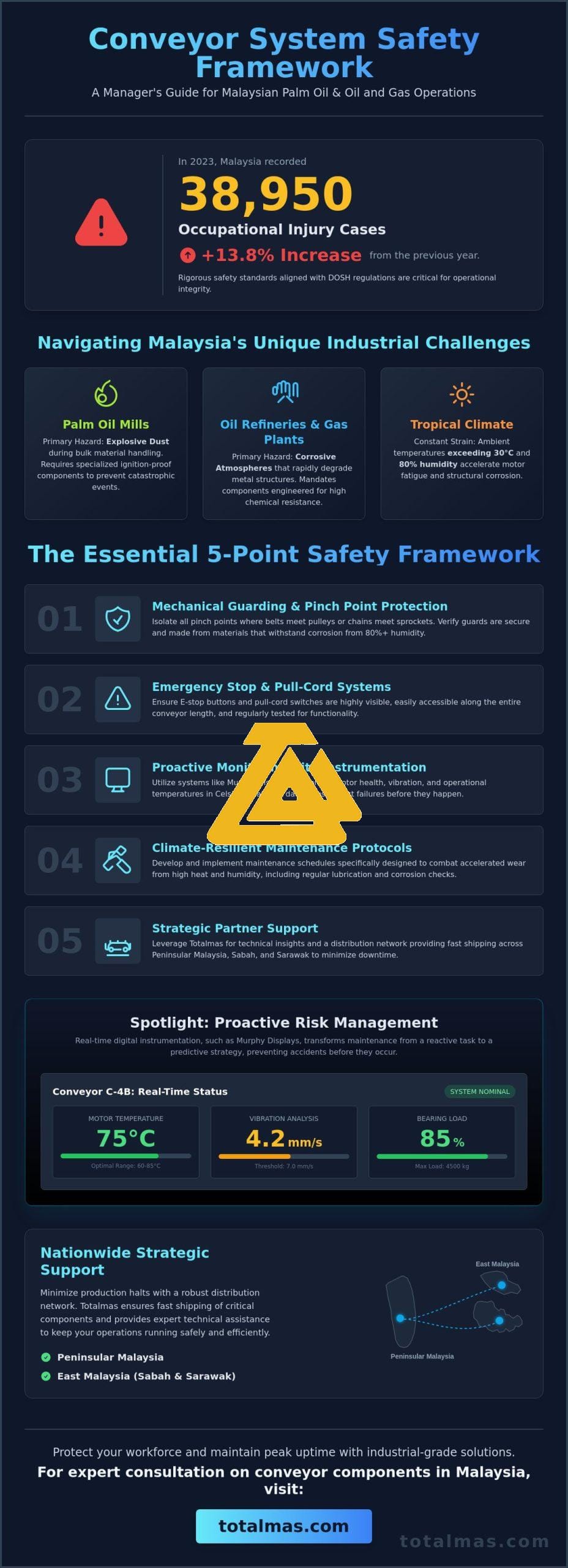
Did you know that Malaysia recorded 38,950 occupational injury cases in 2023, which is a 13.8% increase from the previous year? For factory managers in the palm oil and oil and gas sectors, these figures highlight the critical need for rigorous operational standards. Prioritizing industrial conveyor system safety is a complex task, particularly when tropical humidity and heavy-duty cycles combine to accelerate equipment fatigue and maintenance requirements.
You’re likely focused on balancing production targets with the safety of your workforce. This article provides a comprehensive framework to help you navigate these challenges and achieve a zero-accident workplace culture. We’ll preview essential mechanical safeguards, electronic monitoring solutions, and compliance strategies for Department of Occupational Safety and Health (DOSH) regulations. By incorporating technical insights from Totalmas and ensuring reliable support across Peninsular and East Malaysia, including Sabah and Sarawak, you can maintain peak uptime and protect your team effectively.
Key Takeaways
- Understand how DOSH regulations and multi-layered protection strategies form the foundation of safety for palm oil and oil and gas facilities.
- Implement a 5-point checklist for industrial conveyor system safety that addresses critical mechanical safeguards and emergency stop visibility.
- Transition to proactive risk management by utilizing Murphy Displays for real-time monitoring of motor health and operational temperatures in Celsius.
- Develop maintenance protocols specifically designed to counter the effects of 80% humidity and high-temperature tropical environments on material handling equipment.
- Access technical insights from Totalmas and leverage a distribution network that ensures fast shipping and support across Peninsular Malaysia, Sabah, and Sarawak.
Understanding Conveyor Safety in the Malaysian Industrial Context
Industrial conveyor system safety represents more than a collection of physical guards. It’s a multi-layered strategy designed to protect personnel while maintaining the rigorous flow of production. In Malaysia, where industrial output often relies on high-volume material handling, a single mechanical failure can lead to catastrophic downtime or severe injury. Effective safety protocols integrate mechanical barriers with electronic monitoring to create a resilient operational environment that thrives despite heavy-duty demands. This approach ensures that safety isn’t a hurdle to production but a foundational element of a zero-accident workplace culture.
The Regulatory Landscape: DOSH and JKKP Compliance
The Department of Occupational Safety and Health (DOSH), or Jabatan Keselamatan dan Kesihatan Pekerjaan (JKKP), serves as the primary authority overseeing plant safety. The Factories and Machinery Act 1967 remains a cornerstone for conveyor operations, requiring that all material handling equipment Malaysia meets stringent design and maintenance standards. Managers must conduct regular safety audits to verify the integrity of their systems. Standardized reporting for near-misses and equipment failures is essential. These records don’t just satisfy government inspectors; they help identify systemic weaknesses before a 500 kg load causes a workplace accident. Compliance with these regulations ensures your plant remains operational and legally protected.
Sector-Specific Hazards: From Palm Oil Mills to Oil Refineries
Malaysian industries face unique environmental challenges that complicate safety management. Palm oil mills must manage explosive dust hazards during bulk material handling, requiring specialized ignition-proof components. In contrast, oil refineries and chemical processing plants deal with corrosive atmospheres that rapidly degrade metal structures. Ambient temperatures frequently exceed 30°C, which places immense strain on motor longevity and belt integrity. Conveyor belt safety systems must be robust enough to withstand these tropical conditions without failing. Totalmas provides deep technical insights into selecting components that are specifically engineered to thrive in these harsh Malaysian climates.
Safety is a direct driver of operational efficiency. A well-guarded and monitored system is inherently easier to maintain because it encourages a disciplined approach to equipment health. When critical components require replacement, the geographical spread of Malaysia can create logistical hurdles. Totalmas addresses this challenge with a distribution network that covers Peninsular Malaysia and East Malaysia, including Sabah and Sarawak. Fast shipping of spare parts and the availability of technical assistance ensure that your industrial conveyor system safety standards are maintained without causing extended production halts. Prioritizing these safety frameworks protects your most valuable asset: your people.
The Essential 5-Point Conveyor Safety Checklist
Implementing a robust framework for industrial conveyor system safety requires moving beyond general observations to specific, technical inspections. For Malaysian plant managers, this checklist serves as a practical guide to identifying vulnerabilities before they escalate into operational failures. Whether you’re overseeing a palm oil refinery or an oil and gas processing facility, these five pillars ensure your material handling equipment remains compliant and reliable.
Mechanical Guarding and Pinch Point Protection
The first line of defense is physical isolation. Every pinch point, where a belt meets a pulley or a chain engages a sprocket, must be enclosed. Inspections should focus on the integrity of pulley guards, side screens, and under-panelling. In high-vibration environments common in Malaysian mills, fasteners often loosen over time. It’s vital to verify that all guard mountings are secure and that the materials used can withstand the impact of a snapped belt or a stray 10 kg palm kernel cluster. Modern guarding should allow for visual inspection of the internal components without requiring full removal, reducing the risk of technicians bypassing safety protocols for quick checks. If your current barriers are showing signs of corrosion due to 80% humidity levels, you may need to consult Totalmas expertise in conveyor components for more resilient material options.
Emergency Stops and Pull-Cord Switches
A safety system is only as effective as its accessibility during a crisis. Emergency stop (E-stop) buttons and pull-cord switches must be visible and reachable from any point along the line. Adhering to OSHA conveyor safety regulations, E-stops should generally be placed every 10 to 15 meters. For long-distance bulk handling systems, pull-cord switches provide a continuous safety interface. Regular testing protocols must ensure that a single activation triggers an immediate, line-wide shutdown through the central control panel. This prevents the “cascading” effect where upstream equipment continues to dump material onto a stopped section, creating further hazards and complex cleanup tasks.
The final three points of the checklist address the broader operational environment. Electrical and fire safety focus on preventing motor overheating, especially when ambient temperatures exceed 30°C. Ergonomic design reduces physical strain during manual loading or sorting phases, which is essential for maintaining long-term worker health. Finally, signage and training must be standardized. Visual warnings should be clear and multilingual to accommodate the diverse Malaysian workforce. To maintain these standards across your entire operation, Totalmas offers comprehensive support and technical assistance. Our distribution network ensures that critical safety components reach plants in Peninsular Malaysia and East Malaysia, including Sabah and Sarawak, without the delays that often compromise industrial conveyor system safety.
Advanced Monitoring: Using Instrumentation to Prevent Accidents
While mechanical guards provide a physical barrier, digital instrumentation acts as an early warning system. Many plants in the palm oil and oil and gas sectors still rely on reactive maintenance, waiting for a belt to snap or a motor to smoke before taking action. Moving toward proactive industrial conveyor system safety means integrating sensors that provide real-time data. This shift allows managers to intervene before a minor misalignment becomes a major workplace hazard. By moving beyond physical barriers, you create a responsive environment where equipment health is visible at all times.
Real-Time Visibility with Murphy Displays
Murphy Displays provide a centralized interface for monitoring critical engine and motor parameters. By tracking RPM and operating temperatures in Celsius, operators can detect the subtle signs of friction or overwork that precede a mechanical failure. These displays can be configured to trigger alarms for abnormal vibration or belt slippage, which are common issues in high-humidity Malaysian environments where 80% moisture levels are standard. This digital oversight significantly reduces the need for manual inspections in high-risk zones, such as elevated galleries or enclosed pits. Adhering to Conveyor guarding and maintenance standards becomes more efficient when you have a digital record of equipment health.
Pressure and Flow Monitoring for Bulk Handling
Consistent material throughput is essential for both efficiency and safety. Utilizing high accuracy flow meters allows engineers to monitor the volume of material on the belt in real-time. A sudden load spike, perhaps caused by a blockage in a hopper or a surge in palm fruit bunches, can lead to belt snapping or motor fires. By integrating these sensors with Enovation Controls, the system can execute an automated safety shutdown the moment a parameter exceeds safe limits. This automation is a critical component of industrial conveyor system safety, ensuring that human error doesn’t lead to equipment damage or injury. Plants looking to reduce manual handling errors and labor dependency can also explore how a trusted Mec Handling equipment supplier Malaysia relies on can help transition operations toward custom automation solutions.
Partnering with a seasoned industrial instrumentation supplier Malaysia like Totalmas ensures that your safety protocols are backed by proven technology. We understand that technical support is vital, especially for plants in East Malaysia where lead times can be a concern. Our distribution network is designed to provide fast shipping and expert assistance across Peninsular Malaysia, Sabah, and Sarawak. This comprehensive support ensures that your instrumentation remains calibrated and functional, providing a reliable layer of protection for your workforce and your equipment.
Maintenance Protocols for the Malaysian Tropical Climate
Malaysian industrial environments present a specific set of challenges for material handling systems. With average humidity levels often exceeding 80%, the risk of atmospheric corrosion is a constant threat to structural integrity. Ensuring industrial conveyor system safety in these conditions requires a maintenance schedule that accounts for accelerated wear and tear. Tropical climates don’t just affect worker comfort; they degrade machinery at a faster rate than in temperate regions. It’s essential to implement protocols that prioritize the longevity of your components to avoid sudden mechanical failures.
Corrosion Control and Material Integrity
Atmospheric moisture and salt spray in coastal industrial zones, such as those in Port Klang or Bintulu, can compromise steel supports within months. You should inspect structural components and rollers for rust every 30 days. For oil and gas processing environments, selecting chemical-resistant materials is a necessity rather than an option. Protective coatings can extend equipment life, but they must be checked for chips or peeling that expose the underlying metal. In the palm oil industry, the combination of high humidity and oily residues creates a sludge that can seize rollers or cause belt slippage. Regular cleaning protocols are required to prevent this buildup from creating dangerous operational imbalances.
Motor and Drive Train Cooling
Ambient temperatures in Malaysian plants frequently remain above 30°C, which places immense thermal stress on conveyor motors. Adequate airflow is vital. Dust buildup on motor housings acts as an unintended layer of insulation, trapping heat and increasing the risk of fire. You must ensure that cooling fans are clear and that any heat exchangers are operating at peak efficiency. Monitoring lubrication levels is equally critical. High-temperature environments require specific grease types that don’t thin out or oxidize rapidly. If your lubrication fails, the resulting friction can lead to a motor seize, which is a primary cause of industrial conveyor system safety incidents.
Investing in high-quality hardware is the most effective way to reduce maintenance frequency. Heavy duty conveyor systems Malaysia operations rely on are specifically engineered to handle the heavy loads and harsh conditions found in Malaysian mills and refineries. These systems integrate better with advanced monitoring tools, allowing you to track equipment health before a failure occurs. To ensure your plant remains compliant and safe, you need a partner who understands these regional challenges. Totalmas provides the technical expertise and high-performance components required to keep your operations running smoothly. Our distribution network ensures fast shipping and dedicated technical assistance across Peninsular Malaysia, Sabah, and Sarawak. Contact Totalmas today to optimize your conveyor maintenance strategy and protect your operational uptime.
Strategic Support: Fast Shipping and Technical Assistance in Malaysia
Maintaining industrial conveyor system safety requires more than a checklist; it demands a reliable supply chain and technical expertise. In the high-stakes environments of Malaysian palm oil mills and oil refineries, waiting weeks for a critical safety component isn’t an option. Downtime often leads to improvised repairs that compromise the entire safety framework. Selecting a partner who understands the nuances of bulk material handling equipment is essential for long-term operational success. Totalmas serves as this steady hand, bridging the gap between technical requirements and logistical realities.
East Malaysia Support: Sabah and Sarawak Logistics
Factory managers in East Malaysia frequently face longer lead times compared to their counterparts in Peninsular Malaysia. Totalmas addresses this geographical challenge by managing regional inventory specifically for rapid response. Whether your facility is located near Bintulu or deep within the palm oil corridors of Sabah, reducing lead times for critical safety components is our priority. We understand that a failed pull-cord switch or a malfunctioning sensor in a remote site can halt production for days. Our distribution network ensures that technical support and essential parts reach Sabah and Sarawak promptly. This commitment includes the availability of on-site technical consultations for specialized systems, ensuring that distance never compromises your plant safety.
Technical Consultation and Safety Training
Hardware is only effective if your team knows how to use it. Totalmas provides comprehensive operator training on Murphy Displays and Enovation Controls to ensure your staff can interpret digital data correctly. We help customize safety instrumentation for unique plant layouts, ensuring that every 10 to 15 meters of your conveyor line is adequately protected. This proactive approach prevents accidents before they occur. It’s not just about selling parts; it’s about a long-term partnership that prioritizes your zero-accident workplace culture.
You can contact Totalmas for a comprehensive safety instrumentation audit. We evaluate your current setup, from motor heat monitoring in Celsius to the placement of emergency stops. Our team provides actionable insights that align with Malaysian DOSH regulations while optimizing your uptime. By integrating high-quality components with expert guidance, you ensure that industrial conveyor system safety remains a constant in your facility. We remain committed to supporting the Malaysian industrial sector with proven reliability and functional success, regardless of the complexity of your material handling requirements.
Securing Your Plant’s Operational Future
A zero-accident workplace culture isn’t achieved through luck; it’s built on a foundation of robust mechanical guarding and advanced digital monitoring. This approach ensures your facility remains resilient against the unique challenges of the Malaysian climate, where high humidity and temperatures often exceeding 30° Celsius accelerate equipment wear. Prioritizing industrial conveyor system safety protects your most valuable assets while maintaining the steady flow of production in the palm oil and oil and gas sectors.
Totalmas brings over 33 years of industrial experience to your operation as an authorized distributor for Murphy and Enovation Controls. Our nationwide distribution network is designed for fast shipping and technical assistance, covering both Peninsular Malaysia and East Malaysia. Whether your plant is in the industrial hubs of the Klang Valley or the remote regions of Sabah and Sarawak, we provide the steady hand and technical expertise you need to stay compliant with DOSH regulations.
Take the next step in optimizing your material handling framework. Consult with Totalmas for Your Conveyor Safety and Instrumentation Needs and ensure your equipment continues to perform at its peak. We’re here to help you build a safer, more efficient future.
Frequently Asked Questions
What are the most common conveyor hazards in Malaysian factories?
Entanglement at pinch points, belt slippage due to high humidity, and combustible dust in palm oil mills are the primary risks. In the oil and gas sector, corrosive atmospheres can weaken structural supports, leading to unexpected collapses or mechanical failures. Ensuring proper guarding and regular cleaning of oily residues is essential for maintaining industrial conveyor system safety.
Does DOSH require specific safety guards for all industrial conveyors?
Yes, the Department of Occupational Safety and Health (DOSH) enforces the Factories and Machinery Act 1967, which mandates the guarding of all dangerous moving parts. This includes pulleys, drive chains, and shear zones. Regular audits are necessary to ensure that your material handling equipment remains compliant with these local statutory requirements to avoid fines and operational shutdowns.
How often should I test the emergency pull-cords on a long-distance conveyor?
You should perform functional tests on emergency pull-cords at least once a month. This ensures that the switches are responsive and that the signal correctly reaches the central control panel for an immediate shutdown. For systems spanning several kilometers, these tests help identify cable tension issues caused by tropical heat expansion before an actual emergency occurs.
Can Murphy Displays be integrated into existing conveyor control systems?
Murphy Displays are designed for high compatibility and can be retrofitted into most existing industrial control frameworks. They provide a digital interface for monitoring motor RPM and operating temperatures in Celsius, allowing operators to spot trends that lead to mechanical failure. Integrating these displays reduces the need for manual, high-risk inspections in hazardous plant areas.
What is the impact of high humidity on conveyor belt safety and tension?
Humidity levels exceeding 80% often lead to surface condensation on pulleys, which causes belt slippage and inconsistent tension. This moisture also accelerates the corrosion of metal rollers and fasteners, increasing the risk of a snapped belt. Totalmas recommends using moisture-resistant components and frequent tension checks to mitigate these tropical environmental challenges.
How does Totalmas support industrial plants in Sabah and Sarawak?
Totalmas provides dedicated support to East Malaysia through a distribution network that prioritizes fast shipping of critical spare parts. We maintain regional inventory to reduce lead times for plants in Sabah and Sarawak, ensuring that safety components are always available. Our technical assistance teams are also available for on-site consultations to solve complex material handling issues in remote locations.
Are there specific fire safety standards for bulk material handling in the palm oil industry?
While general fire safety codes apply, palm oil mills must specifically manage the risk of combustible dust and fiber ignition. Motor temperatures must be strictly monitored in Celsius to prevent overheating in dusty environments. Using Enovation Controls for automated thermal shutdowns is a proven method to reduce fire risks during high-volume material processing.
What is the benefit of using Enovation Controls for automated safety shutdowns?
Enovation Controls provide a proactive safety layer by automatically halting operations when sensors detect abnormal pressure, flow, or temperature. This prevents a single component failure from cascading into a plant-wide disaster or causing serious injury. By removing the reliance on human reaction time, you significantly enhance the overall industrial conveyor system safety within your facility.