
Operating a pressure vessel without a valid Certificate of Fitness can result in fines of up to RM100,000 under the 2024 DOSH regulations. For a factory manager in the palm oil or oil and gas sectors, these regulatory pressures are compounded by the technical reality of Malaysia’s tropical climate. High humidity often leads to drifting signals and inaccurate readings in your instrumentation. You understand that a single failure doesn’t just halt production; it compromises the safety of your entire facility. This guide helps you master the selection and maintenance of a differential pressure transmitter to ensure your operations remain both efficient and compliant.
We’ll examine the technical principles of the SmartMeasurement ALDPT series and its role in meeting MSPO 2.0 standards and PETRONAS technical requirements. You’ll learn how to navigate the complex selection process for hazardous environments and where to find dependable technical support. Whether your plant is in the Klang Valley or a remote site in Sabah or Sarawak, Totalmas provides the insights and fast shipping necessary for long term operational success. We’ve structured this information to serve as a practical resource for optimizing your process efficiency through proven industrial solutions.
Key Takeaways
- Master Bernoulli’s Principle to precisely determine pressure differentials using orifice plates.
- Explore specialized applications for flow and level measurement tailored to the unique operational demands of Malaysian palm oil mills and refineries.
- Evaluate critical selection factors like turndown ratios and repeatability to maintain performance in harsh conditions.
- See why integrating a differential pressure transmitter with Murphy Displays improves your facility’s real-time monitoring capabilities.
- Rely on Totalmas for technical insights and fast shipping that reaches every corner of Peninsular Malaysia, Sabah, and Sarawak.
What is a Differential Pressure Transmitter? Essential Principles
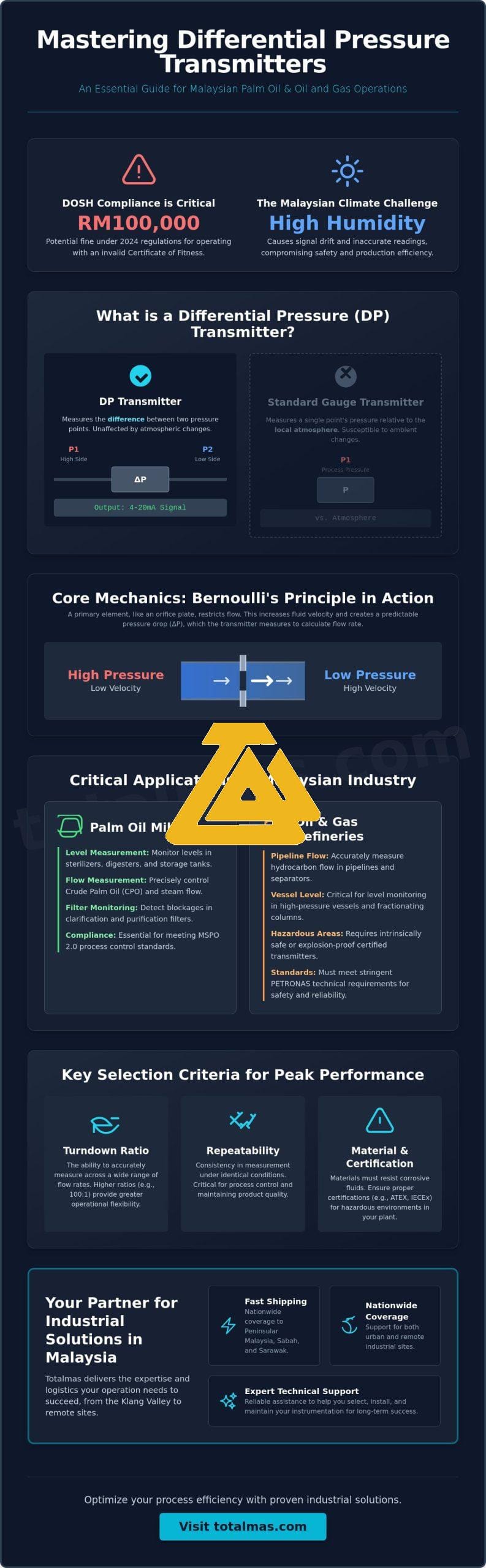
A differential pressure transmitter serves as a cornerstone of industrial automation, particularly within the demanding environments of Malaysian oil refineries and palm oil mills. At its core, this device measures the variance between two distinct pressure points in a process. While a standard gauge transmitter measures pressure relative to the atmosphere, the differential model focuses on the delta between a High Side and a Low Side connection. This calculation allows factory managers to monitor everything from filter blockages to fluid flow rates with high precision.
The internal sensing element detects this physical pressure difference and converts it into a standardized electrical output signal, usually 4-20mA. This signal is then transmitted to a control system or a Murphy Display for real-time monitoring. For Malaysian operations, the differential pressure transmitter is often preferred over standard gauge pressure because it remains unaffected by changes in ambient atmospheric pressure. It offers a more versatile solution for complex setups where calculating the relationship between two points is more critical than knowing the absolute pressure of one.
Basic Units of Measurement in Malaysian Industry
Technical accuracy in Malaysia requires strict adherence to the Metric system. While legacy equipment might still reference PSI, modern standards across Peninsular and East Malaysia have shifted toward Bar and Kilopascal (kPa). Temperature compensation is equally vital; transmitters must be calibrated to handle process temperatures measured in Celsius. In high-pressure refinery environments, even a minor deviation in accuracy can lead to significant safety risks or product loss. Reliable instrumentation ensures that your facility meets local DOSH standards while maintaining peak efficiency.
The Evolution of Pressure Instrumentation
Industrial monitoring has moved far beyond simple mechanical gauges. Modern plants now utilize digital high temperature pressure transmitters that offer superior stability and diagnostic capabilities. These smart transmitters often incorporate HART or PROFIBUS protocols, allowing for seamless integration with factory-wide SCADA systems. Totalmas supports this digital transition by providing advanced hardware and technical assistance. Whether you’re located in the industrial hubs of Selangor or remote areas of Sabah and Sarawak, access to fast shipping and expert support ensures your instrumentation stays online and accurate.
The Mechanics of Measurement: Primary Elements and Bernoulli’s Principle
Measuring flow and level accurately depends on the interaction between physics and precision engineering. A differential pressure transmitter doesn’t work in isolation; it requires a primary element to create a measurable physical change in the process stream. This change is governed by Bernoulli’s Principle, which states that as the velocity of a fluid increases, its pressure decreases. By placing a restriction in the pipe, we create a predictable pressure drop. The transmitter then measures the difference between the upstream and downstream pressure to calculate the flow rate or liquid level.
The internal pressure transducer acts as the secondary element, converting the physical force of the fluid into a reliable 4-20mA electrical signal. Because the relationship between flow and differential pressure is non-linear, square root extraction is a critical step in the measurement process. Most modern transmitters perform this calculation internally to provide a linear output that corresponds directly to the flow rate. This ensures your control system receives accurate data for process optimization and safety monitoring.
Common Primary Elements: Orifice Plates and Flanges
In Malaysian palm oil refineries and chemical plants, orifice plates remain the industry standard for cost-effective flow measurement. These plates must be constructed from materials capable of resisting corrosive fluids and high-velocity wear. Precision is vital; even a minor burr on the orifice edge can lead to significant measurement errors. Totalmas supplies precision-engineered orifice flanges that meet stringent industrial standards, ensuring long-term reliability for your facility. If you’re upgrading your piping systems, consider consulting with the team at Totalmas for integrated measurement solutions.
Diaphragm Seals and Capillary Systems
Certain processes in the oil and gas sector involve high temperatures or highly viscous media that could damage a transmitter’s internal components. In these cases, diaphragm seals and capillary systems provide a necessary barrier. These systems use a flexible diaphragm to isolate the transmitter from the process media, transferring pressure through a fill fluid. It’s essential to account for capillary length, as longer runs can slightly increase response times. For installations across Peninsular Malaysia or remote sites in Sabah and Sarawak, choosing the right seal configuration is key to preventing downtime.
Reliable technical assistance is a hallmark of the Totalmas service model. We understand that getting parts to East Malaysia quickly is a priority for factory managers. Our distribution network is designed for fast shipping, ensuring that critical components like diaphragm seals and orifice plates reach your site without unnecessary delays. This commitment to logistics supports the operational realities of managing industrial plants in diverse geographical locations.
Critical Applications in Malaysia: Oil & Gas and Palm Oil Sectors
In the Malaysian industrial landscape, the differential pressure transmitter is more than a measurement tool; it’s a vital component for safety and regulatory compliance. Whether you’re managing one of Malaysia’s 451 palm oil mills or an offshore platform, precise data ensures operational continuity. These devices excel in flow measurement by monitoring gas and liquid throughput across upstream and downstream processes. They also provide essential level measurement for closed, pressurized tanks where atmospheric reference isn’t possible.
Beyond flow and level, these transmitters play a defensive role in maintenance. By detecting pressure drops across industrial filtration systems, they identify clogs before they lead to pump cavitation or equipment failure. In advanced chemical separation, they’re used for density and interface measurement, ensuring that distinct fluid layers are accurately identified during processing. This versatility is why DP instrumentation remains a standard requirement for factory managers seeking to optimize their output while adhering to strict local standards.
Optimising Palm Oil Mill Efficiency
For mills working toward MSPO 2.0 (MS 2530:2022) certification, efficiency is a mandatory goal. Differential pressure transmitters are used to monitor boiler steam flow, which is critical for waste heat recovery units and energy management. In the clarification station, measuring pressure drops across tanks helps maintain the quality of crude palm oil. Additionally, these sensors ensure accurate flow in palm oil mill effluent (POME) treatment plants. Accurate monitoring at these stages prevents environmental non-compliance and maximizes the recovery of valuable products.
Safety and Compliance in Oil & Gas
The oil and gas sector demands adherence to rigorous API standards and PETRONAS technical specifications. In these high-stakes environments, DP transmitters are indispensable for flare gas measurement and environmental reporting. They provide the reliable data needed to meet DOSH requirements for pressure vessel safety. Integrating these sensors with Murphy Displays allows for real-time engine and pump status monitoring, giving operators a clear view of process health. This integration helps prevent costly shutdowns and ensures that all equipment operates within safe parameters.
Totalmas understands the geographical challenges of managing facilities across the region. We provide technical assistance and fast shipping that covers both Peninsular Malaysia and East Malaysia. Whether your site is located in the industrial zones of Johor or a remote facility in Sabah or Sarawak, our distribution network ensures you receive the necessary instrumentation and support without delay. This commitment to reliability helps Malaysian factory managers maintain a steady hand on their operations, regardless of their location.
Selection Criteria: Environmental and Technical Considerations
Selecting a differential pressure transmitter for Malaysian industrial sites requires a balance between laboratory precision and field-hardened durability. The high tropical humidity and frequent heavy rainfall across the region present a constant risk of moisture ingress and signal drift. For equipment installed in non-climate-controlled environments, an IP66 or IP67 rating is essential to ensure long-term reliability. These ratings provide the necessary protection against the ingress of dust and high-pressure water jets, which is critical for maintaining operational uptime during the monsoon seasons.
Technical performance is defined by accuracy and repeatability. Accuracy ensures the measurement is close to the true value, while repeatability ensures the transmitter provides the same reading under identical conditions over time. Another vital factor is the turndown ratio, which describes the range over which the device can maintain its specified accuracy. A higher turndown ratio allows a single transmitter to handle a wider variety of process conditions without needing recalibration or replacement, providing greater flexibility for fluctuating production lines in palm oil mills. When evaluating your procurement options, working with a qualified industrial pressure transmitter supplier who understands both the technical specifications and the logistical realities of Malaysian operations can significantly reduce the risk of costly downtime.
Material Compatibility and Corrosion Resistance
Aggressive process media in chemical plants and refineries demand careful selection of wetted parts. Standard 316L stainless steel is often sufficient, but highly corrosive fluids may require Hastelloy or Monel to prevent premature failure. In specialized oil and gas applications, hydrogen permeation can degrade sensor performance, necessitating gold-plated diaphragms. Managers often use high accuracy flow meters alongside DP transmitters to provide redundant verification and ensure data integrity. Selecting the right materials from the start prevents costly emergency shutdowns and environmental leaks.
Temperature Compensation and Static Pressure Limits
Ambient temperature fluctuations in Malaysian factories, which often range from 25°C to 38°C, can impact sensor electronics. Modern transmitters utilize internal temperature compensation to maintain stability across these shifts. You must also account for “Static Pressure Shift,” where the high line pressure in a pipe causes the transmitter’s zero-point to move. For 2026, standardizing your calibration intervals based on these environmental stressors is a best practice for maintaining peak performance. Proper commissioning ensures that these physical variables don’t compromise your process control.
Reliable technical support is essential when navigating these complex selection criteria. Totalmas provides expert guidance and a comprehensive distribution network that covers Peninsular Malaysia, Sabah, and Sarawak. Our commitment to fast shipping means you don’t have to wait weeks for critical instrumentation or spare parts. If you’re looking to optimize your facility’s measurement accuracy, contact the experts at Totalmas for a professional consultation tailored to your specific operational landscape.
Totalmas Solutions: Technical Support and Distribution in Malaysia
Selecting the right hardware is only half the battle for a factory manager. Long-term operational success depends on having a technical partner who understands the Malaysian industrial landscape. Totalmas has established itself as a specialized supplier of industrial instrumentation and Murphy Displays, bridging the gap between advanced technology and practical factory needs. We maintain a robust local inventory to ensure that when a critical component like a differential pressure transmitter requires replacement, your downtime is measured in hours rather than weeks. This commitment to local stock availability is what sets us apart as a reliable partner for your facility’s maintenance needs.
Our distribution network is designed to handle the unique geographical challenges of the region. We provide on-site technical assistance and professional consultation for complex instrumentation setups, ensuring that your equipment is commissioned correctly from day one. By choosing a partner with deep roots in the local sector, you gain access to a steady hand that can navigate the nuances of Malaysian regulatory compliance and operational stressors. We don’t just sell products; we provide the technical foundation required for sustained process efficiency and safety.
Expert Consultation for Industrial Automation
With over 33 years of experience, our team has solved unique challenges across Malaysia’s most demanding sectors. We provide customized solutions for bulk material handling and waste heat recovery units (WHRU), ensuring that every sensor contributes to your facility’s bottom line. Our engineers guide you on how to integrate pressure sensors for industrial automation effectively, moving your plant toward a more digital and efficient future. This expertise allows us to troubleshoot issues that generic providers might overlook, such as the specific impact of tropical heat on signal stability.
Fast-Track Logistics for Remote Regions
Many global providers overlook the logistical hurdles of supporting East Malaysia. Totalmas has built a dedicated support network for the industrial hubs in Bintulu, Miri, and Kota Kinabalu. We prioritize fast-track logistics to ensure that critical instrumentation reaches Sabah and Sarawak with the same efficiency as our Peninsular clients. Whether you’re operating a palm oil mill in the interior or an offshore platform, our distribution network is designed to keep your processes running without delay. Contact Totalmas today for a professional consultation on your pressure measurement needs and experience the reliability of a seasoned industrial partner.
Securing Your Factory’s Operational Future
Maintaining a competitive edge in the Malaysian industrial sector requires more than just high-quality equipment; it demands a deep understanding of how variables like tropical humidity and static pressure shift affect your instrumentation. Throughout this guide, we’ve explored how a correctly specified differential pressure transmitter serves as the backbone for accurate flow and level measurement in your facility. By prioritizing material compatibility and adhering to the latest 2024 DOSH regulations, you ensure both process efficiency and mandatory safety compliance.
Totalmas supports your operational goals with over 33 years of industrial experience and a specialized inventory. As an authorized distributor for Enovation Controls and Murphy Displays, we offer the technical depth required to solve complex automation challenges. Our commitment to fast shipping and on-site assistance covers every region, providing reliable support for plants in Peninsular Malaysia as well as remote operations in Sabah and Sarawak. We invite you to Contact Totalmas Sdn Bhd for Expert Industrial Instrumentation Support to discuss your specific measurement requirements. Let’s work together to build a stable, efficient, and safe industrial environment for your business.
Frequently Asked Questions
What is the difference between gauge pressure and differential pressure?
Gauge pressure measures force relative to the local atmospheric pressure, while differential pressure measures the difference between two specific pressure points in a process. In a differential pressure transmitter, this is calculated as the delta between the high side and low side ports. This distinction is vital for flow and level applications where atmospheric fluctuations would otherwise introduce measurement errors into your control system.
Can a differential pressure transmitter be used for level measurement in an open tank?
You can use a differential pressure transmitter for level measurement in an open tank by venting the low side port to the atmosphere. The high side port connects to the bottom of the tank to measure the hydrostatic head of the liquid. This method provides a reliable reading of the liquid height based on the fluid density, which is a common practice in palm oil mill storage tanks.
Why is the 4-20mA signal standard for industrial pressure transmitters?
The 4-20mA signal is the industry standard because it’s highly resistant to electrical noise and allows for long cable runs without signal loss. It also provides a live zero, where a 4mA reading indicates a functioning sensor at zero pressure, while 0mA signals a loop failure. This reliability is essential for maintaining safety standards in Malaysian refineries and chemical processing plants where signal integrity is paramount.
How often should I calibrate my differential pressure transmitter in a tropical climate?
Most industrial standards recommend calibrating transmitters every 6 to 12 months, though the harsh Malaysian climate may require more frequent checks. High ambient temperatures, often exceeding 35 Celsius, and extreme humidity can cause electronic components to drift over time. Regular verification ensures that your instrumentation remains within the accuracy limits required by DOSH and international safety protocols for high pressure environments.
What is an orifice plate, and why is it used with DP transmitters?
An orifice plate is a thin metal plate with a precisely machined hole placed within a pipe to create a deliberate pressure drop. When used with a transmitter, this restriction allows for the calculation of flow rates based on Bernoulli’s Principle. It’s a cost effective and proven primary element used extensively for steam and water flow monitoring in palm oil mills across Peninsular and East Malaysia.
Does Totalmas provide technical support for DP transmitters in Sarawak?
Totalmas provides comprehensive technical support and distribution services across all of Sarawak, including major industrial hubs like Bintulu and Miri. We understand the importance of minimizing downtime, so we offer fast shipping and on site assistance for our entire range of instrumentation. Our network ensures that factory managers in East Malaysia receive the same level of expert partnership as those in Peninsular Malaysia.
What hazardous area certifications are required for O&G plants in Malaysia?
Malaysian oil and gas facilities typically require instrumentation with ATEX or IECEx certifications for hazardous environments. These standards ensure that the equipment is designed to prevent ignition in the presence of flammable gases or dust. Adhering to these certifications is a critical part of meeting PETRONAS technical standards and ensuring the safety of personnel operating in Zone 0, 1, or 2 areas onshore and offshore.
How does humidity affect the electronics of a pressure transmitter?
High humidity can cause moisture to ingress into the transmitter housing, leading to terminal corrosion and potential short circuits. This environmental stress often results in signal drift or erratic readings that compromise process control. Choosing instrumentation with high IP ratings and ensuring proper seal maintenance is vital for protecting sensitive electronics from the operational realities of the Malaysian tropical landscape and avoiding costly emergency repairs.