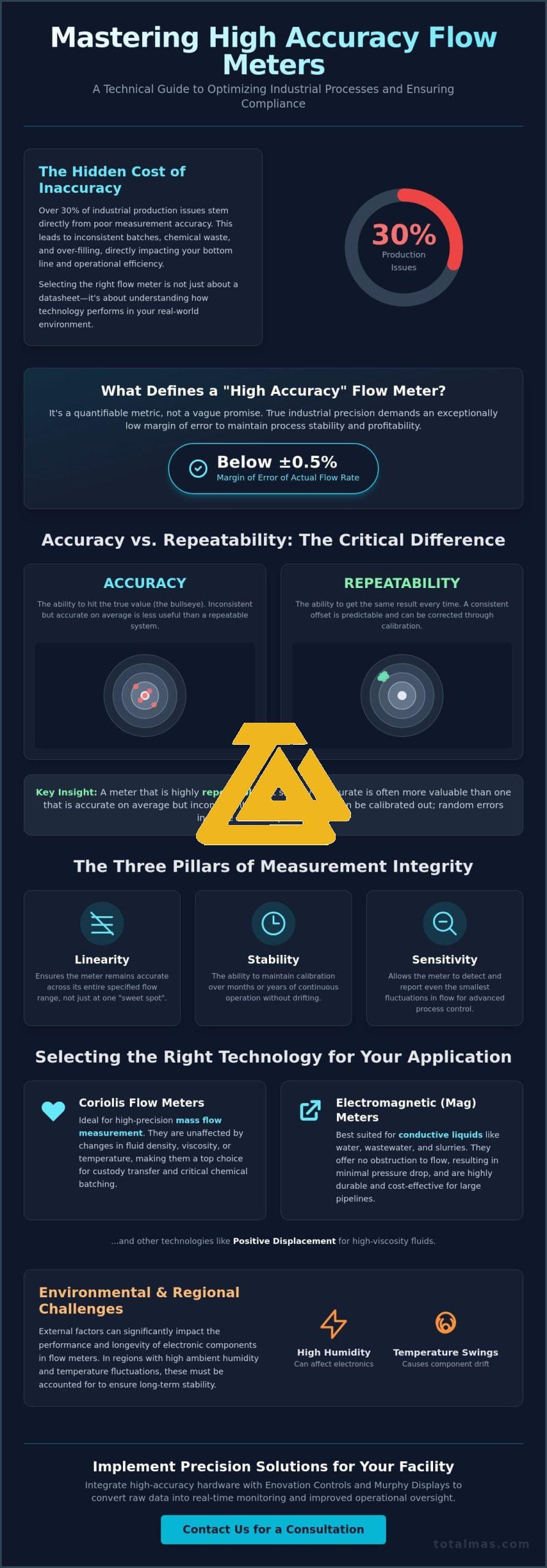
Did you know that over 30% of industrial production issues stem directly from poor measurement accuracy? It’s a common frustration for engineers who see inconsistent batch results despite installing equipment labeled as precise. You’ve likely dealt with the rising costs of chemical waste or over-filling that occur when a device fails to perform under real-world conditions. Selecting high accuracy flow meters involves more than just glancing at a datasheet. It requires a technical understanding of how different technologies behave in your specific environment.
We understand that reliability is the foundation of your operations. This guide will help you master the nuances of accuracy and repeatability to optimize your processes and protect your bottom line. We provide a structured framework for choosing between technologies like Coriolis, magnetic, and positive displacement meters. You’ll also learn how to align your equipment with international standards and local requirements, such as the Environmental Quality (Industrial Effluent) Regulations 2009. This ensures your facility remains compliant, efficient, and profitable through tighter process control.
Key Takeaways
- Identify the technical threshold for high accuracy flow meters, which typically requires a margin of error below ±0.5% to maintain industrial process stability.
- Distinguish between accuracy and repeatability using the target analogy to determine which metric is more critical for your plant’s calibration and corrective actions.
- Evaluate specific technologies like Coriolis for mass flow precision or Electromagnetic meters for conductive liquids to ensure the hardware matches your fluid dynamics.
- Account for regional environmental challenges, such as high ambient humidity and temperature fluctuations, which can impact the performance of electronic transmitters.
- Integrate precision measurement hardware with Enovation Controls and Murphy Displays to convert raw data into real-time monitoring and improved operational oversight.
What Defines a High Accuracy Flow Meter?
In industrial engineering, accuracy isn’t a vague concept of “good enough.” It is a specific, quantifiable metric representing the maximum deviation between a meter’s reading and the true value of the fluid passing through it. While general-purpose devices might offer a wide range of tolerances, high accuracy flow meters are typically defined by a margin of error below ±0.5% of the actual flow rate. Achieving this level of precision requires a deep understanding of flow measurement principles and how they interact with fluid dynamics in a piping system.
Measurement traceability is essential for maintaining trust in industrial data. In Malaysia, the National Metrology Institute of Malaysia (NMIM) serves as the authoritative body for establishing and maintaining these measurement standards. When you select a meter, you’re not just buying a sensor; you’re investing in a system that aligns with national and international benchmarks. This alignment ensures that your data is defensible during audits and reliable for critical process decisions.
The financial implications of these specifications are significant. High-precision instruments directly impact your return on investment by minimizing operational waste. For example, a small 0.2% error in a high-volume production line can result in thousands of liters of “product giveaway” over a year. By tightening these tolerances, plants can reduce chemical over-dosing and ensure that every liter of output is accounted for accurately.
The Three Pillars of Measurement Integrity
True precision relies on three technical characteristics. First is linearity, which ensures the meter remains accurate across its entire specified flow range rather than just at a single “sweet spot.” Second is stability. This is the device’s ability to maintain its calibration over months or years of continuous operation without drifting. Finally, sensitivity allows the meter to detect and report even the smallest fluctuations in flow rate, providing the granular data needed for advanced process control.
Why Accuracy Matters in Malaysian Industry
Precision is a requirement for sectors like palm oil processing and chemical batching. In these environments, even slight deviations can compromise product quality or lead to expensive batch failures. Beyond internal quality control, high accuracy flow meters are vital for custody transfer and fiscal metering. When fluids change ownership, the measurement must be beyond reproach to satisfy legal and commercial obligations. This level of control helps Malaysian manufacturers stay competitive by reducing unnecessary costs and meeting stringent regulatory standards for industrial discharge and resource management. Working with a qualified industrial flow meter supplier Malaysia ensures that your procurement decisions are backed by local technical expertise and compliance with SIRIM standards.
Accuracy vs. Repeatability: Understanding the Critical Difference
Engineers often use the terms accuracy and repeatability interchangeably, but they describe two distinct performance characteristics. To visualize the difference, consider a target. Accuracy is the ability to hit the bullseye. Repeatability is the ability to hit the same spot every single time, even if that spot isn’t the center. In industrial processes, a meter that is repeatable but slightly inaccurate is often more useful than one that is accurate on average but inconsistent. This is because a consistent offset can be corrected through calibration, whereas erratic behavior indicates a fundamental lack of control. High-quality data from NIST on flow meter accuracy emphasizes that establishing a baseline of repeatability is the first step toward true precision.
External variables like fluid viscosity and temperature fluctuations significantly impact these metrics. When temperature rises, fluid density changes, which can cause a meter to drift if it isn’t designed to compensate for these shifts. Maintaining high accuracy flow meters in a plant environment requires regular verification to ensure that environmental stressors haven’t compromised the device’s consistency. Totalmas assists clients by providing on-site support to calibrate these systems, ensuring both metrics remain within the required tolerances for your specific application.
Percent of Reading (RD) vs. Percent of Full Scale (FS)
Understanding how a manufacturer calculates error is vital for proper selection. Percent of Reading (RD) means the error remains constant relative to the actual flow rate. In contrast, Percent of Full Scale (FS) defines the error based on the meter’s maximum capacity. As the flow rate drops, the “allowable” error in an FS-rated meter becomes a much larger percentage of the actual flow. Reading accuracy is superior for wide-turn-down applications because the error margin doesn’t balloon as flow rates drop toward the bottom of the meter’s range.
When to Prioritise Repeatability Over Absolute Accuracy
There are scenarios where absolute accuracy takes a backseat to consistency. In closed-loop control systems, such as maintaining a steady chemical dose, the controller needs the meter to react the same way every time a valve moves. If the meter is highly repeatable, the process stays stable. Over-specifying absolute accuracy can lead to unnecessary costs without providing a functional benefit to the process. If your goal is long-term stability rather than fiscal billing, focusing on a repeatable solution might be the more efficient path. You can explore our range of reliable flow meters to find a balance that fits your operational needs.
Selecting the Right Technology for Precision Applications
Choosing the right hardware is a fundamental engineering decision that dictates the long-term success of your process. While many options exist on the market, high accuracy flow meters are not one-size-fits-all solutions. Coriolis flow meters represent the gold standard for mass flow accuracy, often reaching ±0.05% of the reading. They measure mass directly rather than volume, which effectively eliminates errors caused by changes in fluid density, pressure, or temperature. For conductive liquids and abrasive slurries, electromagnetic (Mag) meters provide exceptional precision without obstructing the flow path. These devices typically achieve an accuracy within +/- 0.2% in many applications, making them a staple for water treatment and chemical processing.
Ultrasonic transit-time meters offer a sophisticated, non-invasive solution for clean liquids. They maintain high accuracy without introducing a pressure drop, which is a major advantage for energy-intensive systems. This technology is particularly useful for retrofitting projects where shutting down operations to cut pipes is not an option. For steam and high-velocity gas applications, vortex shedding meters provide a reliable and robust choice. When selecting a flowmeter, you must weigh these technological strengths against the physical state of your medium and the specific data requirements of your facility. Facilities planning to modernize their instrumentation should also review our ultimate checklist for selecting a digital flow meter for factories, which covers IoT integration, the NMI R 117:2026 standard, and long-term reliability considerations for 2026 and beyond.
Matching Technology to Fluid Properties
Fluid properties are the primary drivers of meter performance. The Reynolds Number is a critical calculation for any engineer; it determines whether the flow is laminar or turbulent. Sensors like vortex meters rely on specific flow profiles, so they may struggle if the Reynolds Number is too low. Corrosive chemicals present another layer of complexity, requiring careful material selection for internal liners, such as PTFE or PFA, to prevent sensor degradation. In the oil and gas sector, high-viscosity fluids pose a significant challenge for many standard technologies. In these cases, positive displacement meters or Coriolis units are often the preferred choice because their operating principles aren’t as sensitive to the “thickness” of the liquid. Facilities that also manage dry materials alongside liquid streams should consider how bulk material handling equipment integrates with precision flow measurement to create a unified, data-driven production environment.
Installation Factors That Kill Accuracy
Even the most advanced sensor will fail if the installation environment is flawed. Straight pipe runs are a non-negotiable requirement for most high-precision devices. You’ll usually need at least 10 diameters of straight pipe upstream and 5 diameters downstream to ensure a stable, predictable flow profile. If air bubbles or excessive turbulence are present, they’ll distort the sensor readings and lead to the inconsistent batch results that plague many plants. Proper grounding is also essential for electromagnetic flow meters. Without a stable electrical reference point, the tiny micro-volt signals generated by the moving fluid can be easily obscured by electrical noise from nearby motors or pumps.
Environmental Challenges for Flow Meters in Malaysia
Operating precision instrumentation in a tropical climate presents a set of technical hurdles that aren’t always addressed in standard product manuals. In Malaysia, the combination of high ambient humidity and consistent heat can significantly degrade the performance of electronic transmitters over time. Humidity levels often exceeding 80% create a risk of moisture ingress, which can lead to signal drift or total component failure. While high accuracy flow meters are designed for precision, their sensitive electronics require robust protection to maintain that performance in local conditions. Proximity to heavy machinery, such as large centrifugal pumps, also introduces industrial vibration and electrical noise that can interfere with low-voltage sensor signals.
Maintaining measurement integrity requires more than just high-quality hardware; it demands a proactive approach to environmental management. Temperature fluctuations, even within a narrow range, affect both the fluid’s density and the physical dimensions of the meter itself. This is why having access to local expertise is vital. A Kuala Lumpur-based supplier like Totalmas provides the rapid response needed for recalibration and troubleshooting, ensuring that your systems don’t suffer from prolonged downtime. You can contact our technical team to discuss environmental hardening for your specific site requirements.
Mitigating Thermal Expansion and Density Shifts
Temperature-compensated flow meters are essential for maintaining accuracy when process conditions vary. These systems often integrate data from pressure transmitters to perform multi-variable flow calculations in real-time. This integration is critical because fluids are not static in their physical properties. For example, a 10-degree Celsius increase in temperature can cause petroleum-based fluids to expand by approximately 0.7% to 1.0%, which significantly alters volumetric accuracy if the system fails to compensate for the change. By using multi-variable sensors, you ensure that the mass balance of your plant remains correct despite external thermal shifts. Facilities that pair precise flow measurement with a waste heat recovery unit Malaysia solution can further quantify and capture the thermal energy that would otherwise be lost, directly improving overall plant efficiency.
Maintenance Schedules for Tropical Environments
A rigorous maintenance schedule is the best defense against environmental degradation. In Malaysia’s climate, engineers must prioritize preventing moisture ingress in terminal housings by inspecting seals and cable glands regularly. Using enclosures with an IP67 or IP68 rating is a baseline requirement, but even these need periodic checks to ensure the integrity of the gaskets. We recommend regular zero-point verification and field calibration to identify drift early. This practice is especially important for high accuracy flow meters used in effluent monitoring to stay compliant with the Environmental Quality (Industrial Effluent) Regulations 2009, where recorded data must be both precise and defensible. Facilities operating in remote locations across Sabah and Sarawak should consult our 2026 procurement guide for industrial flow meter suppliers in Malaysia to understand how to secure local technical support and minimize costly downtime from overseas sourcing delays.
Implementing Precision Solutions with Totalmas
Totalmas has spent over 33 years refining its expertise within the Malaysian industrial landscape. This deep-rooted experience allows us to serve as a dependable mentor for businesses looking to move beyond basic measurement. Transitioning to high accuracy flow meters is a strategic investment that requires a holistic view of the entire measurement chain. We don’t just provide a sensor; we design integrated solutions that may include centrifugal pumps and pressure transmitters to ensure your process remains optimized and controlled. Our position as a seasoned expert ensures that every technical solution we provide is backed by decades of proven reliability.
Custom engineering is at the heart of our service model. Whether you’re managing complex chemical processing or looking to improve efficiency with a waste heat recovery unit Malaysia implementation, the precision of your flow data is the deciding factor in your system’s performance. By upgrading from standard devices to high-precision alternatives, facilities can significantly reduce operational waste. We focus on matching specific technical capabilities with your broader operational benefits, ensuring that your transition to high-precision measurement is seamless and effective.
Data Integrity: From Sensor to Display
Many engineers overlook the fact that a high-precision sensor is only as effective as the system that interprets its signal. This is why the display unit, such as a Murphy PowerView display from Enovation Controls, is as critical as the flow meter itself. A high-quality display ensures that the precision captured at the pipe is accurately reflected in the control room. If the display or controller can’t process the high-resolution data from the meter, the benefit of the sensor is lost.
Maintaining signal accuracy over long cable runs is a common challenge in large industrial sites. While traditional 4-20mA signals are standard, moving to digital protocols like Modbus can eliminate the risk of signal degradation due to electromagnetic interference. These integrated systems allow for automated logging, creating a reliable audit trail that is essential for efficiency reporting and regulatory compliance. This structured approach to data ensures that measurement integrity is maintained from the point of contact to the final report.
Consultative Support and Technical Partnership
Our commitment to your success extends far beyond the point of sale. The Totalmas process begins with a comprehensive site audit to understand the specific fluid dynamics and environmental stressors at your facility. This consultative approach ensures that the equipment we recommend is perfectly matched to your application, from initial selection through to final equipment commissioning. We prioritize long-term partnerships over simple transactions, providing a steady hand for our clients.
Having a partner with local inventory and technical support in Kuala Lumpur means that help is always within reach. This proximity is vital for maintaining the performance of high accuracy flow meters through regular verification and rapid response. If you’re ready to enhance your process control and reduce operational uncertainty, you can contact Totalmas for a professional flow measurement audit. We act as a single point of contact to handle your most complex requirements with ease and professional authority.
Optimizing Your Industrial Process with Precision Control
Achieving high-level precision requires a careful balance between selecting the right technology and managing environmental variables. The distinction between absolute accuracy and repeatability remains a cornerstone of system stability. By integrating high accuracy flow meters with robust display systems, you ensure that your data remains reliable from the sensor to the control room. This approach reduces operational waste and secures your facility’s long-term efficiency.
Totalmas brings over 33 years of industrial experience to every project. As an authorized distributor for Enovation Controls and Murphy Displays, we provide the hardware and technical expertise needed to solve your most complex measurement challenges. Our specialized technical support team is based in Kuala Lumpur, providing the local partnership required for rapid response and ongoing system optimization.
Consult with Totalmas for Your High Accuracy Flow Requirements and take the next step toward tighter process control. We look forward to supporting your transition to a more precise and profitable operation.
Frequently Asked Questions
What is the most accurate type of flow meter for liquids?
Coriolis flow meters are the most accurate technology for liquid measurement because they measure mass directly rather than volume. By eliminating variables like temperature and pressure that affect density, these devices achieve accuracy levels as high as ±0.05% of the reading. This makes them the preferred choice for high-value custody transfer applications where even a tiny error results in significant financial loss.
How often should a high accuracy flow meter be calibrated?
Most high accuracy flow meters require calibration at least once per year to ensure they remain within their specified tolerances. The exact frequency depends on the criticality of the process and local regulations, such as the Environmental Quality (Industrial Effluent) Regulations 2009 in Malaysia. Regular verification helps identify sensor drift caused by mechanical wear or chemical buildup before it affects your production quality.
Can I use a high accuracy flow meter for corrosive chemicals?
Yes, you can use these meters for corrosive chemicals by selecting appropriate wetted materials for the internal components. Magnetic flow meters are frequently used in these applications because they can be fitted with non-reactive liners like PTFE or PFA. Choosing the correct material ensures the sensor withstands chemical attack while maintaining its precision over a long service life without degrading the sensor electrodes.
What is the difference between accuracy and uncertainty in flow measurement?
Accuracy represents how close a measurement is to the actual value, while uncertainty defines the range of statistical doubt associated with that measurement. While a datasheet might list a specific accuracy percentage, uncertainty accounts for all variables in the measurement chain, including the calibration equipment and environmental conditions. Understanding both is essential for engineers who need to document compliance with international standards like ISO 17025.
How does pipe diameter affect flow meter accuracy?
Pipe diameter directly influences the flow velocity, which must fall within the meter’s optimal operating range to ensure reliable data. If the pipe is too large, the velocity may be too low for the sensor to detect accurately; if it’s too small, it can cause an excessive pressure drop. Engineers must also ensure sufficient straight pipe runs relative to the diameter to provide a stable flow profile for the sensor.
Is a digital flow meter more accurate than an analog one?
Digital flow meters are generally more reliable than analog versions because they are less susceptible to signal noise and attenuation over long distances. While the sensing element might be similar, a digital transmitter provides more granular data and advanced diagnostics. Integrating these with systems like Murphy Displays allows for real-time monitoring and more accurate data logging for compliance and audit trails. Factories evaluating this transition can benefit from our detailed guide on choosing the right digital flow meter for factories, which outlines key selection criteria and emerging industry standards for 2026.
What environmental factors in Malaysia most affect flow meter performance?
High ambient humidity and extreme temperature fluctuations are the primary environmental challenges in Malaysia. Humidity can lead to moisture ingress in electronic housings if seals aren’t properly maintained, potentially causing signal failure. Additionally, temperature shifts affect fluid density, which can distort volumetric readings. Using IP67 or IP68 rated enclosures and temperature-compensated high accuracy flow meters is vital for maintaining performance in tropical climates.
Does a higher price always mean higher accuracy in flow meters?
A higher price does not always guarantee better results if the technology is poorly matched to the specific application. For instance, an expensive Coriolis meter is unnecessary for a simple water-monitoring task where a more affordable magnetic meter provides sufficient precision. The goal is to select a meter that offers the best real-world accuracy for your specific fluid properties and environmental conditions rather than just the highest price point.