A sudden engine failure at a remote site in Sarawak or Sabah doesn’t just halt production; it triggers a logistical nightmare that can last for days while waiting for specialized technicians to arrive. You know that relying on manual data logging often leads to missed early warning signs, and by the time a worker records a temperature exceeding 95 Celsius, the internal damage is likely already critical. In this high-stakes environment, industrial engine monitoring systems are essential tools for maintaining operational continuity within the Malaysian oil and gas and palm oil sectors.
We understand the challenge of meeting MSPO 2.0 standards and the 2024 OSHA amendments while managing rising fuel costs. This guide provides a practical roadmap for selecting and installing automated control panels that offer real-time visibility and fail-safe shutdown protocols to prevent catastrophic failure. You’ll discover how to optimize engine efficiency and utilize the extensive distribution and technical support of Totalmas to secure your operations across both Peninsular and East Malaysia.
Key Takeaways
- Transition from manual data logging to advanced Murphy Displays and Enovation Controls to gain centralized, real-time visibility of engine health.
- Understand how the J1939 protocol and CAN bus architecture streamline industrial engine monitoring systems by significantly reducing wiring complexity and improving data accuracy.
- Follow a structured two-step audit process to determine the best integration path for your specific mechanical or electronic engine fleet.
- Discover specialized monitoring solutions designed to withstand high humidity and the geographical challenges of remote palm oil mills in Sabah and Sarawak.
- Leverage the technical expertise and fast shipping network of Totalmas to secure reliable support and local inventory throughout Peninsular and East Malaysia.
What are Automated Engine Control Panels?
An automated engine control panel acts as the central processing unit for your machinery’s health, serving as the critical brain that interprets complex mechanical data into actionable intelligence. For decades, Malaysian factory managers relied on analog gauges that provided limited, often delayed information. Today, the industry has evolved toward sophisticated industrial engine monitoring systems that integrate sensors, wiring harnesses, and advanced controllers into a single cohesive unit. These modern systems utilize the Controller Area Network (CAN bus) protocol to communicate seamlessly with the engine’s Electronic Control Unit (ECU). By centralizing this data, these panels provide real-time diagnostics and automated safety shutdowns that prevent minor issues from escalating into catastrophic failures.
The core components of these systems include high-precision sensors that monitor vital signs, specialized wiring harnesses for signal integrity, and the human-machine interface (HMI) where operators interact with the data. This setup doesn’t just display numbers; it logs historical performance data, allowing you to track trends and identify wear before a breakdown occurs. In the demanding environments of the oil and gas sector, this proactive approach is the difference between a routine maintenance check and a multi-day operational halt.
The Role of Murphy Displays in Modern Monitoring
Visualizing engine health requires hardware that can withstand the harsh operational realities of the Malaysian industrial landscape. Murphy PowerView displays are specifically engineered for these environments, offering sunlight-readable screens that remain legible even in the intense glare of an offshore platform or an open-air palm oil mill. These displays are ruggedized to handle high ambient temperatures, ensuring consistent performance when engine fluids reach levels exceeding 100 Celsius. Instead of interpreting a vibrating needle, operators receive clear, digital readouts of oil pressure, coolant temperature, and fuel consumption. This clarity allows for precise adjustments that optimize engine longevity and fuel efficiency.
Automated vs. Manual Monitoring Systems
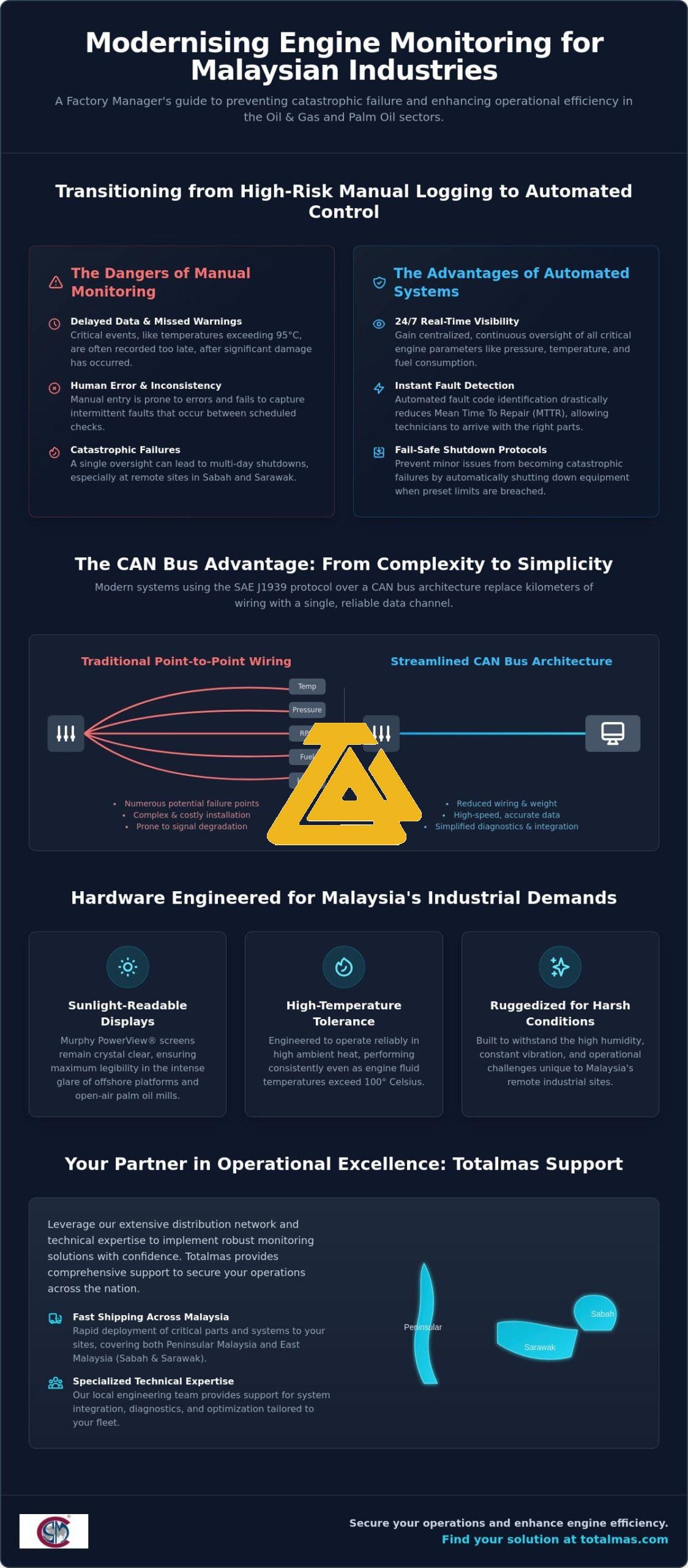
Relying on manual monitoring introduces significant risks, particularly in large-scale operations where a single oversight leads to expensive downtime. Manual data entry is prone to human error and often fails to capture intermittent faults that occur between scheduled inspections. Automation provides 24/7 oversight without the need for constant human presence at the engine site. This is especially vital for remote installations across Sabah and Sarawak, where technical staff may not be immediately available. By implementing automated industrial engine monitoring systems, you can significantly reduce the Mean Time To Repair (MTTR). The system identifies fault codes instantly, allowing your team to arrive on-site with the correct parts already in hand. Totalmas supports these implementations with deep technical expertise and fast shipping across Peninsular and East Malaysia, ensuring your transition to automated control is backed by reliable local inventory.
The Mechanics of Engine Data: J1939 and CAN Bus
Understanding the underlying communication architecture is vital for any factory manager looking to modernize their facility. Most modern industrial engine monitoring systems rely on a high-speed serial data network. By adhering to the SAE J1939 standard, these systems ensure that data regarding engine speed, temperature, and fluid levels is transmitted with absolute precision. This technology replaces the thick looms of traditional wiring with a streamlined CAN bus architecture. A single pair of twisted wires now carries all the data from the engine’s Electronic Control Unit (ECU) to your display. This simplification doesn’t just reduce the weight of the installation; it removes dozens of potential failure points where wires could fray or disconnect due to vibration.
The shift from mechanical sensors to smart digital transmitters has redefined how we perceive engine health. While old mechanical gauges were prone to calibration drift, digital sensors provide a consistent signal that isn’t affected by the distance between the engine and the panel. Integrating Enovation Controls allows you to interpret this raw stream of data into a clear narrative. Instead of viewing isolated numbers, you see how different parameters interact, such as how increased load impacts fuel consumption and exhaust temperatures. If you’re looking to upgrade your current setup, exploring Totalmas industrial solutions can help you identify the right hardware for your specific engine models.
Critical Parameters to Monitor
To maximize efficiency in a palm oil mill or an offshore platform, you must track specific metrics that impact your bottom line. Monitoring engine RPM alongside load percentage is essential for fuel optimization, ensuring your engines aren’t running at inefficient speeds for the work they’re doing. You should also keep a close watch on:
- Fluid Temperatures: Real-time Celsius readings for coolant and oil to prevent thermal breakdown.
- Operational Pressures: Monitoring oil and fuel pressure in kg/cm² to detect pump wear or filter clogs early.
- Electrical Health: Battery voltage and alternator output to ensure the engine is ready to start when needed, especially for emergency backup generators.
Interpreting Diagnostic Trouble Codes (DTCs)
Modern automated panels have moved far beyond the cryptic “blink codes” of the past. When a fault occurs, the system translates the numerical code into a text-based alert on the screen. These alerts follow a strict hierarchy that helps operators prioritize their response. A “Warning” might indicate a high air filter restriction that needs attention at the next shift, while a “Derate” tells you the engine is intentionally limiting power to protect itself. A “Critical Shutdown” occurs when parameters reach dangerous levels, such as a coolant temperature exceeding 105 Celsius, instantly stopping the engine to prevent a total loss. Choosing the right hardware is crucial for managing these alerts effectively, and you can see how different brands stack up in this review of Enovation Controls vs competitors. These systems ensure that whether your site is in Peninsular Malaysia or a remote corner of Sarawak, your team has the information needed to act decisively.
How to Select and Integrate an Automated Control Panel
Selecting the right hardware for your facility requires a structured evaluation of your current operational needs and future scalability. You shouldn’t view a control panel as a standalone component; it’s the foundation of modern industrial engine monitoring systems. Integrating these systems effectively within a Malaysian factory environment involves a five step framework to ensure technical compatibility and long term reliability. Following the broader principles of industrial monitoring and diagnostics ensures that your investment provides the necessary data to prevent expensive unplanned downtime.
- Step 1: Audit your engine fleet. Determine which engines are mechanical and which are electronic. This dictates whether you need a full retrofit or a simple digital integration.
- Step 2: Define connectivity requirements. Decide if you need Modbus RTU for local monitoring, CAN bus for engine communication, or remote telemetry for sites located hundreds of kilometers away.
- Step 3: Evaluate environmental conditions. Choose a display with a high IP rating (IP67 or higher) to withstand the high humidity and ambient temperatures common in Peninsular and East Malaysia.
- Step 4: Map auxiliary I/O requirements. Ensure the panel can monitor associated equipment, such as centrifugal pumps or conveyors, to provide a holistic view of the process line.
- Step 5: Verify local compliance. Confirm the hardware meets Malaysian power standards and safety regulations, including the latest 2024 OSHA amendments.
Retrofitting Legacy Mechanical Engines
Many palm oil mills still rely on legacy mechanical engines that lack electronic control units. You don’t need to replace these engines to gain digital visibility. By installing magnetic pickups to measure RPM and digital pressure transmitters, you can effectively “digitize” older equipment. This allows you to bring legacy assets into your modern industrial engine monitoring systems. When planning these upgrades, partnering with an experienced Enovation Controls distributor Malaysia ensures you receive the correct retrofit kits and technical guidance. Retrofitting is often a more cost effective solution than full engine replacement, provided the mechanical core remains sound.
Integration with Plant-Wide Automation
Modern factories require seamless communication between the engine floor and the central control room. Your automated control panels should connect directly to SCADA or DCS systems via Modbus RTU or TCP protocols. This integration allows for centralized monitoring of high temperature pressure transmitters and fluid levels across the entire plant. It’s vital to manage this data flow carefully to avoid network congestion, especially in large scale oil and gas facilities. Totalmas provides the technical assistance needed to configure these networks, ensuring that critical alerts reach your operators instantly, whether they’re on-site or in a regional office. Our distribution network covers Sabah and Sarawak, providing the fast shipping required to keep your automation projects on schedule.
Optimizing Performance in Malaysia’s Oil & Gas and Palm Oil Sectors
Operating industrial machinery in Malaysia presents unique environmental stressors that standard equipment often fails to handle. High relative humidity and ambient temperatures that frequently exceed 30 Celsius create a corrosive, high-heat atmosphere that can degrade sensitive electronics. For the oil and gas sector, these challenges are compounded by the need for explosion-proof compliance in hazardous zones. Implementing industrial engine monitoring systems in these environments requires hardware that isn’t just functional but specifically rated for extreme conditions. This ensures that critical assets, such as firewater pumps and emergency generators, remain ready for immediate deployment during a power failure or safety event.
The palm oil industry faces its own set of geographical hurdles. Many mills are situated deep within the interior of Sabah and Sarawak, where technical support can be hundreds of kilometers away. In these remote locations, an automated control panel serves as your first line of defense. By monitoring parameters like oil pressure and coolant temperature in real-time, the system can trigger an automated shutdown before a minor leak becomes a total engine seizure. To ensure your facility remains operational, it’s vital to consult with Totalmas for specialized engine management hardware that is proven to perform in the Malaysian climate.
Challenges of Remote Operations in East Malaysia
Logistical delays are a reality for any manager overseeing assets in East Malaysia. When a component fails in a rural Sarawak site, the downtime can extend for days due to shipping times. Using a high-durability Murphy PowerView display Malaysia standard ensures your interface remains functional despite vibration and heat. Modern panels now incorporate satellite or cellular telemetry, allowing you to monitor engine health from a central office in Kuala Lumpur or Kuching. This connectivity lets you establish a predictive maintenance schedule based on actual engine hours and load cycles, rather than relying on guesswork that doesn’t account for local logistical constraints.
Optimizing Palm Oil Mill Efficiency
With the mandatory MSPO 2.0 standards now in effect, palm oil mills are under increased pressure to optimize energy consumption and manage emissions. Many mills have transitioned to using biogas engines and steam turbines for power generation. Automated control panels allow you to integrate engine data with your Waste Heat Recovery Unit (WHRU) to maximize thermal efficiency. By monitoring engine load cycles during peak harvest seasons, you can identify periods of fuel wastage and adjust operations accordingly. Totalmas supports these efforts with fast shipping and technical assistance across Peninsular and East Malaysia, ensuring your mill has the inventory needed to maintain peak performance. Whether you’re managing a single engine or a complex network of conveyors and pumps, automation provides the visibility required to meet modern sustainability goals while protecting your bottom line.
Implementing Murphy and Enovation Controls with Totalmas Support
Selecting the right hardware is only half the battle for factory managers. Successful implementation of industrial engine monitoring systems depends heavily on the technical support and logistical reliability of your local partner. Totalmas has served as a specialized resource for the Malaysian industrial sector since 1991, offering deep expertise in Enovation Controls and Murphy displays. This long-standing presence ensures that you aren’t just purchasing a component; you’re securing a partnership with a seasoned expert that understands the nuances of local operational demands.
We recognize the specific geographical challenges of operating in East Malaysia. While international competitors may offer cloud-based platforms, they often lack the physical infrastructure to support remote sites when hardware issues arise. Totalmas bridges this gap by maintaining local inventory and a robust distribution network that prioritizes fast shipping to both Peninsular Malaysia and the remote regions of Sabah and Sarawak. Reducing the time between a fault detection and the arrival of a replacement part is critical for minimizing downtime, especially when your site is located hundreds of kilometers from the nearest urban center.
Our Commitment to Technical Excellence
With over 33 years of experience in industrial instrumentation and control, we provide a level of technical depth that goes beyond simple equipment sales. Our team offers on-site support and specialized training for your maintenance staff, ensuring they can navigate modern digital interfaces with confidence. We manage a comprehensive supply chain that includes flow meters, ANSI and API centrifugal pumps, and waste heat recovery units. This allows us to serve as a single point of contact for your entire process line, ensuring that your engine monitoring data integrates perfectly with your broader plant automation goals.
Ensuring Long-Term Reliability
Reliability in the oil and gas and palm oil sectors is built on the availability of genuine parts and expert commissioning. We provide full warranty support and maintain a steady supply of authentic spare parts to ensure your systems remain operational for the long term. If your facility requires a unique configuration, such as custom alarm logic for high-temperature environments reaching 100 Celsius, we offer custom panel design tailored to your specific requirements. This practical approach ensures that your industrial engine monitoring systems are not just technologically advanced, but perfectly suited to the realities of the Malaysian landscape. Contact Totalmas today to discuss how we can optimize your engine health and operational efficiency.
Securing Your Industrial Future with Automated Controls
Transitioning from manual oversight to automated systems is a critical step for maintaining competitive efficiency in today’s industrial landscape. By leveraging the J1939 protocol and rugged hardware, you gain the real-time visibility needed to prevent catastrophic failures before they occur. These industrial engine monitoring systems don’t just protect your machinery; they ensure your facility meets modern safety and sustainability standards while significantly reducing long-term maintenance costs.
With over 33 years of industrial experience, Totalmas is your dedicated partner for implementing reliable technical solutions. As an authorized Enovation Controls distributor, we offer specialized assistance and fast shipping to ensure your operations remain uninterrupted, whether you’re located in Peninsular Malaysia or at a remote site in Sabah or Sarawak. Our team is ready to help you navigate the complexities of system integration and remote telemetry.
Consult with Totalmas for your automated engine control panel needs to protect your assets and optimize your operational performance. We’re committed to supporting your success with proven technology and dependable local expertise.
Frequently Asked Questions
What is the difference between a basic gauge and an automated control panel?
A basic gauge provides a single, passive data point that requires constant human observation to be useful. In contrast, an automated control panel acts as the central brain for industrial engine monitoring systems, processing multiple signals simultaneously. These panels don’t just display numbers; they log historical data, interpret complex fault codes, and trigger automated responses to protect your machinery from damage when critical thresholds are exceeded.
Can I install an automated panel on an older mechanical engine?
You can certainly install an automated panel on legacy mechanical engines by using a digital retrofit kit. This process involves adding magnetic pickups for RPM and digital pressure transmitters to convert mechanical signals into electronic data. Totalmas provides specialized hardware that allows these older assets to benefit from modern diagnostics, ensuring your legacy equipment in palm oil mills can be monitored with the same precision as newer electronic models.
How do automated panels improve fuel efficiency in Malaysian factories?
Automated panels improve fuel efficiency by monitoring engine load cycles and ensuring the engine operates within its most efficient power band. In Malaysian industrial settings, this prevents engines from running at inefficient speeds during periods of low demand. By tracking fuel consumption alongside load percentage, managers can identify operational habits that waste energy and implement data-driven changes to reduce total fuel costs and kilograms of emissions.
Are Murphy Displays suitable for high-temperature environments in Sabah and Sarawak?
Murphy Displays are specifically engineered to withstand the extreme humidity and high ambient temperatures common in Sabah and Sarawak. These units feature ruggedized, IP67-rated enclosures that protect internal electronics from tropical moisture and dust. They remain fully legible in direct sunlight and are designed to operate reliably even when ambient temperatures exceed 35 Celsius, making them ideal for the demanding outdoor environments of East Malaysia.
What communication protocols do Enovation Controls support?
Enovation Controls primarily utilize the SAE J1939 standard and CAN bus architecture for high-speed engine communication. They also support Modbus RTU and TCP/IP protocols, which are essential for integrating industrial engine monitoring systems with existing plant-wide SCADA or DCS networks. This broad compatibility ensures that engine data can be shared seamlessly with other industrial automation components, providing a holistic view of your factory’s operational health.
Does Totalmas provide technical support for installation in remote areas?
Totalmas provides comprehensive technical support and on-site commissioning across both Peninsular and East Malaysia. Our engineers are experienced in the logistical requirements of reaching remote sites in Sarawak and Sabah, ensuring your systems are installed according to manufacturer specifications. We complement this field support with fast shipping from our local inventory, helping you maintain project timelines regardless of your facility’s geographical location.
How do these panels handle emergency shutdowns in Oil & Gas applications?
In hazardous Oil & Gas environments, these panels execute automated safety protocols the instant a sensor detects a critical parameter violation. If oil pressure drops below the required kg/cm² or coolant temperatures reach a dangerous Celsius level, the panel triggers an immediate shutdown. This automated intervention happens in milliseconds, preventing catastrophic engine failure and reducing the risk of fire or secondary damage in sensitive production zones.
What is the typical ROI for upgrading to an automated engine monitoring system?
The return on investment for an automated system is usually achieved through the prevention of unplanned downtime and expensive emergency repairs. By identifying minor faults before they lead to a total engine seizure, you avoid the massive costs of major overhauls and lost production time. While results depend on your specific fleet, many managers find that avoiding a single catastrophic failure pays for the entire monitoring system upgrade.