
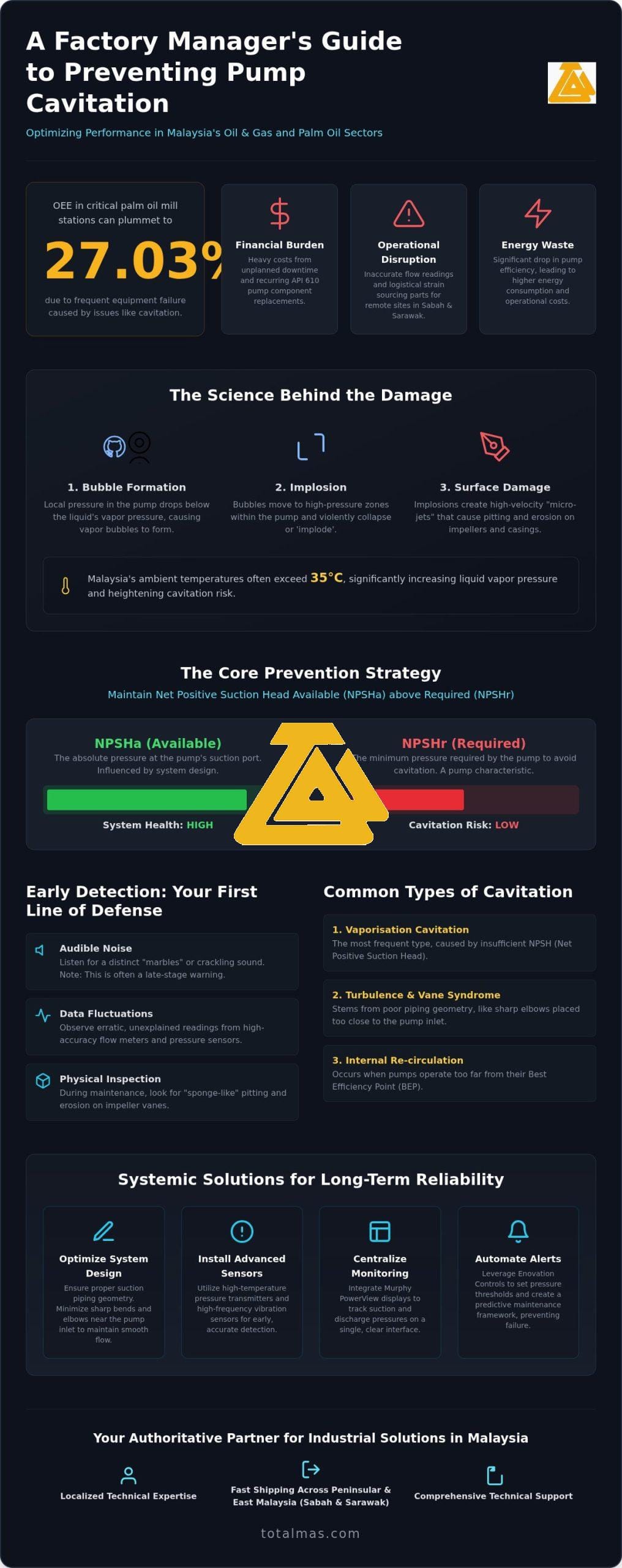
Did you know that critical stations in Malaysian palm oil mills can see Overall Equipment Effectiveness (OEE) drop as low as 27.03% because of frequent equipment failure? For factory managers in the oil and gas or palm oil sectors, this represents more than just a statistic; it reflects the heavy financial burden of unplanned downtime and the recurring cost of replacing expensive API 610 pump components. You’ve likely felt the frustration of inaccurate flow readings caused by vapor bubbles or the logistical strain of sourcing parts for remote sites in Sabah and Sarawak.
This guide provides the technical roadmap you need to master how to prevent pump cavitation and secure your operational continuity. By implementing precision hydraulic strategies and integrating advanced monitoring tools like Murphy Displays, you can significantly reduce maintenance costs and extend the lifespan of your centrifugal pumps. We will examine how to optimize system health within Malaysia’s challenging 35°C tropical climate. Totalmas stands as your authoritative partner, offering the deep industry expertise and comprehensive technical support required to maintain peak performance across Peninsular and East Malaysia.
Key Takeaways
- Understand the physics of vapor bubble collapse and learn to distinguish cavitation noise from mechanical failure to protect your API 610 pump components.
- Master the technical calculations for how to prevent pump cavitation by ensuring NPSHa remains consistently above NPSHr despite Malaysia’s high ambient temperatures.
- Discover how to optimize suction piping and utilize high temperature pressure transmitters to maintain system-wide pressure health in palm oil and oil and gas facilities.
- Benefit from Totalmas’s localized technical expertise and fast shipping services that cover remote operations in both Sabah and Sarawak.
- Leverage automated monitoring with Enovation Controls to create a predictive maintenance framework that reduces costly downtime and extends machinery lifespan.
Understanding Pump Cavitation and Its Impact on Industrial Operations
Cavitation is a physical phenomenon where vapor bubbles form and suddenly collapse within a liquid. This occurs when the local pressure inside the pump drops below the liquid’s vapor pressure at its current temperature in Celsius. When these bubbles move into high-pressure zones, they implode with immense force. Totalmas has observed that this isn’t just a technical glitch; it’s a destructive process that creates “micro-jets” of liquid. These jets strike metal surfaces at high velocities, causing physical pitting and erosion on impellers and casings. It’s a silent killer of machinery.
In Malaysian oil and gas and palm oil plants, the consequences are severe. Unplanned downtime can cost millions of RM annually. Beyond machinery damage, cavitation leads to significant energy waste as the pump’s efficiency plummets. Understanding how to prevent pump cavitation is essential for operational continuity, especially when replacement parts for API 610 pumps might face logistical delays to East Malaysia. Reliability starts with a deep grasp of the underlying physics.
The Science of Vapor Pressure and Temperature
Ambient temperatures in Malaysia often exceed 30°C or 35°C. This high baseline temperature directly influences the vapor pressure of processed fluids. According to Bernoulli’s principle, as flow velocity increases at the pump suction, pressure must drop. If the fluid is already warm, such as in palm oil sterilization or wastewater treatment, it’s much closer to its boiling point. This makes the system extremely sensitive to even minor pressure drops. High-temperature fluids are at a significantly higher risk of flashing into vapor before they even reach the impeller.
Common Types of Cavitation in Centrifugal Pumps
Vaporisation cavitation is the most frequent culprit. It happens when the Net Positive Suction Head (NPSH) is insufficient. However, managers must also watch for Turbulence and Vane Syndrome. These issues typically stem from poor piping geometry, such as elbows placed too close to the pump inlet. Finally, internal re-circulation poses a risk when pumps operate too far from their Best Efficiency Point (BEP). This causes the fluid to swirl back into the impeller, creating localized pressure drops that trigger bubble formation. Mastering how to prevent pump cavitation requires addressing these design and operational mismatches simultaneously. It’s about maintaining a steady, predictable flow environment.
Identifying the Signs: How to Detect Cavitation Early
Early detection is the most cost-effective way to manage system health. While many engineers wait for the unmistakable sound of “marbles” rattling inside the pump, this often indicates that damage is already occurring. Distinguishing this specific crackling noise from standard mechanical failure, such as bearing wear or shaft misalignment, is crucial for determining how to prevent pump cavitation before catastrophic failure occurs. High-frequency vibration sensors can detect these micro-implosions long before they become audible to the human ear. In the high-stakes environment of Malaysian oil and gas, these sensors provide the first line of defense against unplanned downtime.
Cavitation also introduces significant “noise” into your process data. If you notice erratic, unexplained fluctuations in your high accuracy flow meters, it’s likely due to vapor bubbles disrupting the sensor’s ability to provide a steady reading. During scheduled maintenance, inspect the impeller for “sponge-like” pitting. This erosion pattern is a definitive sign that vapor bubbles are collapsing against the metal surface. If left unaddressed, these pits eventually lead to impeller failure, requiring costly replacements that can be difficult to source quickly in remote regions like Sabah or Sarawak.
Digital Monitoring with Murphy Displays
Modern plants in Malaysia are shifting toward real-time diagnostics to protect their assets. Integrating a Murphy PowerView display Malaysia allows factory managers to track suction and discharge pressure simultaneously on a single interface. By setting threshold alarms, the system can alert operators to pressure drops that indicate imminent cavitation. Enovation Controls play a vital role here, providing automated pump protection and shutdown protocols. These systems ensure that expensive API 610 components aren’t destroyed during a low-pressure event, even when operators aren’t physically present at the pump station.
Physical Symptoms and Inspection Techniques
Beyond digital tools, physical symptoms offer vital clues during your daily rounds. Monitor motor amperage closely; cavitation often causes erratic power consumption as the pump struggles with a non-homogeneous fluid mixture. You should also record temperature increases in Celsius across the pump housing. Heat-related distress in seals and bearings often follows cavitation, as the collapsing bubbles release localized energy that can’t be dissipated quickly. Totalmas provides comprehensive technical support across both Peninsular and East Malaysia to help your team interpret these signs and maintain operational continuity.
Core Strategies to Prevent Vaporisation and Turbulence Cavitation
Engineering a reliable pumping system requires a precise balance between pressure and temperature. To address how to prevent pump cavitation effectively, you must ensure that the Net Positive Suction Head Available (NPSHa) consistently exceeds the Net Positive Suction Head Required (NPSHr). In Malaysia, where ambient temperatures often reach 35°C, the vapor pressure of your process fluid is naturally higher than in temperate climates. This reduces your safety margin. Lowering the fluid temperature in Celsius, even by a few degrees, can significantly decrease vapor pressure and restore the necessary NPSH margin to keep the liquid in its stable state.
Selection of the correct pump size is equally critical. A pump should ideally operate within 10% of its Best Efficiency Point (BEP). When a pump runs too far to the left or right of its curve, internal recirculation increases, creating localized low-pressure zones that trigger bubble formation. For challenging applications where the suction head is limited, installing an inducer can lower the NPSHr of the pump, providing an additional layer of protection against vaporisation without requiring massive structural changes to the plant.
Suction Side Optimization for Malaysian Plants
Physical modifications to the suction side offer the most direct path to improved NPSHa. Raising the supply tank level increases the static head, pushing more pressure toward the pump inlet. In palm oil mills, where fluids often carry debris, cleaning strainers and filters on a strict schedule is vital. A partially blocked strainer creates a significant pressure drop, often acting as the primary trigger for cavitation. Totalmas recommends utilizing API 610 centrifugal pumps Malaysia for high-demand oil and gas applications. these units are specifically designed for low NPSH requirements and robust performance in tropical industrial sectors.
Managing Turbulence and Flow Path
Piping geometry dictates the stability of the fluid entering the impeller. You should follow the ’10-diameter rule,’ ensuring a straight pipe run equal to ten times the pipe diameter immediately before the pump suction. This allows the flow profile to stabilize, reducing the risk of turbulence-induced pressure drops. When installing reducers, avoid using eccentric reducers with the flat side down, as this configuration can trap air pockets that eventually enter the pump. Additionally, ensure proper submergence in sumps to prevent vortexing. If the liquid level is too low, the pump will draw in air, leading to air entrainment that mimics many of the destructive symptoms of vapor cavitation. Totalmas provides technical support across Peninsular and East Malaysia to help you audit these piping configurations for maximum reliability.
Systemic Maintenance and Design for Long-Term Reliability
Establishing a rigorous maintenance checklist is the foundation of long-term reliability. Your team should prioritize monitoring seal integrity and impeller wear, as even minor degradation can alter the internal pressure profile and trigger bubble formation. Integrating high temperature pressure transmitters across the system allows for continuous, automated data collection. This data is essential for understanding how to prevent pump cavitation in real-time, as it highlights suction-side pressure drops before they reach critical vapor pressure levels. Maintaining a dedicated stock of critical spare parts for API pumps ensures that when wear is detected during a vibration audit, repairs happen immediately. This proactive approach prevents a minor cavitation event from escalating into a mill-wide shutdown.
Adapting to High-Viscosity and Chemical Loads
Palm oil mills face unique challenges due to the high viscosity of crude palm oil (CPO) and industrial effluent. Viscous fluids require precisely adjusted flow rates to maintain laminar flow, as the friction losses in high-viscosity liquids are significantly higher than in water. Material selection for impellers must be robust enough to resist both the mechanical impact of bubble collapse and the corrosive nature of chemical loads. The integration of a waste heat recovery unit Malaysia can also shift the operational landscape for your pump stations. While these units significantly improve energy efficiency by capturing thermal energy, they often increase the temperature of the fluid being pumped. As temperatures rise toward 50°C, the vapor pressure increases, which directly reduces your NPSH safety margin and necessitates a re-evaluation of your suction pipe diameter.
Regional Logistics and Support in Malaysia
Operating in remote industrial zones across Sabah and Sarawak requires a logistics strategy that accounts for geographic distance and port transit times. Relying on generic overseas suppliers often leads to weeks of unplanned downtime while waiting for specialized API 610 components. Totalmas addresses this logistical hurdle by prioritizing fast shipping of critical components to East Malaysia, ensuring that your facility maintains operational continuity. Local technical support is just as vital; having a seasoned expert available to troubleshoot on-site can prevent the trial-and-error maintenance approach that often damages machinery further. With over 33 years of experience in the Malaysian industrial sector, our engineers provide localized engineering audits on how to prevent pump cavitation by considering the specific humidity and temperature challenges of the tropical climate. For tailored advice on optimizing your pump’s performance and longevity, reach out to Totalmas for comprehensive technical support.
Optimizing Your Pump Performance with Totalmas Solutions
Totalmas provides a comprehensive range of ANSI and API 610 centrifugal pumps specifically engineered for the rigorous conditions of Malaysia’s oil and gas and palm oil sectors. Our solutions go beyond hardware. We focus on integrating advanced Enovation Controls to provide automated pump system protection. This digital layer acts as a fail-safe, monitoring pressure differentials and flow rates to intervene before physical damage occurs. When you’re determining how to prevent pump cavitation, having a system that can automatically throttle or shut down during a low-pressure event is a critical advantage. We offer full technical support and on-site consultation services across both Peninsular and East Malaysia. Our team understands the urgency of industrial operations, which is why we prioritize fast delivery of instrumentation and pump spares to keep your factory running.
Why Totalmas is the Preferred Industrial Partner
With over 33 years of experience in the Malaysian industrial landscape, Totalmas has established itself as a reliable mentor for plant managers. We serve as a single point of contact for pumps, high-accuracy flow meters, and comprehensive engine monitoring systems. This integration simplifies procurement and ensures that every component in your fluid handling system is designed to work together. Our commitment to reliability means we only provide high-quality instrumentation capable of withstanding the demanding environments of a palm oil mill or an offshore platform. We don’t just sell equipment; we build long-term partnerships based on proven technical success and functional excellence. Our deep roots in the sector allow us to provide insights that generic suppliers simply can’t match.
Next Steps for Plant Managers
Taking a proactive stance is the most effective way to eliminate unplanned downtime. We recommend requesting a comprehensive pump system audit to identify specific cavitation risks within your current piping and process flow. Upgrading legacy systems with Murphy digital displays allows for real-time health monitoring, providing your team with the data needed to make informed decisions before a failure occurs. If you’re ready to secure your operational continuity and extend the lifespan of your machinery, Contact Totalmas today for expert industrial solutions. Our engineers are ready to support your facility in Sabah, Sarawak, or anywhere across Peninsular Malaysia with the expertise required to master how to prevent pump cavitation and optimize your plant’s overall efficiency.
Securing Operational Continuity through Technical Excellence
Mastering NPSH calculations and integrating real-time digital monitoring are the most effective ways to protect your capital-intensive machinery. By addressing both hydraulic design and rigorous maintenance schedules, you ensure your pumps operate at their Best Efficiency Point despite Malaysia’s challenging 35°C ambient temperatures. Understanding how to prevent pump cavitation is not just about avoiding audible noise; it’s about safeguarding the long-term profitability and safety of your plant operations.
With over 33 years of Malaysian industrial experience, Totalmas provides the specialized API 610 and palm oil expertise required to solve complex fluid handling challenges. We understand the logistical hurdles of the region, which is why we offer comprehensive technical support and fast shipping to both Peninsular Malaysia and remote sites in Sabah and Sarawak. Our team is committed to being your steady partner in industrial reliability.
Contact Totalmas for Expert Pump Solutions and Technical Support today to audit your systems. We look forward to helping you achieve a resilient and efficient production environment that stands the test of time.
Frequently Asked Questions
What is the most common cause of pump cavitation in Malaysian factories?
High ambient temperatures combined with suction line restrictions are the leading causes of cavitation in local plants. In palm oil mills, fluids are often processed at high temperatures in Celsius, which naturally increases vapor pressure and reduces the safety margin for the pump. Clogged strainers or undersized suction piping further drop the pressure, creating the perfect conditions for vapor bubbles to form. Addressing these thermal and physical restrictions is the first step in learning how to prevent pump cavitation.
Can I still run my pump if I hear a slight cavitation noise?
Running a pump that is making cavitation noise is not recommended because damage occurs almost immediately. That distinct rattling sound indicates that vapor bubbles are imploding against the impeller with enough force to pit the metal. Continued operation will lead to material fatigue, seal failure, and eventually a catastrophic breakdown of your API 610 components. It’s more cost-effective to stop the pump and fix the suction issue than to pay for a full rebuild later.
How do I calculate NPSHa for a palm oil processing system?
You calculate Net Positive Suction Head Available by adding the absolute pressure at the suction source to the static head, then subtracting friction losses and the fluid’s vapor pressure. For palm oil, you must account for the specific vapor pressure at the current process temperature in Celsius. High-viscosity fluids also increase friction losses in the piping. Totalmas engineers can help you perform these calculations to ensure your system design maintains a safe margin above the pump’s required NPSH.
What is the difference between cavitation and air entrainment?
Cavitation is an internal phase change where the liquid itself turns into vapor bubbles due to low pressure. Air entrainment is the introduction of external air into the pump, often caused by a vortex in a supply tank or a leak in the suction gasket. While both cause vibration and a drop in flow, air entrainment doesn’t involve the destructive micro-jets created by imploding vapor bubbles. Identifying whether the bubbles are vapor or air is crucial for applying the correct fix.
How does temperature (in Celsius) specifically affect cavitation risk?
Temperature affects risk because vapor pressure rises as the liquid gets hotter. In Malaysia’s tropical climate, process fluids often start at a higher baseline temperature, leaving less room for pressure drops before the liquid reaches its boiling point. Managing these thermal variables is a core component of how to prevent pump cavitation. If you can’t increase the suction pressure, you may need to lower the fluid temperature by a few degrees to restore a stable operating environment.
Are certain types of centrifugal pumps more resistant to cavitation?
Yes, API 610 centrifugal pumps are specifically engineered for high-reliability applications in the oil and gas sector and often have lower NPSH requirements. Pumps designed with an inducer or a double-suction impeller can also handle lower suction pressures more effectively than standard utility pumps. Choosing a pump that is correctly sized for your system’s specific hydraulic profile is the most reliable way to ensure long-term, cavitation-free performance in demanding industrial environments.
Does Totalmas offer technical support for plants in Sabah and Sarawak?
Totalmas provides comprehensive technical support and on-site consultations for industrial facilities across both Peninsular and East Malaysia. We understand the logistical challenges faced by plants in Sabah and Sarawak, which is why we prioritize fast shipping for critical pump spares and instrumentation. Our 33 years of experience in the Malaysian market ensures that your remote operations receive the same level of engineering expertise and reliable equipment as those in the Klang Valley.
Can Murphy displays help prevent pump failure from cavitation?
Murphy displays are highly effective for early detection because they provide real-time monitoring of suction and discharge pressures. By integrating these displays with Enovation Controls, you can set automated threshold alarms that alert operators to a pressure drop before cavitation becomes audible. In many cases, the system can be programmed to trigger an automatic shutdown, protecting your expensive machinery from the physical destruction caused by low-pressure events and ensuring overall operational continuity.