
Selecting the wrong pump for high-viscosity fluids can result in more than just inefficient flow; it can lead to RM100,000 in fines under the Occupational Safety and Health Regulations 2024 if your system fails to meet mandatory safety standards. As a primary centrifugal pump supplier Malaysia businesses rely on for technical expertise, we recognize that managing thick or abrasive media requires a precise engineering approach rather than a simple procurement checklist. You’ve likely experienced the frustration of frequent pump failure due to cavitation or the soaring energy costs associated with oversized equipment. It’s a common struggle when technical specifications don’t align perfectly with the unique rheology of your fluids.
This guide will help you master the critical technical criteria for selecting high-performance industrial pumps to ensure operational efficiency and equipment longevity. We’ll explore the nuances of viscosity impact, the latest DOSH Certificate of Fitness requirements, and how to achieve an optimized flow that reduces long term maintenance costs. By the end, you’ll have the framework to choose a reliable technical partner for your instrumentation and fluid handling needs.
Key Takeaways
- Learn why standard water pumps fail when handling industrial oils or slurries and how fluid rheology dictates your equipment choice.
- Master the use of Viscosity Correction Factors to accurately size pumps for thick media, ensuring reliable flow rates and system stability.
- Avoid the common “bigger is better” procurement myth by understanding the critical importance of operating at the Best Efficiency Point (BEP).
- Utilize a structured methodology for data collection to streamline your RFQ process with a specialized centrifugal pump supplier Malaysia.
- Discover the operational benefits of sourcing integrated solutions, including flow meters and controls, from a single technical partner.
Navigating Fluid Viscosity in Malaysia’s Industrial Landscape
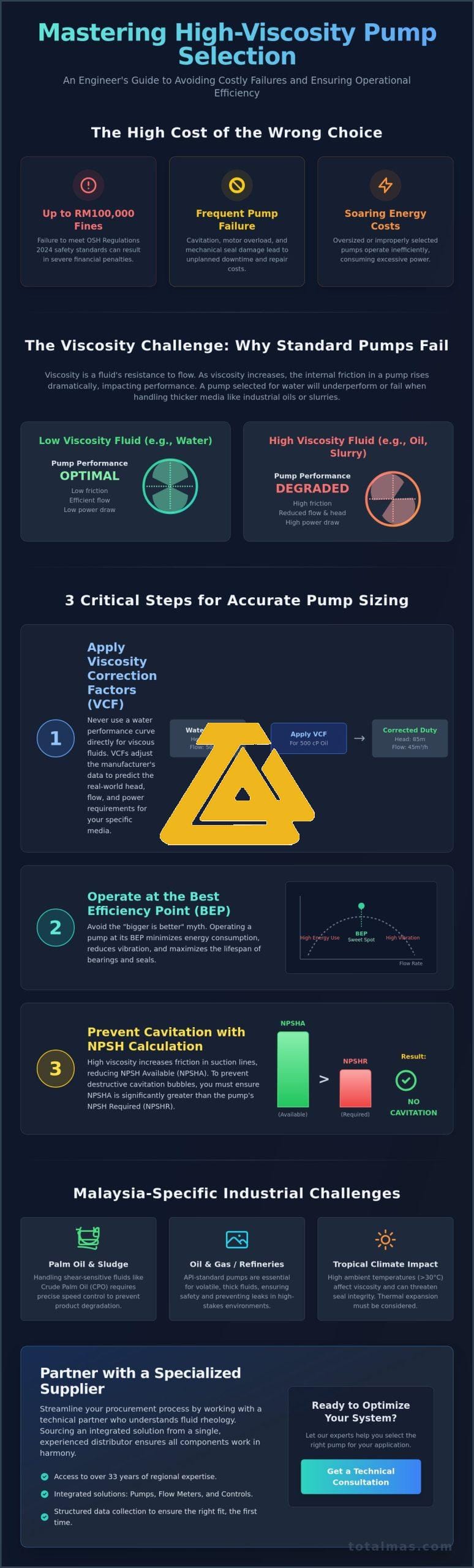
Viscosity is the measure of a fluid’s internal resistance to flow, a factor that fundamentally dictates the performance of any pumping system. In a Centrifugal pump, high viscosity creates significant internal friction. This friction reduces the pump’s head and flow rate while simultaneously increasing the power required from the motor. When you select a pump based solely on water performance curves, you risk equipment failure when that same pump encounters industrial oils or thick slurries.
Standard water pumps aren’t built for these challenges. They often suffer from motor overload or severe cavitation when the fluid’s resistance exceeds the impeller’s design limits. This is why partnering with a proven centrifugal pump supplier Malaysia is essential for long term plant operational efficiency. A distributor with over 33 years of regional experience knows that fluid properties aren’t static; they shift based on pressure, shear, and local environment. Making an informed choice at the procurement stage prevents the costly cycle of emergency repairs and unplanned downtime. For facilities that also require water handling solutions, understanding how to evaluate a qualified industrial water pump supplier Malaysia is equally critical to maintaining compliance and operational continuity.
Challenges in Palm Oil and Oil & Gas Sectors
In Malaysia, the palm oil industry handles crude palm oil (CPO) and industrial sludge, both of which possess complex rheological profiles. Some processing fluids are shear-sensitive, meaning their viscosity changes as they’re moved by the impeller. If the pump speed is too high, it can damage the product’s quality. For offshore and refinery applications, we provide API-standard pumps designed to handle these volatile, thick fluids while meeting strict safety protocols. These robust designs prevent the leaks and mechanical failures that often plague standard industrial equipment in high-stakes environments.
The Impact of Temperature on Fluid Flow
Malaysia’s tropical climate presents unique challenges. Ambient temperatures, often exceeding 30°C, directly affect fluid viscosity. While heat generally makes fluids thinner and easier to pump, it also threatens pump seal integrity and cooling systems. Thermal expansion can cause misalignment or seal face damage if not accounted for during the selection process. To maintain stability, some facilities integrate a Waste Heat Recovery Unit (WHRU) to regulate process temperatures. This ensures the fluid remains within a predictable viscosity range, protecting both the pump and the accuracy of connected flow meters.
How to Evaluate Centrifugal Pump Performance for Thick Fluids
Centrifugal pumps operate by converting rotational energy into kinetic energy. When handling viscous fluids, this process encounters significant resistance. As the fluid becomes thicker, the impeller must work harder to move the same volume, leading to a drop in total head and a sharp increase in brake horsepower. Evaluating performance requires more than just looking at a standard water curve. You must apply a Viscosity Correction Factor to adjust the manufacturer’s data for the specific gravity and centipoise of your medium.
Engineers often refer to an industrial pump performance guide to determine these derating factors. Failure to account for these changes leads to undersized motors and premature mechanical failure. As a leading centrifugal pump supplier Malaysia, we emphasize that the shaft and bearings in these systems endure the highest stress. Selecting heavy-duty components ensures your system can withstand the torque requirements of high-viscosity applications. Integrating your pump with advanced instrumentation, such as Murphy displays or precision flow meters, allows for real-time health monitoring to catch performance drifts before they cause a shutdown.
Understanding Net Positive Suction Head (NPSH)
Net Positive Suction Head (NPSH) is the most critical calculation when dealing with thick fluids. Cavitation occurs when the pressure at the impeller eye drops below the fluid’s vapor pressure, creating destructive bubbles. High viscosity increases friction loss in the suction piping, which reduces the NPSH Available (NPSHA). To prevent this, you must ensure the NPSHA is significantly higher than the NPSH Required (NPSHR). Often, this means operating the pump at lower speeds to give the viscous fluid more time to enter the impeller without flashing into vapor.
Material Compatibility for Chemical Processing
Chemical processing in Malaysia often involves corrosive elements that require specific metallurgy. Alloys like 316 Stainless Steel or Duplex are common, but the choice between ANSI and API material classes depends on your industry’s safety standards. ANSI pumps are versatile for general chemical use, while API-standard pumps provide the extra wall thickness and robust sealing required for hazardous hydrocarbon transport in refineries. Proper seal selection, such as double mechanical seals with a buffer fluid, is vital to prevent leaks when transporting hazardous or high-cost industrial fluids. For a deeper understanding of material selection and seal design for corrosive media, our chemical pump fundamentals reference guide provides a comprehensive technical framework aligned with the latest ASME and ISO standards.
Overcoming Common Misconceptions in Industrial Pump Selection
A frequent error in procurement is the belief that choosing a pump with significantly higher capacity provides a “safety margin” for future expansion. This “bigger is better” approach is a fundamental misconception that often leads to systemic failures rather than operational security. Every industrial pump is designed to operate most efficiently at a specific point on its performance curve, known as the Best Efficiency Point (BEP). When you run a pump too far to the left or right of this point, hydraulic radial thrust increases. This puts immense pressure on the shaft and bearings, leading to premature mechanical failure.
Selecting a centrifugal pump supplier Malaysia based solely on the lowest initial quote is another common pitfall. While a cheaper generic pump might save RM 500 on the initial purchase order, the Total Cost of Ownership (TCO) usually skyrockets. High energy consumption, frequent part replacements, and unplanned downtime quickly erase any initial savings. A reliable technical partner focuses on consultation rather than simple product distribution. They ensure the equipment matches the actual resistance of your piping system, which protects your long term bottom line.
Why Oversizing Leads to Cavitation and Failure
Oversizing doesn’t just waste electricity; it creates high-velocity flow that leads to internal turbulence and vibration. This turbulence often causes suction recirculation and cavitation, even if your NPSH calculations appear correct on paper. If a pump is too powerful for the system’s discharge requirements, it may operate in a “deadhead” condition. This causes the fluid temperature to rise rapidly within the casing, which can damage seals and warp the impeller. Precise sizing reduces the need for frequent maintenance and extends the life of your seals and bearings.
The Hidden Costs of Generic Pump Solutions
Off-the-shelf pumps often lack the rigorous standardization of ANSI or API centrifugal pumps. In the Malaysian industrial sector, sourcing spare parts for non-standardized or generic equipment can be a logistical nightmare, often resulting in weeks of lost production. Specialized pumps are built to international standards, ensuring that parts are interchangeable and accessible. Partnering with a local distributor provides essential technical backup and support. This local presence ensures that you aren’t just buying a piece of hardware, but securing a reliable supply chain for the future.
A Step-by-Step Guide to Selecting the Right Industrial Pump
Selecting an industrial pump is an engineering calculation of rheology and resistance, not just a procurement exercise. Before reaching out to a centrifugal pump supplier Malaysia, you must establish a baseline of technical data to ensure the equipment matches your specific process needs. This structured approach prevents the common errors of oversizing or material mismatch that lead to system failure. Utilizing high accuracy flow meters for baseline data collection ensures that your performance requirements are based on empirical evidence rather than theoretical estimates.
Verifying a distributor’s technical credentials and regional history is just as vital as the hardware itself. A provider with decades of experience in the Malaysian market understands local environmental factors and regulatory shifts. They don’t just ship a box; they provide the technical oversight necessary to integrate the pump into your existing control systems, such as Murphy displays or Enovation controls.
Step 1: Mapping Fluid Properties and Flow Requirements
You can’t specify a high-performance pump without a complete profile of the medium. Use this checklist to gather essential data:
- Viscosity: The fluid’s thickness at its actual operating temperature.
- Specific Gravity: The density of the fluid relative to water.
- Vapor Pressure: Critical for determining the required suction head.
- Solid Content: The presence of abrasives that may require hardened impellers or specialized seals.
Once the fluid profile is clear, determine your required Flow Rate (GPM or m3/h) and Total Dynamic Head (TDH). Total Dynamic Head is the sum of static head and friction loss. Because high-viscosity fluids significantly increase friction loss within the piping, your TDH calculation must be precise to avoid head loss at the discharge point.
Step 2: Choosing Between ANSI and API Standards
The application environment dictates the mechanical standard required for your facility. ANSI pumps are the standard for general chemical processing due to their versatility and dimensional interchangeability. However, for the high-temperature or high-pressure demands of the oil and gas sector, API 610 pumps are mandatory. API designs feature more robust casing structures and larger bearing frames to handle extreme thermal expansion and mechanical stress. We advise selecting a partner like Totalmas Sdn Bhd that handles both specialized standards, as this provides the flexibility to match the equipment exactly to the process risk level. If you’re ready to define your system requirements with precision, consult with our technical team today. For water-specific applications, our 2026 procurement guide for industrial water pump supplier Malaysia outlines the regulatory requirements and selection criteria you need to remain compliant under the latest SIRIM and SPAN standards.
Partnering with a Specialized Industrial Pump Distributor in Malaysia
Finding a reliable centrifugal pump supplier Malaysia requires looking beyond a simple hardware vendor. It’s about securing a technical partner that understands the entire fluid handling ecosystem, from the initial suction to the final discharge point. Totalmas Sdn Bhd brings a 33-year legacy to the industrial sector, positioning itself as a comprehensive resource for businesses that prioritize long-term stability over short-term savings. We offer the distinct advantage of a single point of contact for complex requirements, managing the integration of pumps, flow meters, and controls with a steady, experienced hand.
Relying on one specialized distributor simplifies your supply chain and ensures technical accountability. When your instrumentation and pumping hardware come from the same expert source, the risk of compatibility issues vanishes. We invite you to consult with our technical team to design custom solutions that reflect the unique rheology and environmental conditions of your facility. This collaborative approach ensures that your equipment isn’t just functional, but optimized for your specific operational goals.
Totalmas Sdn Bhd: Technical Solutions Beyond Equipment Supply
Our expertise extends into the critical monitoring and control systems that keep your plant running. We specialize in Enovation Controls and Murphy Displays, which provide the real-time data necessary to prevent the cavitation and motor overload discussed in previous sections. Beyond fluid transport, Totalmas Sdn Bhd supports complex infrastructure projects including Waste Water Treatment Plant Solutions and the implementation of a Waste Heat Recovery Unit (WHRU). For facilities requiring integrated material handling, we also provide Mec Handling conveyors, ensuring a seamless flow across your entire production line.
Ensuring Long-Term Reliability with Expert Support
The commitment to your facility doesn’t end at the point of sale. We provide thorough technical backup for all ANSI and API centrifugal pumps, ensuring that your equipment remains compliant with the latest Malaysian industrial standards. By utilizing reliable instrumentation like our orifice plates and high-accuracy flow meters, we help you optimize plant efficiency and reduce the total cost of ownership. If you’re seeking to enhance your operational longevity, contact our Kuala Lumpur office for a professional technical consultation. Let us help you build a system that stands the test of time.
Securing Long-Term Performance for Your Fluid Handling Systems
Selecting the right equipment for high-viscosity fluids requires a deep understanding of rheology and a commitment to precision engineering over simple procurement. We’ve explored how accurate data collection, proper sizing relative to the Best Efficiency Point, and adherence to ANSI/API standards prevent the costly cycle of cavitation and mechanical failure. As a leading centrifugal pump supplier Malaysia trusts for technical depth, we emphasize that the right hardware is only half the solution; expert integration is what ensures longevity.
Totalmas Sdn Bhd brings over 33 years of industrial expertise to every project. As an authorized distributor of Enovation Controls and Murphy Displays, we specialize in high-accuracy instrumentation and ANSI/API centrifugal pumps designed for the most demanding Malaysian applications. We invite you to consult with our technical experts for your industrial pump requirements to ensure your facility operates at peak efficiency. We look forward to supporting your next engineering challenge with proven reliability and expert guidance.
Frequently Asked Questions
What is the difference between an industrial pump distributor and a general supplier?
An industrial pump distributor acts as a technical partner by offering engineering consultation and system integration rather than just fulfilling a purchase order. General suppliers often lack the specialized knowledge required to size equipment for complex rheology. As a dedicated centrifugal pump supplier Malaysia, we provide the technical oversight needed to ensure your pumps work in harmony with your flow meters and control systems.
Can a centrifugal pump handle fluids with high solid content?
Centrifugal pumps can handle solids if they’re specifically configured with an open or semi-open impeller. Standard closed impellers will likely clog or erode quickly when exposed to abrasive media. For applications like industrial sludge or waste water treatment, choosing a pump with hardened metallurgy and specific internal clearances is essential to maintain operational longevity and prevent unplanned shutdowns.
How often should I perform maintenance on an industrial centrifugal pump?
Maintenance frequency depends on your specific operating conditions, but a quarterly inspection schedule is a reliable baseline for industrial systems. You should check mechanical seals for leaks and monitor bearing temperatures regularly to catch early signs of wear. High-demand applications in the oil and gas sector may require more frequent vibration analysis to ensure the system remains within its Best Efficiency Point.
What are the common signs of pump cavitation in high-viscosity applications?
The most common signs of cavitation include a distinct sound similar to pumping gravel and excessive vibration in the pump casing. You’ll also notice erratic pressure readings and a significant drop in flow rate. In high-viscosity applications, these symptoms often indicate that the suction pressure has dropped below the fluid’s vapor pressure, causing vapor bubbles to form and collapse against the impeller.
Why are API 610 pumps preferred for the oil and gas industry in Malaysia?
API 610 pumps are the industry standard for Malaysian refineries and offshore platforms because they’re engineered for extreme safety and durability. These pumps feature heavier wall thicknesses and more robust bearing frames compared to standard industrial designs. This extra structural integrity is necessary to handle the high temperatures and pressures associated with hazardous hydrocarbon transport without risking catastrophic seal failure.
How do I calculate the Total Dynamic Head (TDH) for my pumping system?
You calculate Total Dynamic Head (TDH) by adding the static head to the friction loss of the entire piping system. Static head represents the vertical distance the fluid must be lifted, while friction loss accounts for the resistance created by pipes, valves, and fittings. Because thick fluids create much higher friction, your TDH calculation must be adjusted for viscosity to ensure the motor has enough power to move the medium.
Does Totalmas provide spare parts for the industrial pumps they distribute?
Totalmas ensures the availability of critical spare parts for all ANSI and API centrifugal pumps within our distribution portfolio. We understand that downtime in a Malaysian processing plant can lead to significant revenue loss, so we maintain a supply chain for essential components like seals, bearings, and impellers. This long-term support is a core part of our commitment to being a reliable technical partner for your facility.
Can I use a flow meter to monitor the health of my industrial pump?
You can definitely use a flow meter or a Murphy display to monitor the health of your industrial pump. By comparing real-time flow data against the manufacturer’s performance curve, you can identify gradual drops in efficiency that suggest internal wear or clogging. This proactive monitoring allows your team to schedule maintenance before a minor performance drift turns into a complete system failure.