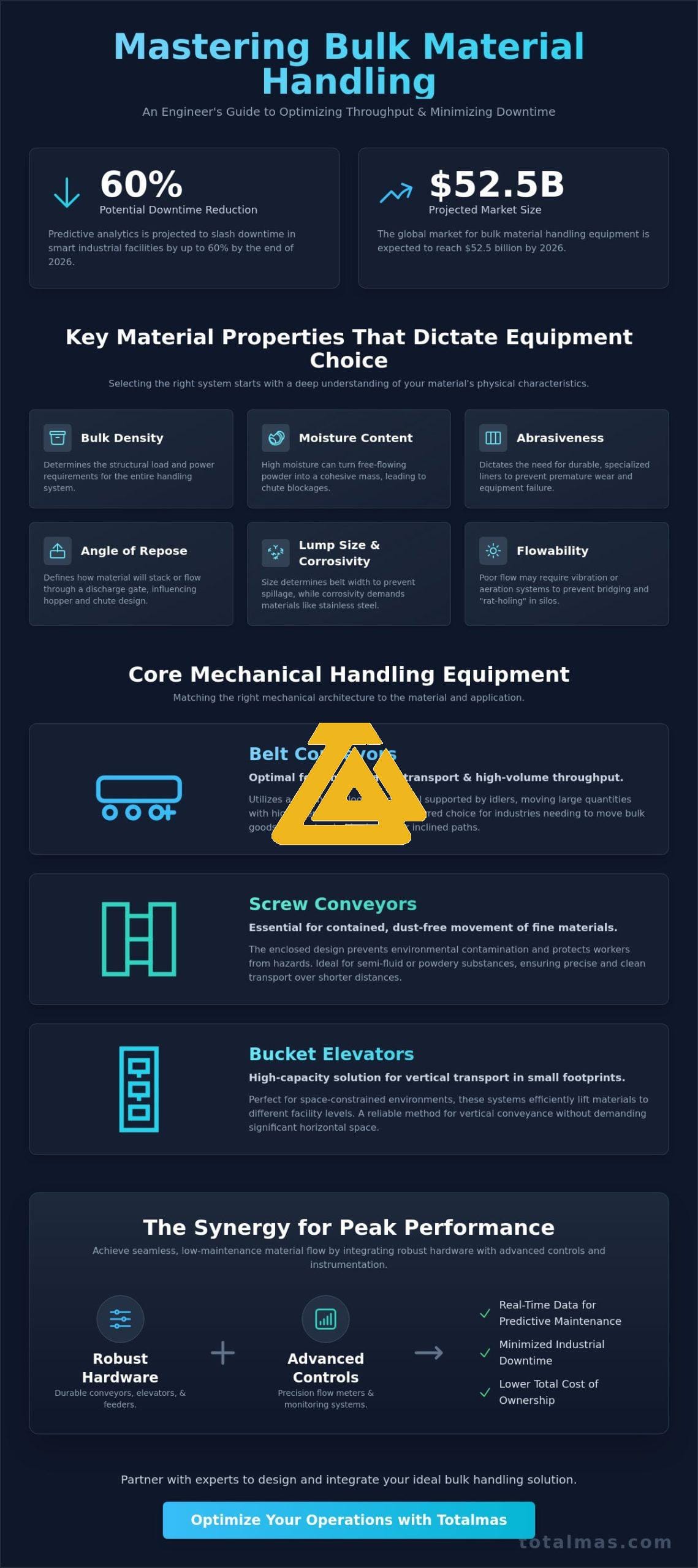
Predictive analytics is expected to reduce downtime in smart industrial facilities by up to 60% by the end of 2026, a year where the market for bulk material handling equipment is projected to reach $52.5 billion. Despite this growth, many operations still face high operational costs due to equipment failure and material degradation during transport. You likely recognize that a single bottleneck in your transport line can stall an entire production schedule, leading to costly delays and excessive manual intervention. It’s a common challenge to lack the real-time data required to monitor material flow and equipment health effectively.
Selecting the right system is no longer just about moving product; it’s about protecting your investment through precision instrumentation. This guide provides the technical insights necessary to master the selection and integration of advanced handling systems. You’ll learn how to optimize throughput while minimizing downtime in your industrial operations. We will explore how to pair mechanical reliability with monitoring systems for predictive maintenance and ensure your handling line operates with maximum energy efficiency.
Key Takeaways
- Learn how to evaluate material characteristics like bulk density and abrasiveness to select the most durable bulk material handling equipment for your facility.
- Discover the operational advantages of Mec Handling conveyors and when to deploy belt systems for long-distance, high-volume throughput.
- Master a comparative framework to determine whether mechanical or pneumatic systems offer the best ROI based on your specific vertical lift and transport requirements.
- Understand why integrating precision instrumentation, such as high-accuracy flow meters, is critical for achieving real-time data and minimizing industrial downtime.
- Identify how the synergy between robust hardware and advanced controls creates a seamless, low-maintenance material flow across your entire production line.
Understanding the Foundations of Bulk Material Handling Equipment
Bulk material handling is the specialized engineering field focused on the movement and control of dry, powdery, or lumpy materials in an industrial setting. It’s a discipline that transforms raw commodities into manageable flow streams for processing or transport. For those seeking a technical baseline, Understanding the Foundations of Bulk Material Handling Equipment involves analyzing how physical properties dictate the design of conveyors, hoppers, and feeders. Without this rigorous engineering approach, systems often succumb to material clogging, excessive wear, and operational bottlenecks that halt production.
Engineers must account for four primary characteristics: bulk density, moisture content, abrasiveness, and the angle of repose. Bulk density determines the structural load on the system, while moisture content can turn a free-flowing powder into a cohesive mass that blocks chutes. Abrasiveness dictates the necessity for specialized liners, and the angle of repose defines how material will stack or flow through a discharge gate. In the Malaysian industrial landscape, these factors are particularly critical for the palm oil and mineral sectors. Handling abrasive iron ore or sticky palm fruit bunches requires bulk material handling equipment tailored to these specific physical demands to ensure long-term reliability.
Key Material Properties That Influence Equipment Choice
Lump size is a decisive factor in determining the width and speed of conveyor belts. If the belt is too narrow for the maximum lump size, material will spill or jam at transfer points. Corrosivity also plays a vital role; materials with high chemical reactivity or moisture require stainless steel components in screw conveyors and hoppers to prevent premature failure. Finally, flowability informs whether a system needs vibration or aeration to ensure consistent discharge. Choosing the wrong mechanism for a low-flow material often leads to bridging or “rat-holing” in silos, which necessitates manual intervention and increases safety risks.
The Economic Impact of Efficient Material Movement
The scale of this sector is immense, with the global market for bulk material handling equipment projected to reach $52.5 billion by 2026. Inefficiency carries a heavy price tag. For instance, conveyor belt misalignment doesn’t just damage the belt; it leads to material loss and increased energy consumption as the motor works harder to overcome friction. Efficient handling maintains product quality by preventing material degradation during transport, which reduces waste and ensures that the final output meets strict industrial standards. By optimizing these systems, plants can significantly lower their total cost of ownership while maintaining a steady, reliable output that supports a healthy bottom line.
Core Categories of Mec Handling Equipment and Their Applications
Reliability in industrial transport begins with selecting the correct mechanical architecture for the specific material being moved. Mec Handling conveyors serve as the backbone of modern material transport, providing the structural integrity required for continuous operation. When Selecting the Right System, engineers must evaluate whether the application requires high-volume horizontal transport or precise vertical lift. Standardizing on robust hardware ensures that the transport line remains a steady asset rather than a source of frequent maintenance. For those interested in technical depth, Selecting the Right System involves matching equipment mechanics to the specific flow properties of the material.
Belt conveyors remain the preferred choice for long-distance transport and high-volume throughput. These systems use a continuous loop of material supported by idlers to move large quantities of product with minimal energy. In contrast, screw conveyors are essential for the contained, dust-free movement of fine or semi-fluid materials. Because they are enclosed, they prevent environmental contamination and protect workers from respiratory hazards. For vertical transport in space-constrained industrial environments, bucket elevators provide a high-capacity solution that utilizes a small footprint to move materials to different facility levels.
Conveyor Systems: Belt vs. Screw vs. Drag
A technical breakdown of belt conveyors reveals three critical components: idlers, pulleys, and drive units. The idlers support the belt and load, while the drive units provide the necessary torque for movement. Screw conveyors offer the unique advantage of mixing or dosing materials while they are in transit, making them ideal for chemical or food processing. If you are handling fragile or hazardous materials, tubular drag conveyors are superior. They use a chain-and-disk assembly to gently pull material through a sealed pipe, which eliminates the risk of product degradation or external leaks.
Feeders and Dischargers: Controlling the Flow
Achieving a consistent material rate is the primary role of vibrating pan feeders. These devices use controlled vibrations to move material from a hopper into the primary conveyor line at a steady pace. To direct material flow across multiple lines, engineers employ rotary valves and diverter flaps. These components allow for the seamless switching of product streams without stopping the entire line. For applications requiring precise flow restriction and measurement, integrating orifice plates and flanges provides the necessary control to maintain system pressure and monitor volume. This level of precision ensures that your bulk material handling equipment operates within its designed performance parameters, reducing the risk of surges that lead to equipment strain.
Selecting the Right System: A Comparative Evaluation Framework
Selecting bulk material handling equipment requires a rigorous evaluation of your facility’s specific operational demands. A standard decision matrix should prioritize three variables: material characteristics, transport distance, and vertical lift requirements. While belt conveyors are the industrial standard for long horizontal runs, pneumatic systems are often superior when routing is complex or when handling fine, dry powders that require total containment. You must determine if the material is abrasive, cohesive, or fragile, as these factors immediately narrow the field of viable mechanical solutions. Engineering a system that doesn’t align with these physical realities leads to premature component fatigue and frequent, unscheduled stops.
Financial planning must shift from a focus on initial CAPEX to a Total Cost of Ownership (TCO) model. While some systems appear cost-effective at the point of purchase, their long-term maintenance and energy requirements can be prohibitive. With the global market for bulk material handling equipment expected to reach $52.5 billion by 2026, the industry is moving toward smarter, more efficient designs. Integrating predictive analytics into your selection can reduce downtime by up to 60% in smart facilities. For operators in Malaysia, a major concern is balancing specialized equipment needs with local parts availability. Standardizing on Mec Handling components ensures that your facility maintains a reliable supply chain for critical spares, reducing the risk of extended outages due to shipping delays.
Throughput and Capacity Analysis
Matching equipment speed to plant-wide production targets prevents the handling line from becoming a bottleneck. For vertical transport, calculating the safe working load (SWL) for bucket elevators is essential to prevent motor burnout and structural stress. Throughput capacity is the volume of material moved per unit of time under standard operating conditions. By ensuring your system is sized for peak demand rather than average flow, you create a buffer that accommodates surges in production without compromising equipment health.
Environment and Safety Considerations
Safety standards are evolving, and your equipment must comply with the latest regulatory frameworks. The OSHA 2026 agenda includes a heightened focus on heat hazard prevention in high-risk indoor environments like warehouses and processing plants. Dust suppression remains a critical requirement for coal, grain, and cement handling to prevent respiratory issues and combustible dust explosions. If your facility operates in a volatile chemical environment, explosion-proof ratings for motors and controls are non-negotiable. Designing for ergonomics is equally vital; providing clear access points for routine maintenance ensures that technicians can perform inspections safely and efficiently, further minimizing the risk of operational errors. For a comprehensive overview of how to protect your workforce and meet DOSH requirements, review this industrial conveyor system safety checklist for Malaysian plants.
Optimizing Performance with Precision Instrumentation and Controls
Mechanical reliability is only half the equation in a high-performance facility. While the structural integrity of your bulk material handling equipment ensures physical transport, it’s the instrumentation that provides the operational visibility needed to prevent failure. Relying solely on manual oversight often leads to late-stage detection of issues, which results in the high operational downtime previously discussed. Modern systems require a digital layer that monitors the health of every component in real-time. Without this data, operators are essentially flying blind, unable to predict when a component is nearing the end of its service life. Partnering with a trusted industrial instrumentation supplier Malaysia ensures you have access to the right sensors, transmitters, and monitoring tools to build this critical digital layer effectively.
For operations involving bulk liquids or slurries, integrating high accuracy flow meters is essential for maintaining precise volume control. These instruments allow engineers to synchronize the feed rate with downstream processing equipment, ensuring the system isn’t overwhelmed by surges. Similarly, in pneumatic transport lines, pressure transmitters serve as an early warning system. They detect subtle changes in line resistance, allowing operators to address potential blockages before they cause a total system shutdown. For facilities operating in high-heat environments such as palm oil processing or mineral refining, deploying high temperature pressure transmitters is critical to maintaining accurate readings and DOSH compliance under extreme thermal stress. This proactive approach transforms bulk material handling equipment from a passive mechanical asset into a responsive, smart system.
Real-Time Monitoring with Murphy Displays
Visualizing system health is critical for protecting the massive capital investment of a handling line. Murphy Displays provide a centralized interface for monitoring temperature, pressure, and RPM across all handling drives. These displays allow for the configuration of automated alerts that trigger the moment a parameter drifts outside of its safe operating range. This is especially vital for remote conveyor sections where manual inspections are infrequent. For mobile handling units, integrating Enovation Controls provides automated engine protection, shutting down the power source if critical levels are breached to prevent catastrophic mechanical failure.
Precision Measurement in the Handling Line
Instrumentation does more than just prevent failure; it optimizes the entire production cycle. By using flow meters, you can ensure that material input perfectly matches plant-wide production targets. In tubular conveyors, pressure sensors identify the specific location of a material buildup, which significantly speeds up the clearing process. Implementation of these digital tools is a strategic move, as predictive analytics is expected to reduce downtime in smart facilities by up to 60% by late 2026. This transition to data-driven management allows your team to focus on high-value maintenance tasks rather than routine manual checks.
If you’re looking to upgrade your current infrastructure with smarter controls, explore our range of precision instrumentation and displays to secure your operational uptime.
Totalmas: Your Partner for Integrated Bulk Handling Solutions
Totalmas Sdn Bhd has served as a cornerstone of the Malaysian industrial sector for over 33 years, providing the technical expertise required to manage complex material streams. We don’t just supply individual components; we deliver a unified approach to bulk material handling equipment. By acting as a single point of contact, we eliminate the friction often found when coordinating between multiple vendors. Our role is to ensure that every piece of hardware, from the primary conveyor to the smallest pressure transmitter, functions as a cohesive unit. This integrated perspective is what allows our clients to achieve the seamless material flow and minimal manual intervention discussed throughout this guide.
Operating large-scale handling systems involves significant energy requirements. To address this, many forward-thinking facilities are now integrating a waste heat recovery unit Malaysia to capture and repurpose thermal energy from industrial processes. This strategic addition helps offset the electricity costs associated with high-capacity Mec Handling conveyors and heavy-duty pumps. It’s a practical solution for businesses looking to optimize energy consumption across their entire handling line while maintaining high throughput. Our support network, centered in Kuala Lumpur, provides the localized technical assistance necessary to maintain these sophisticated systems across Malaysia.
The Totalmas Sdn Bhd Advantage: From Hardware to Automation
We bridge the gap between mechanical hardware and advanced control systems. Our approach to technical consultation involves assessing your entire fluid and material handling ecosystem rather than looking at components in isolation. This includes the deployment of high-quality ANSI or API centrifugal pumps and precision orifice plates to manage liquid stages of the handling process. By combining Mec Handling hardware with Murphy Displays and Enovation Controls, we provide a “brain” for your “iron.” This synergy ensures that your bulk material handling equipment is protected by real-time monitoring and automated safety protocols.
Next Steps for Optimizing Your Handling Infrastructure
Improving your operational efficiency starts with a clear understanding of your current performance. We recommend requesting a technical audit to identify bottlenecks or energy leaks in your existing material handling setup. Our team can help you customize monitoring dashboards that reflect your specific plant requirements, ensuring you have the data needed for predictive maintenance. If you’re ready to enhance your facility’s reliability, contact our Kuala Lumpur office to schedule a professional consultation. We’ve the experience and the proven hardware to help you achieve a more profitable, lower-maintenance industrial operation.
Advancing Your Industrial Handling Strategy
Industrial efficiency is achieved through the deliberate synergy of robust mechanical design and intelligent monitoring. By prioritizing high-quality bulk material handling equipment and integrating real-time data, you move beyond reactive maintenance into a state of operational excellence. You’ve seen how the correct choice of transport architecture, when paired with digital oversight, protects your capital investment from the risks of material degradation and equipment failure.
Totalmas brings over 33 years of industry experience to help you bridge the gap between heavy hardware and precision automation. As an authorized distributor for Enovation Controls and Murphy Displays, we provide the specialized expertise in Mec Handling and industrial instrumentation needed to secure your plant’s throughput. Our team is ready to support your facility with proven solutions that reduce manual intervention and enhance overall performance. It’s time to transform your handling line into a reliable, high-performance asset.
Consult with Totalmas for Your Integrated Bulk Handling Solution today and ensure your operations remain a steady, reliable leader in your sector.
Frequently Asked Questions
What is the most common type of bulk material handling equipment?
Belt conveyors are the most prevalent solution for industrial transport due to their ability to move high volumes over long distances with minimal energy. These systems are the standard in sectors like mining and palm oil processing where continuous throughput is essential. Mec Handling conveyors provide the structural reliability needed to handle heavy loads while maintaining a steady flow across the production line.
How do I choose between a belt conveyor and a screw conveyor?
The choice depends on transport distance and the need for material containment. Belt conveyors are superior for long, open runs where high speed is a priority. Screw conveyors are the better option for shorter distances involving fine powders or semi-fluid materials that require a dust-free, enclosed environment. Screws also allow for mixing or dosing during transport, which is a significant advantage in chemical processing.
What industries in Malaysia rely most on bulk material handling?
The palm oil, mineral mining, and cement industries are the primary users of bulk material handling equipment in the Malaysian market. These sectors move massive quantities of raw commodities that require specialized systems to manage bulk density and moisture content. With the U.S. market seeing a 2.5% CAGR through 2036, Malaysia’s industrial landscape is similarly expanding its reliance on automated handling to maintain regional competitiveness.
Can instrumentation like flow meters be used with dry bulk materials?
High-accuracy flow meters are primarily utilized when bulk materials are in a liquid or slurry state during the handling process. They’re essential for synchronizing the input of these materials with downstream processing speeds to prevent system overloads. For dry solids, flow control is typically managed through a combination of vibrating feeders and rotary valves to ensure a consistent material rate.
What are the safety requirements for bulk handling systems in hazardous areas?
Systems operating in volatile environments must feature explosion-proof ratings for all electrical components, including motors and sensors. OSHA’s 2026 agenda emphasizes strict heat hazard prevention and documented training for supervisors in high-risk indoor environments. Effective dust suppression is also a non-negotiable safety requirement for grain and coal handling to mitigate the risk of combustible dust explosions and respiratory hazards. Plant managers can reference a detailed industrial conveyor system safety framework to ensure full compliance with DOSH regulations and protect their workforce effectively.
How does automation with Murphy Displays improve conveyor longevity?
Integrating Murphy Displays allows for the real-time monitoring of critical parameters like drive motor temperature, RPM, and pressure. This digital oversight enables predictive maintenance, which is expected to reduce downtime in smart facilities by up to 60% by late 2026. By setting automated alerts, the system can shut down before a minor fault escalates into a catastrophic mechanical failure, significantly extending the service life of the bulk material handling equipment.
What maintenance is required for high-volume bucket elevators?
Maintenance for bucket elevators focuses on monitoring belt tension, inspecting bucket attachment points, and verifying motor health. It’s vital to regularly calculate the Safe Working Load (SWL) to ensure the system isn’t operating beyond its design capacity. Technicians should also check for material buildup at the boot and head sections, as this can lead to misalignment and increased energy consumption over time.
Is it possible to integrate waste heat recovery with material handling operations?
Yes, integrating a Waste Heat Recovery Unit (WHRU) is an effective way to offset the high energy costs associated with large-scale handling systems. A WHRU captures thermal energy from industrial processes and repurposes it, improving the overall efficiency of the plant. This integration is particularly valuable in heavy industrial settings where conveyors and pumps run continuously, allowing for optimized energy consumption across the entire handling line.