
Did you know that failing to verify your partner’s SPAN registration can result in fines up to RM100,000 or even imprisonment under the Water Services Industry Rules? For Malaysian engineers, the risk of non-compliance is only matched by the operational frustration of frequent pump failures in corrosive environments. We recognize that sourcing a dependable industrial water pump supplier Malaysia is a critical decision that impacts your facility’s long-term efficiency and safety. It’s difficult to maintain peak performance when specialized ANSI or API pumps lack local technical support, leading to inefficient fluid transport and rising costs.
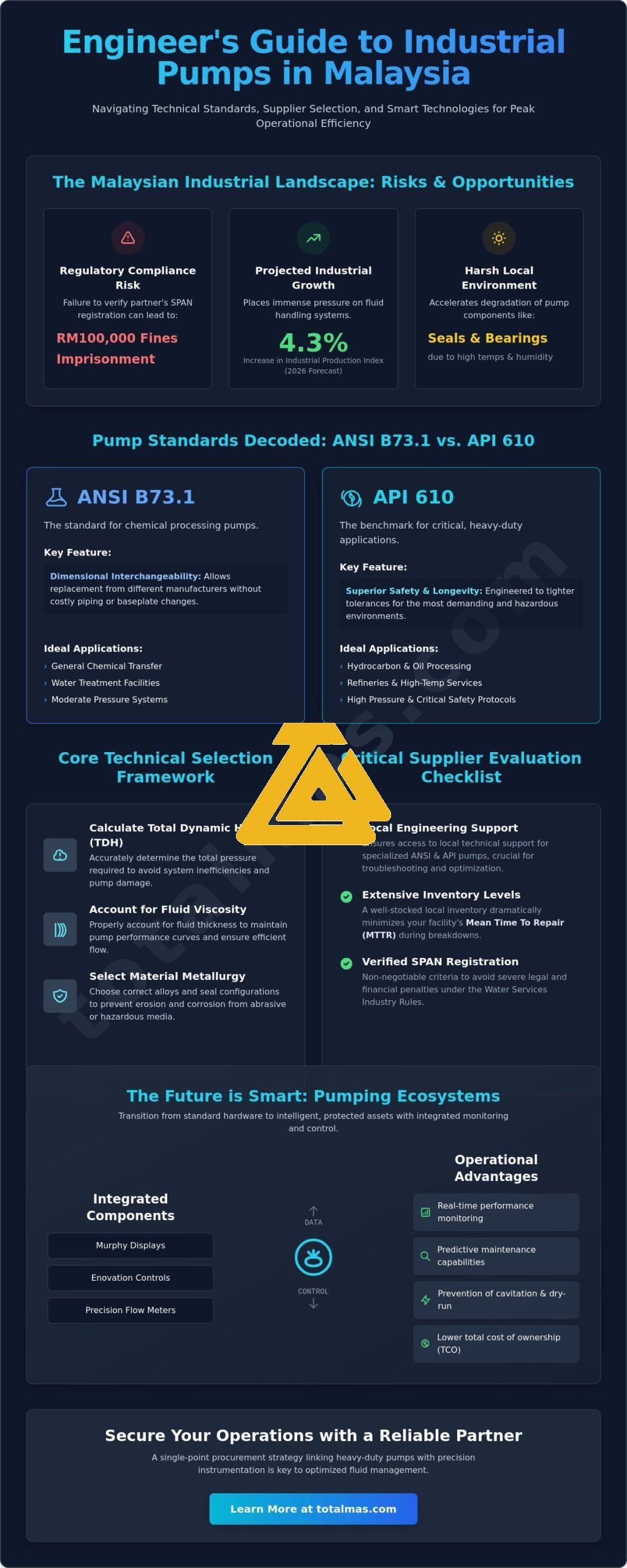
This article serves as a technical resource to help you select, evaluate, and source heavy-duty pumps designed for Malaysia’s most demanding industrial applications. You’ll gain clarity on the 2026 regulatory environment, including the impact of SIRIM 56:2024 ESG reporting standards on procurement. We’ll also preview how integrating advanced flow meters and Enovation Controls into your system can transform raw hardware into a high-performance asset. By the end of this guide, you’ll have a clear roadmap for securing reliable fluid management solutions that align with the projected 4.3% growth in Malaysia’s industrial production index.
Key Takeaways
- Master the technical distinctions between ANSI B73.1 and API 610 standards to ensure your equipment aligns with specific chemical processing or refinery safety protocols.
- Learn to accurately calculate Total Dynamic Head and account for fluid viscosity to maintain pump performance curves and avoid costly system inefficiencies.
- Evaluate an industrial water pump supplier Malaysia based on their engineering support and local inventory levels to effectively minimize your facility’s Mean Time To Repair.
- Understand the process of integrating Murphy Displays and Enovation Controls for real-time monitoring to transform standard pump units into intelligent and protected assets.
- Discover the operational advantages of a single-point procurement strategy that links heavy-duty centrifugal pumps with precision flow meters for optimized fluid management.
The Industrial Pumping Landscape in Malaysia: Meeting High-Performance Demands
Malaysia’s industrial sector is undergoing a period of steady expansion, with growth forecasts for 2026 suggesting an industrial production index increase of up to 4.3%. This trajectory places immense pressure on fluid handling systems, which serve as the heartbeat of manufacturing, energy, and processing facilities. Selecting a seasoned industrial water pump supplier Malaysia is no longer just about purchasing hardware; it’s about securing operational continuity in an environment that is notoriously unforgiving to mechanical equipment. High ambient temperatures and extreme humidity in local plants accelerate the degradation of seals and bearings, making reliability a non-negotiable metric for engineering teams.
Most industrial fluid transport relies on Centrifugal pumps to move large volumes of water and chemicals. However, many facilities fall into the trap of a set and forget mentality. This approach often leads to catastrophic downtime because it ignores the gradual wear caused by corrosive media or fluctuating flow demands. A proactive procurement strategy focuses on equipment that can withstand these stressors while maintaining high hydraulic efficiency. Working with an established industrial water pump supplier Malaysia ensures that your facility receives hardware built for these specific local challenges.
Critical Applications in Palm Oil and Chemical Processing
In palm oil mills, pumps must handle abrasive slurries and high-temperature effluents without constant failure. This requires specific material metallurgy to prevent erosion and premature casing wear. Similarly, chemical hubs in the Klang Valley demand precise transfer solutions where material compatibility is the only defense against hazardous leaks. Utilizing high-spec ANSI or API centrifugal pumps ensures that these demanding media are moved safely. For facilities managing aggressive chemical media, understanding the full technical framework of a chemical pump — including material science, seal selection, and compliance with ISO 15783:2026 — is essential to prevent seal failure, which remains one of the leading causes of unscheduled maintenance in Malaysian processing plants.
The Shift Toward Smart Pumping Ecosystems
The 2026 landscape is defined by the transition from manual checks to automated process control. Malaysian factories are increasingly adopting Industry 4.0 principles to optimize fluid transport and reduce energy waste. By integrating high-accuracy instrumentation, such as Murphy Displays and Enovation Controls, engineers can monitor real-time data to prevent pump cavitation and dry-run conditions. This shift toward smart ecosystems allows for predictive maintenance, ensuring that your pumping assets contribute to a lower total cost of ownership rather than becoming a source of frequent operational expenditure. Real-time monitoring provides the transparency needed to adjust flow rates dynamically, protecting the pump from operating outside its preferred operating region.
ANSI and API Centrifugal Pumps: Understanding the Standards
Choosing the right industrial water pump supplier Malaysia requires a deep understanding of the standards governing pump construction and performance. In heavy industry, a standard water pump designed for general utility won’t suffice. Industrial centrifugal pumps are engineered to much tighter tolerances, allowing them to manage higher pressures, extreme temperatures, and corrosive fluids without failing. The two primary benchmarks you’ll encounter are ANSI and API. These standards don’t just dictate dimensions; they define the safety and longevity of your entire process line.
The ANSI B73.1 standard is the primary specification for horizontal, end-suction centrifugal pumps used in chemical processing. Its main advantage is dimensional interchangeability. This means an ANSI pump from one manufacturer can be replaced by another without requiring expensive piping or baseplate reconfigurations. These pumps are excellent for general chemical transfer and water treatment where pressures remain moderate. However, for the most critical applications in hydrocarbon processing, engineers look toward the American Petroleum Institute. API Standard 610 provides the rigorous framework necessary for pumps operating in high-heat and high-pressure environments. API 610 stands as the gold standard for refinery reliability.
When to Specify ANSI vs. API Standards
Selecting between these standards depends on the severity of your operating environment. While ANSI pumps are cost-effective for non-critical chemical lines, they lack the heavy-duty casing and bearing housing required for refinery service. In the Malaysian oil and gas sector, regulatory bodies often mandate API-compliant equipment for any hydrocarbon service to mitigate the risk of fire or environmental disaster. If you’re managing a facility where fluid temperatures exceed 150 degrees Celsius or suction pressures are exceptionally high, the additional investment in an API-rated unit is essential for risk management. You can consult with an experienced industrial water pump supplier Malaysia to determine which specification fits your project’s technical and budgetary constraints.
Design Features of Heavy-Duty Centrifugal Pumps
The internal design of these pumps varies significantly based on the fluid properties. For instance, open impellers are preferred for handling abrasive slurries common in wastewater treatment, while closed impellers offer higher efficiency for clean water transport. Robust mechanical seals are perhaps the most critical component, acting as the primary defense against hazardous leaks. Material selection is equally vital; while stainless steel is a standard choice for many, exotic alloys like Hastelloy or Duplex stainless steel are often required for aggressive chemical resistance. These design choices ensure that the pump maintains its performance curve even under the most taxing operational cycles.
Technical Selection Framework: Evaluating Flow Rate, Viscosity, and Head
Effective procurement begins with precise technical specifications. According to Malaysian industrial water consumption data, the non-domestic sector accounts for a significant portion of national water usage, necessitating highly efficient transport systems to manage these volumes. When you engage with an industrial water pump supplier Malaysia, the conversation must move beyond simple flow rates to encompass Total Dynamic Head (TDH) and Net Positive Suction Head (NPSH). Calculating TDH requires a thorough accounting of static lift, pressure requirements, and friction losses within your specific piping layout. Failing to account for every elbow and valve can result in a system that underperforms from day one.
Cavitation remains a primary threat to pump longevity in Malaysian plants. This occurs when the NPSH Available at the pump suction is lower than the NPSH Required by the pump design. It leads to the formation of vapor bubbles that implode against the impeller, causing pitting and mechanical failure. To avoid this, engineers must evaluate the relationship between pump speed (RPM) and mechanical wear. While higher RPMs might offer a smaller footprint, they often accelerate seal and bearing degradation. A reliable industrial water pump supplier Malaysia will typically recommend a lower speed for abrasive or continuous-duty applications to extend the Mean Time Between Failures (MTBF).
Handling High-Viscosity and Abrasive Fluids
Transporting thick industrial media presents unique challenges that standard clean-water calculations don’t cover. As fluid viscosity increases, the efficiency of a centrifugal pump drops significantly, requiring a curve correction to ensure the motor isn’t overloaded. For a deep dive into these specific requirements, you can read our technical resource on How to Select Industrial Pumps for High-Viscosity Fluids: A Technical Guide. Adjusting motor power is critical here; a fluid with a high specific gravity or high viscosity requires substantially more torque to maintain the required discharge pressure.
Sizing Your Pump for Operational Efficiency
Many facilities fall into the oversizing trap, choosing a pump larger than necessary to “play it safe.” This leads to the pump operating far from its Best Efficiency Point (BEP), causing vibration, heat buildup, and wasted energy. Understanding where your duty point sits on the pump curve is the only way to ensure reliable operation. In modern Malaysian factories, Variable Frequency Drives (VFDs) are becoming a standard tool to optimize pump output. By adjusting the motor speed to match real-time demand, a VFD ensures the pump stays within its preferred operating region, significantly reducing operational costs and mechanical stress.
Choosing an Industrial Water Pump Supplier in Malaysia: Critical Criteria
Selecting an industrial water pump supplier Malaysia is a decision that extends far beyond the initial procurement cost. While technical specifications like TDH and NPSH are foundational, the supplier’s engineering depth determines whether those specs translate into long-term operational success. A reliable partner doesn’t just deliver a crate; they provide a comprehensive engineering review to ensure the pump integrates seamlessly with existing infrastructure. This level of scrutiny is vital for maintaining the safety standards required in high-pressure environments.
Modern facilities require more than just raw mechanical power. The best suppliers offer integrated solutions that combine heavy-duty centrifugal pumps with precision instrumentation. This includes flow meters and Enovation Controls to monitor performance in real-time. By sourcing these components from a single point of contact, you reduce compatibility issues and streamline your supply chain. Working with an established industrial water pump supplier Malaysia ensures that your engineering team has access to immediate technical guidance when system parameters change.
Proximity and local inventory are the primary defenses against extended downtime. When a critical seal fails or an impeller wears down, waiting weeks for international shipping isn’t an option. A supplier with a robust local spare parts inventory ensures that your facility returns to full capacity within days. Localized testing facilities also allow for performance verification before the equipment is installed, providing peace of mind that the pump meets its rated duty point under actual load conditions.
The Value of Localized Expertise in Kuala Lumpur
Proximity to major industrial zones like Shah Alam and Port Klang allows for rapid response times and localized support. Totalmas brings over 33 years of experience to the Malaysian industrial sector, offering a level of seasoned expertise that newer entrants cannot match. This history enables us to provide on-site consultation services that troubleshoot complex fluid handling issues before they lead to system failure. Understanding local site conditions is essential for recommending the right metallurgy and seal configurations.
After-Sales Support and Technical Training
After-sales support is the hallmark of a committed partnership. This involves training plant personnel on proper pump operation and maintenance to prevent human error, which is a leading cause of premature failure. Preventative maintenance programs for ANSI and API units are designed to identify wear before it becomes catastrophic. Additionally, ensuring long-term accuracy through periodic instrumentation calibration is essential for maintaining process integrity. If you’re looking to upgrade your facility’s pumping reliability, you can consult with our engineering specialists to develop a tailored maintenance and support plan.
Totalmas Sdn Bhd: Your Partner for Industrial Pumping and Instrumentation
Establishing a resilient production line requires a partner that understands the intricate relationship between mechanical hardware and digital oversight. Totalmas positions itself as a premier industrial water pump supplier Malaysia, offering more than just equipment. We provide a single-point resource where engineers can source high-spec ANSI and API centrifugal pumps alongside the precision instrumentation required to manage them. With over 33 years of experience in the Malaysian industrial sector, our team has developed the technical depth necessary to solve unique fluid handling challenges that standard vendors often overlook. We don’t just supply parts; we engineer reliability into your facility’s core operations.
Our commitment to excellence is reflected in our selection of heavy-duty pumps designed for the most taxing environments. Whether you’re managing abrasive slurries in a palm oil mill or high-pressure hydrocarbons in a refinery, our hardware is built to maintain hydraulic performance over long duty cycles. By consolidating your procurement through an established industrial water pump supplier Malaysia, you ensure that every component, from the pump casing to the orifice plates and flanges, meets a unified standard of quality. This holistic approach simplifies maintenance and ensures that your technical support comes from a single, accountable entity.
Synergy Between Pumps and Process Monitoring
Modern pumping systems cannot operate in isolation. Integrating Murphy PowerView displays and Enovation Controls into your pump sets provides real-time visibility into critical metrics like vibration, temperature, and discharge pressure. These displays act as the brain of your pumping system, allowing for automated shutdowns if parameters exceed safe limits. For example, integrating pressure transmitters can protect your investment by preventing dry-run conditions that lead to immediate seal failure. For a deeper understanding of system-wide accuracy, refer to our guide on High Accuracy Flow Meters: The Engineer’s Guide to Precision Measurement.
Energy Efficiency and Sustainability Solutions
Operational costs are a primary concern for any Malaysian plant manager. We focus on reducing these overheads through the selection of energy-efficient pumps that operate at their Best Efficiency Point. Beyond the pump itself, we help facilities explore broader sustainability goals by identifying waste heat recovery opportunities within their fluid transport systems. Utilizing a Waste Heat Recovery Unit (WHRU) can capture thermal energy that would otherwise be lost, redirecting it to improve overall plant efficiency. Learn more about these opportunities in our resource on Waste Heat Recovery Unit Malaysia: The Complete Industrial Guide for 2026. This integrated strategy ensures your facility remains competitive and compliant with evolving ESG standards.
Securing Long-Term Reliability for Your Industrial Fluid Systems
Achieving peak operational efficiency requires a shift from viewing pumps as isolated hardware to seeing them as integrated systems. It’s the only way to ensure long-term success in demanding environments. By prioritizing ANSI and API standards, you ensure your facility meets the rigorous safety and performance requirements of the current industrial landscape. Pairing these heavy-duty centrifugal pumps with precision instrumentation like Murphy Displays and Enovation Controls allows for the real-time monitoring necessary to prevent cavitation and avoid costly downtime.
As a seasoned industrial water pump supplier Malaysia, Totalmas provides the technical depth needed to navigate these complex procurement decisions. Our 33+ years of industrial expertise and specialized ANSI/API pump portfolio ensure your fluid handling requirements are met with proven solutions. We’re an authorized distributor for Enovation Controls and Murphy Displays, offering a single point of contact for both hardware and oversight. This integrated approach simplifies your supply chain while reinforcing the security of your operations.
Consult with our Technical Engineers for Your Pumping Requirements to begin your facility’s system evaluation. We look forward to supporting your next project with the reliability and technical precision your operations demand.
Frequently Asked Questions
What is the difference between an ANSI pump and a standard water pump?
ANSI B73.1 pumps are characterized by their dimensional interchangeability and superior mechanical design compared to general utility pumps. While standard water pumps are suitable for non-critical irrigation or light commercial use, ANSI units feature heavier casings and specialized seal chambers. This design allows them to handle chemical media and higher pressures without the risk of catastrophic failure in industrial process lines.
How do I choose the right industrial water pump supplier in Malaysia?
You should evaluate an industrial water pump supplier Malaysia based on their engineering depth and the availability of local spare parts inventory. A reliable supplier doesn’t just sell hardware; they provide technical consultations to verify that the pump matches your system’s duty point. Ensure they offer integrated solutions, such as flow meters and monitoring displays, to streamline your procurement and maintenance processes.
Why is NPSH critical when selecting a centrifugal pump?
Net Positive Suction Head (NPSH) is the primary metric used to prevent pump cavitation, which causes severe internal pitting and mechanical failure. If the pressure at the suction inlet drops below the fluid’s vapor pressure, bubbles form and implode against the impeller. Engineers must ensure the NPSH Available from the system always exceeds the NPSH Required by the pump to maintain operational integrity.
Can Totalmas provide pumps for highly corrosive chemical applications?
Totalmas supplies specialized ANSI and API centrifugal pumps specifically engineered for aggressive chemical media and corrosive environments. We offer hardware constructed from advanced alloys and stainless steel to prevent chemical degradation and seal leaks. Our technical team assists in selecting the appropriate metallurgy to ensure compatibility with your facility’s specific chemical concentrations and operating temperatures. For a comprehensive reference on material selection and ASME BPVC-2025 compliance, our chemical pump fundamentals guide provides the detailed technical framework needed for specifying equipment in corrosive service.
Do you offer local technical support for pump installation in Kuala Lumpur?
Totalmas provides comprehensive technical guidance and on-site consultation services for industrial facilities throughout the Klang Valley and Greater Kuala Lumpur. Our engineers assist with system troubleshooting and performance verification to ensure that new equipment integrates correctly with your existing piping and control networks. This localized support helps minimize installation errors and optimizes your system’s long-term mechanical reliability.
What are the benefits of integrating Murphy Displays with industrial pumps?
Integrating Murphy Displays with industrial pumps provides real-time visibility into critical performance data such as discharge pressure, vibration levels, and motor temperature. These systems act as a protective barrier, enabling automated shutdowns during dry-run or over-pressure events. By utilizing Enovation Controls, plant managers can transition from reactive repairs to predictive maintenance, significantly reducing the risk of unscheduled downtime.
How does fluid viscosity affect the choice of a centrifugal pump?
Fluid viscosity significantly impacts the hydraulic efficiency of a centrifugal pump, often requiring a reduction in flow and head performance curves. As viscosity increases, the pump requires more torque and power to move the media, which may necessitate a larger motor or a change in impeller design. Choosing an experienced industrial water pump supplier Malaysia ensures that these viscosity corrections are accurately calculated before equipment is commissioned.
What is the typical lead time for API 610 compliant pumps in Malaysia?
Lead times for API 610 compliant pumps depend on the specific metallurgy and seal configurations required for your refinery application. Because these units are engineered to the highest safety standards, they often involve a more detailed manufacturing and testing phase than standard ANSI pumps. It’s best to consult with our technical team early in your procurement cycle to align delivery schedules with your facility’s planned maintenance windows.