
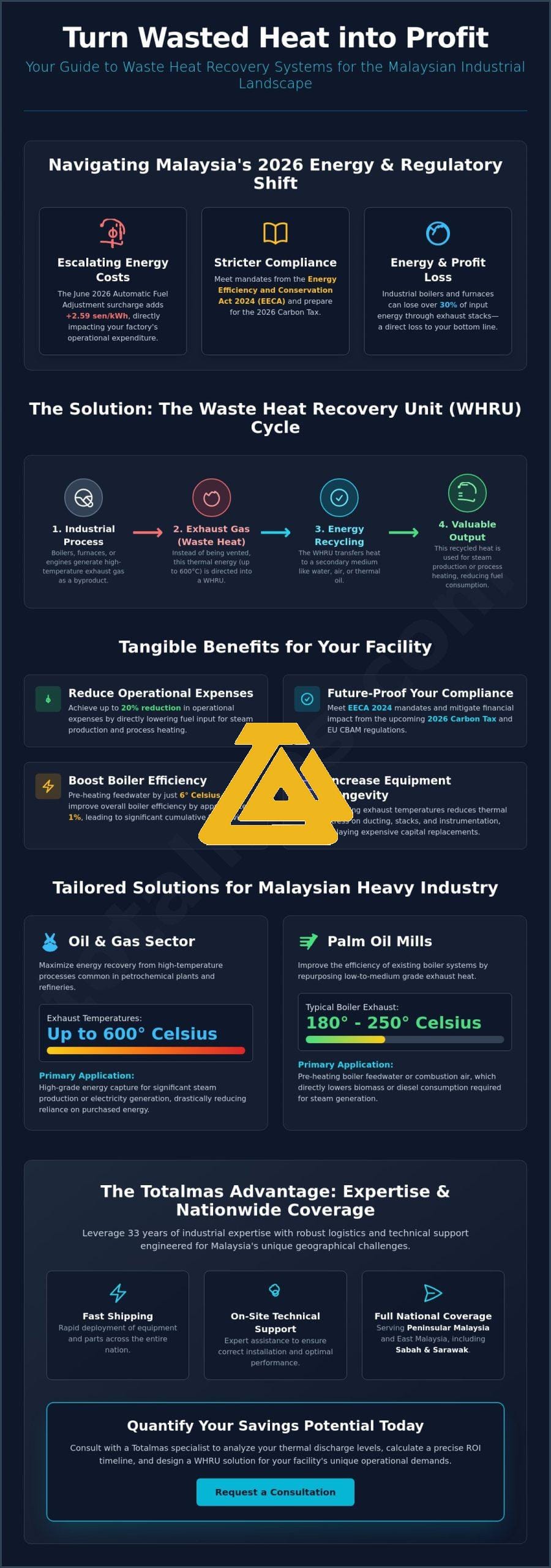
With the June 2026 Automatic Fuel Adjustment surcharge rising to +2.59 sen/kWh, your factory is likely paying significantly more for energy than it did just one month ago. You’re likely feeling the squeeze from escalating fuel prices while facing pressure to meet Energy Efficiency and Conservation Act 2024 (EECA 2024) mandates. It’s a difficult balance to maintain high output in sectors like palm oil or oil and gas while keeping aging boilers running efficiently. We understand that meeting ESG goals shouldn’t come at the expense of your profit margins.
This guide shows you how maximizing waste heat recovery system cost savings can reduce your operational expenses by up to 20% while future-proofing your facility against the 2026 carbon tax. We’ll explore the ROI of industrial waste heat to energy technology and how Totalmas provides the local technical assistance and fast distribution needed across Peninsular Malaysia, Sabah, and Sarawak. You’ll learn how to secure a clear ROI timeline and reduce fuel consumption with reliable equipment that’s built for the practical realities of the Malaysian industrial landscape.
Key Takeaways
- Analyze the 2026 Malaysian energy landscape to understand how capturing exhaust thermal energy directly protects your facility’s profit margins.
- Calculate your potential waste heat recovery system cost savings by applying the “Avoided Cost” principle to process heating and steam production.
- Compare specialized technologies like boiler economizers and WHRUs tailored for the specific thermal profiles of palm oil mills and petrochemical plants.
- Overcome geographical barriers with a logistics network that ensures fast shipping and technical support across Peninsular Malaysia, Sabah, and Sarawak.
- Leverage Totalmas’s 33 years of expertise to implement precise instrumentation and flow meters that validate your system’s long-term operational efficiency.
The Economic Impact of Industrial Waste Heat to Energy in 2026
Waste heat recovery involves the strategic capture of thermal energy that would otherwise be exhausted into the atmosphere during industrial processes. Instead of letting high-temperature gas escape, a Waste heat recovery unit (WHRU) transfers this energy back into the production cycle. In 2026, this isn’t just an environmental choice. It’s a financial necessity. With industrial electricity tariffs facing a +2.59 sen/kWh surcharge as of June 2026, every degree of heat lost is a direct hit to your bottom line. Managers who treat heat as a valuable energy asset rather than a byproduct are seeing superior waste heat recovery system cost savings compared to those relying on traditional boiler setups.
Integrating a waste heat recovery unit Malaysia solution allows your facility to recycle thermal energy for steam production or process heating. This reduces the total fuel input required to maintain operations. Totalmas provides the technical expertise to ensure these systems are sized correctly for the specific demands of the Malaysian climate and industrial standards. By capturing what was once considered waste, you turn a thermal loss into a measurable operational gain.
The Financial Reality of Heat Loss
Typical industrial boilers and furnaces in Malaysia often lose over 30% of their input energy through exhaust stacks. This creates a double financial penalty. First, you pay for fuel that never contributes to your product. Second, unrecovered heat increases the ambient temperature of your facility. This forces your cooling and ventilation systems to work harder, consuming even more electricity. Excessive heat also accelerates the wear of surrounding instrumentation, such as flow meters and displays, leading to higher maintenance costs. Implementing a recovery strategy protects both your budget and your equipment from these thermal stresses.
Strategic Benefits for Malaysian Heavy Industry
The requirements for heat recovery vary significantly across sectors. In the oil and gas industry, exhaust temperatures can reach up to 600 Celsius, offering massive potential for high-grade energy capture. Conversely, palm oil mills can repurpose boiler exhaust to pre-heat feed water or air, directly lowering the biomass or diesel consumption needed for steam. Beyond the immediate waste heat recovery system cost savings, these systems help you comply with the Energy Efficiency and Conservation Act 2024. Totalmas supports these installations with a robust distribution network. We ensure fast shipping and on-site technical assistance for facilities in Peninsular Malaysia and throughout East Malaysia, specifically highlighting our coverage in Sabah and Sarawak.
Quantifying Waste Heat Recovery System Cost Savings
Calculating the financial impact of a thermal capture project requires looking beyond simple fuel reduction. You must evaluate the “Avoided Cost” principle. This involves using recovered heat to replace energy you would otherwise purchase from the grid or external suppliers. By integrating a recovery system, you directly lower the volume of natural gas, diesel, or biomass needed for steam production. These waste heat recovery system cost savings also extend to equipment longevity. When you lower exhaust temperatures before they reach the stack, you reduce the thermal stress on your ducting and structural steel, potentially delaying expensive capital replacements.
Malaysian firms are also facing a new regulatory environment in 2026. With the introduction of the carbon tax and the transition of the EU’s Carbon Border Adjustment Mechanism (CBAM) to paid compliance, energy efficiency is now a trade requirement. Capturing waste heat allows your facility to generate carbon credits or avoid penalties under emerging sustainability frameworks. This transforms your efficiency metrics into a competitive advantage for international exports. To ensure your system is performing to these standards, you can consult with a specialist at Totalmas to review your current thermal discharge levels.
Fuel Savings and Boiler Efficiency
The physics of steam production offer a clear path to savings. In a typical Malaysian boiler setup, pre-heating the feedwater by just 6 Celsius can improve overall boiler efficiency by approximately 1%. For a medium-sized palm oil mill processing 50,000 kilograms of fruit per hour, this efficiency gain translates into thousands of kilograms of saved biomass fuel annually. These results align with current energy efficient waste heat recovery trends that prioritize incremental gains for massive long-term ROI. By utilizing heat that was previously vented, you maintain the same steam output while burning significantly less raw material. For a detailed walkthrough of how to capture these gains from your existing equipment, the guide on boiler waste heat recovery systems provides a structured engineering approach to identifying and assessing your stack’s thermal potential.
Electricity Generation via Organic Rankine Cycle (ORC)
For facilities with significant low-grade waste heat, the Organic Rankine Cycle (ORC) offers a way to generate power for onsite motors and pumps. This technology uses organic fluids with lower boiling points than water to drive turbines even at moderate temperatures. When you compare the cost of self-generated WHR electricity to the rising TNB grid tariffs, the financial incentive is clear. In a continuous 24/7 industrial operation, ORC systems often reach a full ROI within three to five years. Totalmas ensures these complex systems remain operational with a dedicated technical assistance network covering Peninsular Malaysia, Sabah, and Sarawak. This local support is vital for maintaining the reliable instrumentation and flow meters required to validate your ongoing energy savings.
Comparing Recovery Technologies for Palm Oil and O&G
Selecting the right technology depends heavily on the specific thermal profile of your facility. In Malaysia, the requirements for a palm oil mill differ drastically from those of a petrochemical refinery. While palm oil mills focus on biomass boiler exhaust and POME (Palm Oil Mill Effluent) processing, oil and gas refineries deal with higher temperatures and more volatile fluids. Understanding these nuances is the first step toward realizing waste heat recovery system cost savings that actually show up on your monthly reports. For those in the plantation sector, reviewing a dedicated waste heat recovery unit for palm oil industry resource provides a clearer picture of how to handle high-moisture exhaust gas.
In the oil and gas sector, the environment is often more aggressive. High-sulfur fuels and extreme temperatures require corrosion-resistant materials like stainless steel or specialized alloys. Without the right metallurgy, your recovery unit will fail prematurely, wiping out any gains in efficiency. Totalmas provides the technical guidance to match the equipment to your specific process chemistry. We ensure that your investment is protected by hardware that’s built for the long term, supported by a distribution network that reaches from Port Klang to the remote industrial hubs of Sabah and Sarawak.
Heat Exchangers vs. Direct Recovery
Choosing between shell-and-tube and plate heat exchangers is a matter of fluid viscosity and fouling potential. In palm oil mills, where fluids often carry particulates, shell-and-tube designs are frequently preferred for their easier cleaning and maintenance. Plate exchangers offer higher efficiency but can clog in high-fouling environments. Regardless of the choice, you’ll need high accuracy flow meters to monitor fluid exchange efficiency. These instruments provide the data needed to prove your waste heat recovery system cost savings by measuring exactly how much thermal energy is being transferred back into your process.
WHRU Integration in Offshore and Onshore Refineries
Offshore platforms in Sarawak and Sabah waters face unique space and weight constraints. Every kilogram matters when you’re integrating a WHRU into an existing platform architecture. These units must be pressure-rated and compact without sacrificing thermal performance. Onshore refineries have more space but require complex integration with existing piping and control systems. Utilizing high temperature pressure transmitters is essential in these environments to ensure safe operation under volatile conditions. Totalmas acts as your single point of contact for these critical components, providing fast shipping and technical assistance to keep your project on schedule.
Implementation: Overcoming Technical and Geographical Challenges
Moving from a theoretical energy strategy to a functioning installation is where many industrial projects face their toughest hurdles. For a factory manager in Malaysia, the primary concern isn’t just the initial cost. It’s the long-term support. If a recovery unit fails in a remote palm oil mill or an offshore refinery, the resulting downtime can quickly negate your projected waste heat recovery system cost savings. Totalmas addresses this by providing metric-standard technical documentation and engineering support that aligns with local standards. Having data presented in Celsius and kilograms ensures your on-site engineering teams can operate and maintain equipment without the risk of conversion errors. This practical approach bridges the gap between high-level energy goals and daily operational realities.
Our commitment to your facility’s success starts with a localized technical presence. We don’t just ship equipment; we provide the expertise required to integrate these systems into your existing architecture. Whether you’re managing a refinery in Kerteh or a mill in the interior of Sabah, having a reliable technical partner is essential for maintaining system integrity. By choosing a partner with deep roots in the Malaysian industrial landscape, you ensure that your investment in efficiency is protected by a team that understands your specific geographical and technical challenges.
The Instrumentation Factor: Measuring Success
Managing thermal energy requires precise, real-time data. You simply can’t manage what you don’t measure. To accurately validate your waste heat recovery system cost savings, you need a robust network of flow and pressure sensors working in tandem. Totalmas integrates Enovation Controls and Murphy Displays to provide your operators with an intuitive interface for monitoring recovery efficiency. These systems allow for immediate adjustments if thermal transfer rates fluctuate, ensuring you’re always capturing the maximum amount of energy. Flow meter accuracy directly impacts the calculation of thermal energy recovered, turning raw pipe data into a clear financial report for your management team.
Logistics and Support: From KL to Kota Kinabalu
Geographical distance shouldn’t be a barrier to industrial excellence. Totalmas maintains a distribution network that covers the entirety of Peninsular Malaysia while offering specialized support for East Malaysia. We recognize that facilities in Sabah and Sarawak often struggle with slow shipping and a lack of on-site technical assistance. We’ve structured our logistics to prioritize fast shipping of critical spares and the availability of technical experts for troubleshooting in these regions. This local support network is vital for minimizing downtime during WHRU installation and routine maintenance cycles. If you’re ready to discuss a localized implementation plan for your facility, contact Totalmas for specialized industrial support.
Optimizing Your Energy Strategy with Totalmas Solutions
Achieving significant waste heat recovery system cost savings requires more than just high-performance hardware. It demands a partnership with a provider that understands the operational nuances of the Malaysian industrial sector. Totalmas brings over 33 years of experience to factory managers, acting as a single point of contact for Waste Heat Recovery Units (WHRUs) and the critical instrumentation needed to monitor them. We prioritize a “proven reliability” approach, utilizing established technologies that guarantee functional success rather than experimenting with unverified novelties. This steady, expert hand provides the security businesses need when investing in long-term efficiency projects.
Our role as a comprehensive resource means we handle the complexities of equipment selection and integration so you don’t have to. From the initial design phase to the final commissioning, we ensure every component is sized and specified for the high-temperature and high-pressure environments typical of oil refineries and palm oil mills. This end-to-end support model reduces the risk of project delays and ensures that your system delivers the expected ROI from day one.
Why Choose Totalmas for Your WHR Project?
A successful WHR installation relies on a network of supporting equipment to move and monitor thermal energy. Totalmas provides a comprehensive range of ANSI/API centrifugal pumps and high-precision pressure transmitters designed to integrate seamlessly with your recovery unit. Our expertise extends beyond thermal capture; we also offer specialized bulk material handling equipment for fully integrated plant solutions. This authoritative partnership model ensures that every aspect of your facility’s efficiency is addressed by a single, reliable entity. Our distribution network is structured for fast shipping, ensuring that technical assistance is readily available across Peninsular Malaysia and the remote regions of Sabah and Sarawak.
Next Steps: Evaluating Your Plant’s Potential
The path to optimizing your energy strategy begins with a clear understanding of your current thermal discharge. We recommend conducting an initial thermal audit of your existing exhaust streams to quantify the potential waste heat recovery system cost savings available at your site. Measuring exhaust temperatures in Celsius and flow rates in kilograms per hour will provide the baseline data needed for a detailed feasibility study. Once you have these preliminary figures, we invite you to contact our Kuala Lumpur office. Our technical team is ready to review your plant layout and provide a structured consultation on the most effective recovery technology for your specific operational realities. Let us help you turn your waste heat into a strategic energy asset today.
Securing Your Facility’s Thermal Efficiency for 2026 and Beyond
Navigating the 2026 Malaysian energy landscape requires a shift from traditional consumption to strategic thermal capture. As industrial tariffs and carbon regulations tighten, your ability to recycle exhaust energy becomes a primary driver of operational profitability. Realizing long term waste heat recovery system cost savings requires more than just installing a unit; it demands precise instrumentation and a reliable technical partner who understands the geographical challenges of the region. By integrating high-quality flow meters and pressure transmitters, you ensure that every kilogram of steam and every degree Celsius of heat is accounted for in your financial reports.
Totalmas provides this stability with 33 years of industrial experience and a distribution network that ensures fast shipping to both Peninsular and East Malaysia. Whether you’re managing a refinery in Sarawak or a palm oil mill in Sabah, our team offers the specialized instrumentation and technical assistance needed to maintain your system’s integrity. We provide the steady hand and functional expertise necessary to turn thermal waste into a measurable energy asset. You don’t have to face these technical hurdles alone.
Consult with Totalmas for your Waste Heat Recovery Solution to begin a detailed feasibility study for your plant layout. We look forward to helping you optimize your operations for a more efficient and profitable future.
Frequently Asked Questions
How much can a waste heat recovery system save in a typical Malaysian factory?
A typical Malaysian industrial facility can reduce fuel consumption by 5% to 10% using a boiler economizer, with total operational cost savings reaching up to 20% in optimized setups. These waste heat recovery system cost savings are achieved by capturing energy from exhaust streams that often exceed 200 Celsius. Totalmas provides the necessary instrumentation to verify these thermal gains in real-time, ensuring your efficiency targets are met.
Is waste heat recovery viable for small-to-medium-sized palm oil mills?
Yes, waste heat recovery is highly viable for palm oil mills of all sizes. By capturing heat from biomass boiler exhaust, mills can pre-heat combustion air or boiler feedwater, directly reducing the kilograms of fiber and shell required for steam generation. This is particularly effective for managing the high-moisture fuel common in the plantation sector and helps in meeting Energy Efficiency and Conservation Act 2024 (EECA 2024) mandates.
What is the typical ROI period for an industrial waste heat to energy project?
Industrial waste heat to energy projects typically see an ROI period of three to five years, depending on the scale and complexity of the system. Simple boiler waste heat recovery systems such as economizers often pay for themselves much faster due to the immediate reduction in fuel purchase costs. Totalmas assists in calculating a precise ROI timeline based on your plant’s specific exhaust volume and temperature profile to ensure financial clarity before installation.
Does Totalmas provide technical support for WHRU installations in Sarawak?
Totalmas provides comprehensive technical support and on-site assistance for WHRU installations across all regions, including Sarawak and Sabah. We recognize the logistical challenges of East Malaysia and maintain a distribution network designed for fast shipping of critical components. Our technical experts are available for troubleshooting and routine maintenance to ensure your recovery system remains operational with minimal downtime.
Can waste heat recovery units be retrofitted to existing industrial boilers?
Most existing industrial boilers can be retrofitted with waste heat recovery units, such as economizers or air pre-heaters. These retrofits are designed to integrate with your current stack and ducting without requiring a full boiler replacement. Totalmas provides the ANSI/API centrifugal pumps and orifice plates needed to modify your fluid and gas paths for efficient heat transfer during the retrofitting process.
What instrumentation is required to monitor the efficiency of a WHR system?
Monitoring efficiency requires high-accuracy flow meters, pressure transmitters, and centralized displays. Totalmas utilizes Enovation Controls and Murphy Displays to provide real-time visibility into your thermal transfer rates. These instruments allow you to measure exactly how many kilograms of steam are generated per unit of recovered heat, validating your ongoing waste heat recovery system cost savings and providing data for ESG reporting.
Are there government incentives in Malaysia for implementing heat recovery technology?
The Malaysian government offers several incentives, including the Green Technology Financing Scheme (GTFS 5.0), which has been extended until December 31, 2026. This scheme provides government guarantees for green technology projects in the energy and manufacturing sectors. Additionally, the Green Investment Tax Allowance (GITA) can significantly offset the initial capital expenditure for heat recovery systems, improving the overall financial feasibility of the project.
How does high-temperature recovery differ between the Oil & Gas and manufacturing sectors?
High-temperature recovery in the Oil & Gas sector involves exhaust gases reaching up to 600 Celsius, requiring specialized corrosion-resistant alloys to withstand volatile environments. In contrast, the manufacturing and palm oil sectors typically deal with lower-grade heat below 300 Celsius. Totalmas offers specialized instrumentation and WHRUs tailored to the specific thermal and chemical environments of both industries, ensuring equipment longevity and functional success.