What if the most expensive part of your production line wasn’t the raw materials, but the water leaving the facility? As the 2026 regulatory landscape tightens, managing wastewater treatment for food processing industry plants has become a critical factor in maintaining factory ROI. Managers from the palm oil hubs of Peninsular Malaysia to the processing plants in Sabah and Sarawak are facing higher scrutiny on discharge temperatures and organic loads, requiring a more methodical approach to fluid handling and instrumentation.
Maintaining compliance with the Environmental Quality Act 1974 requires a steady hand and proven hardware to avoid inaccurate flow measurements and subsequent fines. This technical guide explores the technologies and maintenance protocols necessary to optimize your treatment plant while reducing chemical and energy costs. We’ll also detail how Totalmas Sdn Bhd supports Malaysian industry with high-accuracy equipment and fast shipping to ensure your facility remains operational and fully compliant with the latest Department of Environment standards.
Key Takeaways
- Understand how to navigate the 2026 Department of Environment (DOE) standards, focusing on the specific discharge limits for Standard A and Standard B zones.
- Identify the most effective primary and secondary technologies for managing high organic loads and oils within wastewater treatment for food processing industry operations.
- Discover the role of precision instrumentation, including high-accuracy flow meters, in optimizing chemical dosing and ensuring accurate regulatory reporting.
- Learn the essential steps for maintaining a compliant Wastewater Treatment Plant (WWTP) through structured calibration and equipment servicing.
- Access technical expertise and rapid parts delivery through Totalmas, supporting industrial sites across Peninsular Malaysia, Sabah, and Sarawak.
The State of Wastewater Treatment in Malaysia’s Food Industry (2026)
Wastewater generated by the Malaysian food sector is notoriously difficult to manage due to its high organic concentration. Unlike standard municipal sewage, effluent from food processing contains elevated levels of Biochemical Oxygen Demand (BOD), Chemical Oxygen Demand (COD), and Total Suspended Solids (TSS). These streams are often saturated with fats, oils, and grease (FOG), particularly in facilities processing palm oil or poultry. Effective wastewater treatment for food processing industry sites requires a robust understanding of these biological loads to prevent system upsets and ensure consistent discharge quality.
2026 marks a significant shift in how Malaysian manufacturers approach environmental stewardship. With the introduction of Regulation No. 2 of 2026 earlier this year, the government has established even tighter standards for the livestock and aquaculture feed sectors. Inefficient wastewater management no longer just risks the environment; it threatens factory ROI through heavy chemical expenditures and energy-intensive operations. Totalmas Sdn Bhd provides deep insights into these industrial challenges, helping businesses transition from reactive maintenance to optimized, high-performance systems.
Department of Environment (DOE) Compliance Standards
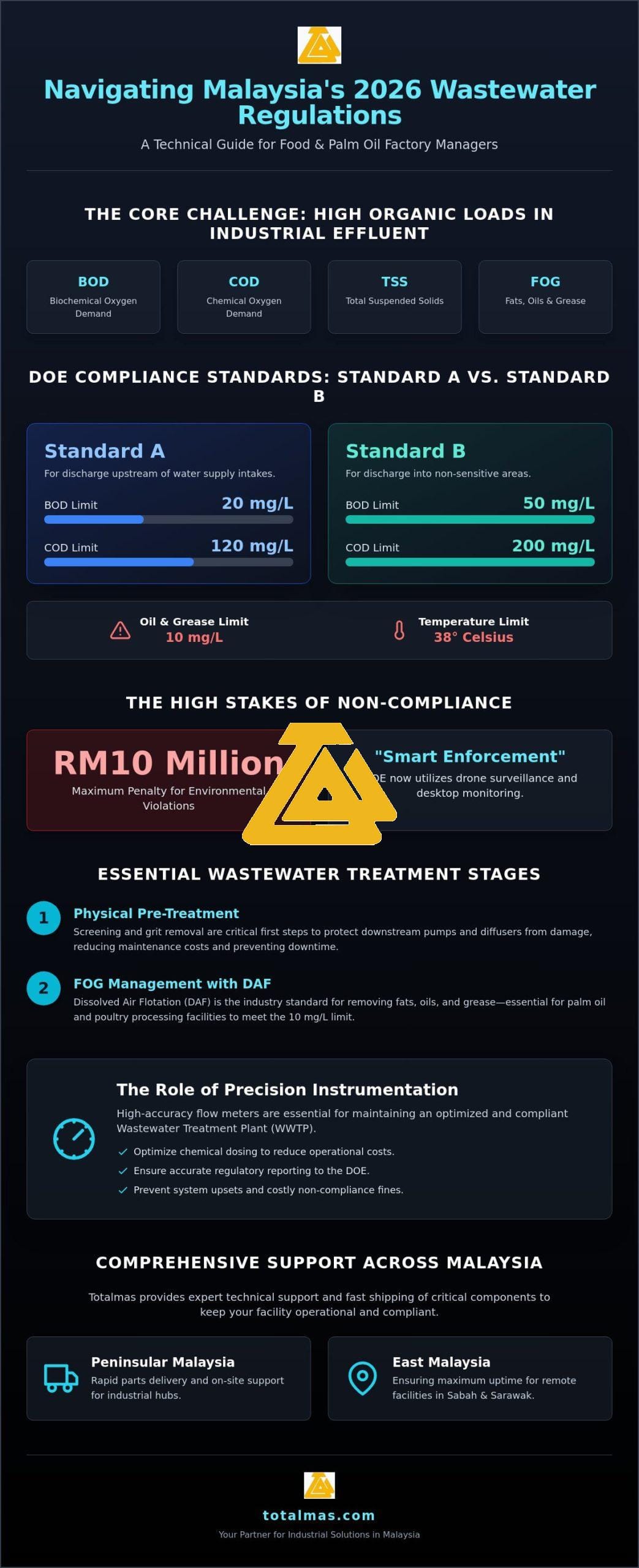
Compliance in Malaysia is governed primarily by the Environmental Quality Act 1974 and the Industrial Effluent Regulations 2009. Factory managers must distinguish between Standard A and Standard B requirements. Standard A applies to discharge upstream of water supply intakes, mandating a BOD limit of 20 mg/L and a COD limit of 120 mg/L. Standard B, for non-sensitive areas, allows for 50 mg/L BOD and 200 mg/L COD.
The stakes for non-compliance have reached an all-time high. Following regulatory updates in 2024, penalties for environmental violations can reach RM10 million. The DOE now utilizes “Smart Enforcement” tactics, including drone surveillance and desktop monitoring, to identify facilities that exceed the 38 Celsius temperature limit or the 10 mg/L oil and grease threshold. Ensuring your plant meets these metrics is essential to avoiding personal liability for company directors and costly stop-work orders.
Challenges Unique to the Malaysian Food Sector
The Malaysian landscape presents specific hurdles, notably the management of Palm Oil Mill Effluent (POME). POME is highly acidic and carries a massive organic load, requiring specialized Core Treatment Technologies to reduce contaminants before the water reaches local drainage channels. Tropical fruit processing also introduces seasonal spikes in volume, often exceeding the 0.1 m³ per ton limit specified in recent regulations for specific sub-sectors.
Reliability remains the primary concern for sites in East Malaysia. Sourcing high-quality components for a wastewater treatment for food processing industry plant in remote areas can lead to significant downtime. Totalmas Sdn Bhd addresses this by providing comprehensive technical support and fast shipping of essential parts, such as high accuracy flow meters and centrifugal pumps, to both Peninsular Malaysia and East Malaysia. Our logistics network ensures that facilities in Sabah and Sarawak maintain the same operational uptime as those in the Klang Valley, keeping your compliance record spotless.
Core Treatment Technologies: Addressing High Organic Loads
Effective wastewater treatment for food processing industry sites begins with the robust removal of physical solids. Primary treatment stages, including screening and grit removal, are essential to protect downstream equipment from mechanical wear. Without adequate screening, large debris can damage centrifugal pumps or clog fine-bubble diffusers, leading to expensive repairs and unplanned downtime. Precision matters at this stage. Removing inorganic solids early ensures that the subsequent chemical and biological stages operate at peak efficiency, reducing the overall energy footprint of the facility.
Physical and Chemical Pre-treatment
Dissolved Air Flotation (DAF) is the industry standard for managing fats, oils, and grease (FOG) in Malaysian food production. By introducing micro-bubbles into the wastewater, DAF units lift emulsified oils to the surface for mechanical skimming. This process is particularly vital for poultry processing and palm oil refineries where oil concentrations often exceed the 10 mg/L limit set for Standard B discharge. Optimizing chemical consumption is another priority. Precise dosing pumps allow for the exact delivery of coagulants and flocculants, which adjust the pH to the required 6.0 to 9.0 range while facilitating solid-liquid separation in sedimentation tanks.
Biological Treatment Systems
Choosing the right biological configuration is the most critical decision in wastewater treatment for food processing industry applications. Activated sludge processes utilize aerobic bacteria to break down organic matter, but they require significant aeration energy. To manage costs, factory managers are increasingly looking at automated dissolved oxygen control. In the palm oil sector, anaerobic digestion remains the preferred method for treating high-strength effluent. This process converts organic waste into biogas, providing a potential renewable energy source for the mill while significantly reducing the BOD load before the water reaches the polishing stage.
Advanced facilities are now adopting Membrane Bioreactors (MBR) to achieve high-quality effluent suitable for industrial reuse. MBR systems combine biological treatment with membrane filtration, eliminating the need for secondary clarifiers and producing water that meets the strictest environmental standards. Totalmas Sdn Bhd provides extensive technical support and wastewater treatment plant solutions to help you navigate these engineering decisions. Whether your facility is in the Klang Valley or located in the remote regions of Sabah and Sarawak, our logistics network ensures fast shipping of critical components. Maintaining a steady supply of spare parts and reliable technical guidance is essential for ensuring your plant remains compliant with the Environmental Quality Act 1974 without sacrificing operational ROI.
Optimising WWTP Performance with Precision Instrumentation
While biological and chemical processes form the core of any wastewater treatment for food processing industry facility, the efficiency of these systems relies entirely on the precision of the hardware managing fluid movement. Inaccurate flow data or pump failure doesn’t just disrupt operations; it leads to regulatory fines and environmental damage. For Malaysian factory managers, 2026 has brought stricter oversight on discharge volumes, with specific sectors limited to a maximum of 0.1 m³ of wastewater per ton of product. Meeting these targets requires instrumentation that performs reliably under the harsh, corrosive conditions common in food processing environments.
Flow Meters: The Eyes of the Treatment Plant
Accurate measurement is the first line of defense against non-compliance. Electromagnetic flow meters are often preferred for sludge and effluent because they have no moving parts to clog, while ultrasonic meters offer non-intrusive measurement for existing pipelines. When selecting high accuracy flow meters, it’s vital to consider the temperature of the stream. With DOE regulations capping discharge at 38 Celsius, real-time monitoring of both flow rate and temperature is essential. Automated data logging reduces the risk of human error in compliance reporting, providing a verifiable audit trail for the Department of Environment (DOE).
Pumping Solutions for Demanding Effluents
The movement of abrasive solids and acidic waste requires specialized pumping technology. Standard pumps often fail prematurely when exposed to the high organic loads of the food sector. Utilizing heavy duty centrifugal pumps constructed from corrosion-resistant materials ensures that your system maintains a consistent effluent flow. These pumps are designed to handle the variable viscosities found in palm oil mill effluent (POME) or poultry processing waste without succumbing to cavitation. Proper maintenance of these units is critical to preventing unplanned downtime that could lead to untreated discharge spills.
Totalmas provides a comprehensive range of instrumentation and pumping solutions, including Murphy displays and Enovation controls for real-time performance monitoring. These displays allow operators to track pump pressure and engine health at a glance, ensuring that the wastewater treatment for food processing industry plant operates within its design parameters. We understand the logistical challenges of operating in East Malaysia. That’s why we prioritize fast shipping and technical support for our clients in Sabah and Sarawak, as well as throughout Peninsular Malaysia. Our team ensures that high-quality spare parts and engineering expertise are always within reach, regardless of your factory’s location.
Regulatory Compliance and Maintenance in Malaysia
Achieving initial compliance is only the first step; maintaining a wastewater treatment for food processing industry facility requires a rigorous, data-driven approach to prevent system drift. In the Malaysian industrial landscape, where humidity and high ambient temperatures can accelerate equipment wear, a reactive maintenance strategy is a liability. A single non-compliance event under the Environmental Quality (Industrial Effluent) Regulations 2009 can now result in penalties of up to RM100,000. For factory managers, the goal is to establish a preventative framework that ensures every sensor and pump operates within its design parameters every day of the year.
Maintenance Protocols for Malaysian Factories
Consistency in wastewater management starts with structured operator checklists. Daily tasks should focus on verifying pH levels stay between 6.0 and 9.0 and ensuring that wastewater temperatures do not exceed 38 Celsius before discharge. Weekly protocols must include the calibration of instrumentation to account for sensor fouling, which is common in high-organic food waste. On a monthly basis, engineers should inspect the mechanical seals of centrifugal pumps and evaluate the efficiency of waste heat recovery units to ensure the plant isn’t wasting energy. Training staff to interpret data from Enovation Controls and Murphy Displays allows for early detection of cavitation or flow irregularities, preventing small issues from becoming regulatory crises.
Logistics and Technical Support
Logistical delays are often the primary cause of extended downtime in Malaysian factories. For facilities located in the industrial hubs of Sabah and Sarawak, waiting weeks for a replacement seal or a calibrated flow meter can lead to untreated discharge and subsequent DOE fines. Totalmas addresses this challenge by maintaining a robust supply chain that prioritizes fast shipping across both Peninsular and East Malaysia. We serve as a single-source supplier, providing everything from orifice plates to complex wastewater treatment for food processing industry solutions, which simplifies the procurement process for busy factory managers.
Reliability is built on partnership. Having access to comprehensive technical support ensures that when a system upset occurs, expert guidance is available to restore the biological balance or recalibrate instrumentation. By consolidating your equipment needs with a seasoned expert, you gain a steady hand in navigating the complexities of the Environmental Quality Act 1974. If you require immediate assistance with your plant’s instrumentation or pumping systems, you can reach out for Totalmas technical support to ensure your facility remains a model of operational excellence and regulatory compliance.
Partnering with Totalmas for Robust Wastewater Solutions
Totalmas has spent over 33 years establishing itself as a cornerstone of the Malaysian industrial sector. We’ve built our reputation on providing more than just hardware; we deliver long-term reliability for complex systems like wastewater treatment for food processing industry facilities. Our deep roots in the oil & gas and palm oil sectors have given us a unique perspective on the durability required for local operations. We don’t just sell equipment. We provide the technical foundation that allows your factory to meet the 2026 DOE standards with quiet confidence and operational security.
The industrial landscape in Malaysia demands a partner who understands that downtime isn’t just a loss of revenue; it’s a risk to your regulatory standing. We position ourselves as a comprehensive resource, a single point of contact that handles diverse and complex requirements with ease. By focusing on proven reliability rather than fleeting novelty, we ensure that every solution we provide—from flow meters to centrifugal pumps—is engineered for functional success in the most demanding environments.
Why Malaysian Industry Trusts Totalmas
Our clients rely on us because we understand that precision and uptime are inseparable. Integrating Murphy PowerView displays into your plant’s control architecture provides operators with the immediate data needed to prevent costly overflows or mechanical failures. This level of monitoring is essential for managing the high organic loads and fluctuating flow rates typical of food processing effluent. It’s about giving your team the tools to see what’s happening inside the pipes in real time.
Beyond fluid handling, our expertise extends to the management of solid waste. By utilizing bulk material handling equipment, factories can efficiently move dewatered sludge for disposal or secondary use, creating a seamless link between the treatment process and waste logistics. Whether your plant is located in the heart of the Klang Valley or in the remote reaches of Sabah and Sarawak, our commitment remains the same. We offer fast shipping and comprehensive technical support across both Peninsular Malaysia and East Malaysia, ensuring that distance never compromises your compliance.
Get Started with a Technical Consultation
Optimizing a wastewater treatment for food processing industry plant requires a customized approach. A one-size-fits-all solution often leads to inefficient chemical dosing or premature pump wear. Totalmas offers in-depth site assessments to evaluate your current flow and pressure measurement capabilities. We help you identify the specific instrumentation packages that will best serve your unique operational needs, ensuring every kilogram of waste is accounted for and treated correctly.
Our team is ready to provide the guidance necessary to navigate the evolving regulatory landscape of 2026. By partnering with a single-source supplier, you streamline your procurement and ensure that every component in your system is designed for maximum compatibility. Contact Totalmas today to discuss how our technical expertise and robust equipment range can secure your facility’s operational future and environmental compliance.
Securing Your Operational Future in 2026
Navigating the 2026 DOE standards requires a shift from reactive fixes to integrated hardware solutions. Precision in flow measurement and robust pumping are no longer optional; they’re essential for staying within the 38 Celsius and BOD/COD discharge limits. Optimizing wastewater treatment for food processing industry plants relies on high-performance instrumentation that can withstand the corrosive nature of organic waste. By prioritizing preventative maintenance and accurate data logging, factory managers don’t just avoid RM10 million fines; they improve their long-term ROI.
With over 33 years of Malaysian industrial experience, Totalmas provides the technical foundation needed for sustainable success. Our full range of API-compliant pumps and high-accuracy flow meters ensures your facility operates at peak efficiency. We take pride in offering specialized support for Sabah and Sarawak, ensuring that technical expertise and fast shipping are available to every corner of the country. Contact Totalmas for expert wastewater instrumentation and equipment support to begin your site assessment. We’re ready to help you build a more resilient and compliant industrial operation.
Frequently Asked Questions
What are the current DOE standards for food industry wastewater in Malaysia?
Malaysian factories must adhere to the Environmental Quality (Industrial Effluent) Regulations 2009, which categorize discharge into Standard A and Standard B. Standard A requires BOD levels below 20 mg/L and COD below 120 mg/L, while Standard B permits 50 mg/L and 200 mg/L respectively. Additionally, Regulation No. 2 of 2026 limits wastewater volume to 0.1 m³ per ton of product for specific sectors and mandates a maximum discharge temperature of 38 Celsius.
How can I reduce the COD and BOD levels in my factory effluent?
Reducing organic loads effectively requires a combination of primary physical screening and secondary biological treatment. Utilizing anaerobic digestion is particularly effective for high-strength streams like palm oil mill effluent, while aerobic activated sludge processes or Membrane Bioreactors (MBR) provide the polishing needed to meet Standard A. Totalmas can assist in selecting the right instrumentation to monitor these biological processes, ensuring they operate at peak efficiency to remove dissolved contaminants.
Which type of flow meter is best for measuring thick sludge?
Electromagnetic flow meters are the most reliable choice for measuring thick sludge or effluent with high suspended solids. Because they don’t have moving parts or internal obstructions, they aren’t prone to clogging or mechanical wear from abrasive particles. Their high accuracy is vital for wastewater treatment for food processing industry reporting, where precise volume tracking is required to stay within the 0.1 m³ per ton limit specified in recent regulations.
Do you provide technical support and shipping to Sabah and Sarawak?
Yes, Totalmas provides comprehensive technical support and fast shipping for all industrial equipment across both Peninsular and East Malaysia. We recognize the unique logistical hurdles faced by factory managers in Sabah and Sarawak. Our supply chain is optimized to ensure that critical spare parts and engineering expertise reach remote industrial sites quickly, helping you maintain compliance and avoid the heavy penalties associated with equipment failure and untreated discharge.
Can I reuse treated wastewater in my food processing facility?
Treated wastewater can be reused for non-potable applications such as cooling tower make-up, floor cleaning, or landscape irrigation. To achieve the necessary water quality for reuse, tertiary treatment stages like ultrafiltration or reverse osmosis are often required. Implementing a water reuse strategy helps factories reduce their environmental footprint and can significantly lower the total volume of discharge, making it easier to comply with increasingly strict Malaysian water consumption regulations.
What is the role of centrifugal pumps in a wastewater treatment plant?
Centrifugal pumps are the workhorses of any wastewater treatment for food processing industry plant, responsible for moving effluent between treatment tanks and handling sludge return. Using heavy-duty ANSI or API centrifugal pumps is essential when dealing with the acidic or abrasive waste common in food production. These pumps ensure a steady flow through the system, preventing the stagnant conditions that can lead to biological upsets or localized overflows that trigger DOE inspections.
How does a waste heat recovery unit improve WWTP efficiency?
A waste heat recovery unit (WHRU) captures thermal energy from processing lines to pre-heat wastewater streams or support anaerobic digesters. This improves the metabolic rate of treatment bacteria and reduces the external energy required to maintain optimal process temperatures. Furthermore, by managing the thermal load of the effluent before it reaches the final discharge point, a WHRU helps ensure the water doesn’t exceed the 38 Celsius limit mandated by the Department of Environment.
Why is real-time monitoring important for environmental compliance?
Real-time monitoring provides an immediate alert if discharge parameters like pH or temperature drift outside the legal 6.0 to 9.0 range. Using Murphy displays and Enovation controls allows operators to track system health continuously, preventing the accidental release of off-spec effluent. With Malaysian penalties reaching as high as RM10 million for major violations, having a verifiable digital record of your plant’s performance is a critical safeguard for both the environment and company directors.