
A sudden mechanical failure at a remote facility in Sabah or Sarawak can result in staggering downtime costs, often exceeding tens of thousands of Ringgit before a technician even arrives on-site. In the high-pressure world of Malaysian oil, gas, and palm oil processing, you understand that equipment reliability isn’t a luxury; it’s the foundation of your operational safety. Mastering the rigorous API centrifugal pump standards is essential to prevent these costly disruptions and maintain strict compliance in hazardous hydrocarbon environments.
This 2026 reliability guide will help you manage the complexities of these standards to ensure safety and optimized performance in your local operations. We’ll clarify the critical differences between API and ANSI specifications and provide a clear framework for selecting the right pump for specific chemical processes. By drawing on the 33 years of expertise at Totalmas Sdn Bhd, you’ll learn how to secure a robust supply chain with fast shipping and comprehensive technical support that reaches every corner of Malaysia, from Peninsular hubs to the furthest reaches of East Malaysia.
Key Takeaways
- Understand why API 610 is the benchmark for safety and reliability in hazardous hydrocarbon and high-temperature environments.
- Learn how heavy-duty casing and shaft stiffness requirements in API centrifugal pump standards significantly extend seal and bearing life.
- Gain clarity on when to specify API 610 pumps over ANSI B73.1 to handle flammable fluids and extreme nozzle loads.
- Identify the specific benefits of applying these standards to downstream Oil & Gas and palm oil processing within the Malaysian landscape.
- Discover how to leverage Totalmas’s 33 years of expertise for technical support and fast shipping across Peninsular Malaysia, Sabah, and Sarawak.
What are API Centrifugal Pump Standards?
API centrifugal pump standards represent the benchmark for equipment performance and mechanical integrity in high-risk industrial environments. Established by the American Petroleum Institute, these standards prioritize safety, reliability, and maintainability above all else. In the context of Malaysia’s industrial landscape, where facilities often operate under extreme conditions, these guidelines provide a framework to prevent catastrophic failures. The standards focus on how a pump is built to handle hazardous fluids, ensuring that even under high pressure, the equipment remains contained and operational.
For refineries and hydrocarbon processing plants, adhering to these standards is non-negotiable. Handling flammable or toxic fluids requires a level of engineering that goes beyond standard industrial requirements. By following centrifugal pump design and operating principles set by the API, engineers can ensure that pumps are designed for a minimum service life of 20 years. The API 610 document serves as the core reference for these pumps, detailing everything from material selection to vibration limits.
The History and Evolution of API 610
The API 610 standard has undergone numerous revisions to keep pace with advancing technology and more demanding process requirements. Early versions focused on basic mechanical stability, but modern editions have evolved to address higher operating temperatures and pressures common in modern Malaysian refineries. There is now a significant emphasis on standardized dimensions and shaft stiffness to minimize deflection, which directly extends the life of seals and bearings. API 610 is widely recognized as the ‘gold standard’ for refinery pumps.
Key Regulatory Bodies and Compliance
While the API is a US-based organization, its standards have achieved global dominance through a close relationship with the International Organization for Standardization (ISO). This international recognition means that a pump compliant with API 610 meets the same rigorous benchmarks whether it is installed in Europe or Malaysia. Totalmas leverages over 33 years of experience to ensure that the equipment supplied meets these international benchmarks, providing peace of mind for factory managers. We understand that compliance is about more than just paperwork; it’s about ensuring the safety of your personnel in Peninsular Malaysia, Sabah, and Sarawak. Our technical support teams are well-versed in these requirements, helping you maintain a reliable supply chain for your most critical operations.
The Engineering Logic of API 610 Requirements
API centrifugal pump standards dictate specific engineering choices that differentiate these machines from standard industrial pumps. One of the most critical aspects is casing design. These pumps feature heavy-duty construction designed to withstand high nozzle loads without deforming. This rigidity ensures that piping stresses don’t cause internal misalignment, which is a common cause of failure in high-pressure Malaysian refineries. By adhering to these pump system efficiency and reliability standards, operators can significantly reduce unplanned maintenance events.
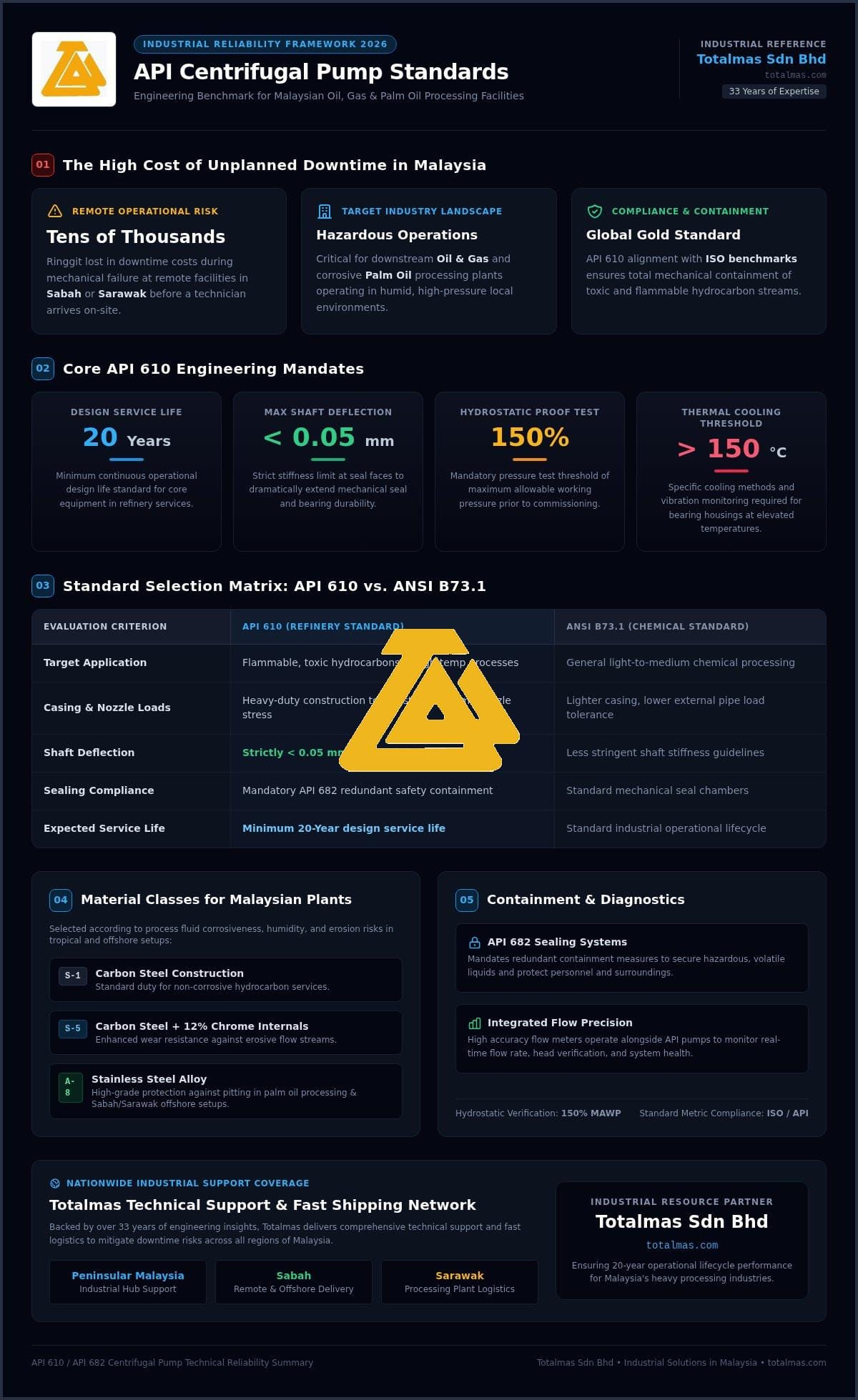
Shaft stiffness is another core requirement. API 610 mandates designs that minimize shaft deflection at the seal faces to less than 0.05 mm. This precision directly extends the life of mechanical seals and bearings, which are the most frequent points of failure in centrifugal systems. Additionally, bearing housings must include provisions for vibration monitoring and often require specific cooling methods to handle fluids exceeding 150 Celsius. All sealing systems must comply with API 682, ensuring that hazardous or flammable liquids are contained with redundant safety measures that protect both personnel and the environment.
Material Classes and Selection
Selecting the correct material class is vital for long-term durability in Malaysia’s humid and often corrosive environments. Common classes like S-1 (carbon steel), S-5 (carbon steel with 12% chrome internals), or A-8 (stainless steel) are chosen based on the chemical properties of the process fluid. For instance, corrosive palm oil processing or offshore applications in Sabah and Sarawak may require higher-grade alloys to prevent pitting and erosion. In these complex setups, high accuracy flow meters work alongside these pumps to provide real-time data on system health and efficiency.
Performance Testing and Documentation
Every pump built to these standards undergoes rigorous hydrostatic testing at 150% of the maximum allowable working pressure. Performance curve verification ensures the pump meets its rated flow and head requirements before it leaves the factory. The goal is to meet the 20-year service life design criteria, providing a level of reliability that justifies the investment for critical infrastructure. This process includes detailed documentation for full traceability, which is essential for regulatory compliance in the Malaysian energy sector. If you are unsure which material class fits your specific application, you can consult with the technical team at Totalmas for a professional assessment and comprehensive support across Malaysia.
API vs. ANSI Pumps: Choosing the Right Standard
Deciding between ANSI and API standards is a critical step for any Malaysian plant manager. While both are centrifugal designs, they serve vastly different operational roles. ANSI B73.1 pumps are the standard for general chemical and water applications. They’re cost-effective and reliable for non-hazardous duties. However, API centrifugal pump standards are designed specifically for the extreme conditions found in refineries and hydrocarbon processing. If you’re handling flammable fluids at high pressures, the API 610 standard isn’t just a recommendation; it’s a safety requirement.
The cost-benefit analysis often comes down to the price of failure. A standard water treatment plant might tolerate a few hours of downtime for a seal replacement on an ANSI pump. In contrast, a refinery in a remote location like Bintulu cannot afford unplanned outages. Investing in an API-compliant pump reduces long-term operational costs by ensuring the equipment can handle 20 or more years of service without catastrophic failure. If a pump failure in a Sarawak refinery results in RM 50,000 of lost production per hour, the initial investment in a higher-spec API pump is easily justified as an insurance policy for your facility.
Structural Differences and Durability
The most visible difference lies in how the pump is mounted. ANSI pumps are typically foot-mounted, which is sufficient for ambient temperatures. API pumps use centerline mounting to ensure that thermal expansion doesn’t disturb shaft alignment. This design feature is exactly why API pumps are preferred for any fluids above 175 Celsius. The casing thickness in an API 610 pump is significantly greater, allowing it to withstand twice the nozzle loads of an ANSI equivalent. These engineering choices lead to a much longer L10 bearing life, often exceeding 25,000 hours of continuous operation in demanding environments.
Totalmas Selection Framework
Choosing the right equipment requires a logical evaluation of fluid volatility and environmental risk. At Totalmas, we help plant managers navigate these choices by assessing the specific needs of the Malaysian industrial sector. If your process involves toxic chemicals or high-temperature oil, the API standard is the correct choice. For general utility water or non-corrosive liquids, an ANSI pump may be more efficient. For a deeper look at procurement strategies, you can read our API 610 Centrifugal Pumps Malaysia guide. Our team provides technical support across Peninsular and East Malaysia, ensuring your facility in Sabah or Sarawak remains compliant and operational.
Applying API Standards in the Malaysian Industrial Landscape
Operational safety in Malaysia depends on more than just high-quality hardware. It requires a deep understanding of how local environmental factors interact with global engineering benchmarks. Coastal refineries in locations like Kerteh, Pengerang, and Bintulu face constant exposure to high humidity and salt spray. These conditions accelerate atmospheric corrosion, making the material selection criteria within API centrifugal pump standards a vital safeguard. Beyond environmental durability, Malaysian factory managers must ensure all pumping systems comply with the Department of Occupational Safety and Health (DOSH) regulations, particularly when handling pressurized or hazardous fluids.
Adhering to these standards ensures that equipment can withstand the unique rigors of the local climate while meeting legal safety requirements. Totalmas leverages 33 years of industrial experience to help clients navigate these technical hurdles. We provide the expertise needed to select equipment that doesn’t just meet a global spec but thrives in the specific heat and moisture levels of the Malay Peninsula and Borneo.
Sector-Specific Applications: O&G and Palm Oil
The downstream Oil & Gas sector remains the primary user of API-grade equipment, where pumps handle volatile hydrocarbons at extreme pressures. However, the palm oil industry increasingly adopts these standards for refinery fractionation processes. These applications often involve processing oils at temperatures exceeding 200 Celsius, where the centerline mounting of an API 610 pump prevents the thermal misalignment issues common in standard pumps. To enhance reliability, many facilities are now integrating a Murphy PowerView display Malaysia for real-time monitoring of pump vibration and bearing temperatures. This proactive approach allows operators to identify potential failures before they result in costly production stops.
Logistics and Support: Peninsular to East Malaysia
Logistical reliability is often as important as the equipment itself. Delivering a 500 kg pump assembly or critical mechanical seals to remote sites in Sabah and Sarawak presents significant challenges. Totalmas has refined its fast shipping protocols to ensure that distance doesn’t compromise your uptime. Our technical support teams are available to assist with installation and troubleshooting across the entire country, providing a steady hand for facilities located far from urban industrial hubs. Whether you are managing a plant in Shah Alam or a remote refinery in Miri, we ensure your supply chain for critical spares remains robust and responsive. If you need to upgrade your current systems to meet modern safety benchmarks, contact Totalmas today for expert guidance on API-compliant solutions.
Sourcing and Maintaining API Centrifugal Pumps with Totalmas
Selecting the right hardware is only half the battle. Successful industrial operations require a partner who understands the long-term implications of API centrifugal pump standards on your maintenance budget. With over 33 years of technical expertise in the Malaysian market, Totalmas provides more than just equipment. We offer a comprehensive approach that begins with a detailed technical consultation to ensure your pump selection aligns perfectly with your specific process requirements. Our support continues long after the initial sale, providing the steady hand needed to manage complex industrial systems.
Integration with advanced monitoring systems is a key component of modern pump longevity. By utilizing Enovation Controls and Murphy displays, we help you transition from reactive repairs to predictive maintenance. This data-driven strategy allows you to monitor vibration and temperature fluctuations, ensuring your pumps operate within their designed performance curves. Implementing these preventative strategies is essential for maximizing the 20-year service life promised by API 610 designs, especially in high-pressure oil and gas environments.
Comprehensive Technical Support and Training
Our commitment to your operational success includes on-site support for installation and commissioning. We don’t just deliver the pump; we ensure it’s correctly aligned and integrated into your existing infrastructure. To empower your team, we offer training sessions for factory managers on maintenance best practices specific to API standards. This includes the effective use of high temperature pressure transmitters for real-time monitoring of system health. By equipping your staff with these technical skills, you reduce the risk of human error and extend the intervals between major overhauls.
The Totalmas Advantage in Malaysia
Totalmas maintains a reliable supply chain that spans both Peninsular and East Malaysia. We understand that a missing part in a Sabah refinery or a Sarawak palm oil mill can halt production entirely. That’s why we prioritize fast response times and efficient shipping protocols across the country. Our deep roots in the local industry mean we’re familiar with the specific regulatory and logistical challenges you face every day. Whether you need a new installation or critical spares for an existing system, our team is ready to assist. Contact Totalmas for your API pump requirements and secure a partnership built on proven reliability and technical excellence.
Securing Long-Term Operational Excellence in Malaysia
Securing the reliability of your industrial operations starts with a deep commitment to established engineering benchmarks. By mastering API centrifugal pump standards, you ensure that your facility is prepared for the rigorous demands of hydrocarbon processing and high-temperature palm oil refining. We’ve explored how these standards protect your infrastructure, the critical differences between API and ANSI equipment, and the necessity of choosing a partner that understands the unique logistical challenges of the Malaysian market.
Totalmas brings over 33 years of industry experience to every project, providing expert support specifically tailored for the Oil & Gas and Palm Oil sectors. Our comprehensive technical services and fast shipping protocols ensure full coverage for both Peninsular Malaysia and East Malaysia, including remote locations in Sabah and Sarawak. Whether you’re upgrading an existing refinery or commissioning a new plant, having a dependable mentor for your technical solutions is the key to minimizing downtime and maximizing safety.
Take the next step in optimizing your facility’s performance. Request a Technical Consultation for API Pumps today and partner with a team dedicated to your long-term success.
Frequently Asked Questions
What is the latest edition of the API 610 standard?
The API 610 12th edition remains the current reference for centrifugal pumps in the petroleum, petrochemical, and natural gas industries. It introduces refined vibration limits and more stringent testing protocols compared to earlier versions. Totalmas ensures that all supplied equipment adheres to these latest API centrifugal pump standards. This ensures that Malaysian facilities remain aligned with global safety benchmarks and benefit from the most recent engineering improvements in pump reliability.
Can an ANSI pump be used in an API 610 application?
ANSI pumps generally shouldn’t be used in API 610 applications involving hazardous hydrocarbons or extreme temperatures. They lack the centerline mounting and heavy casing thickness required to handle high nozzle loads and thermal expansion. Using an ANSI pump where API standards are specified increases the risk of seal failure and environmental leaks. For critical processes in Malaysia, sticking to the API 610 standard is the safest choice for long-term integrity.
How do API standards impact pump maintenance intervals?
API standards are designed for a minimum service life of 20 years and at least three years of uninterrupted operation. The heavy-duty casing and increased shaft stiffness reduce vibration, which directly extends the life of mechanical seals and bearings. This allows you to schedule maintenance intervals much further apart than with standard pumps. For remote sites in Sabah or Sarawak, these longer intervals are vital for reducing the high costs of specialist technician travel.
What are the most common material classes for API pumps in Malaysia?
The most common material classes used in Malaysian industrial sectors include S-1 (carbon steel), S-6 (carbon steel with 12% chrome internals), and A-8 (316 stainless steel). S-6 is frequently selected for its resistance to erosion in hydrocarbon services, while A-8 is preferred for corrosive chemical processing. Totalmas provides technical guidance to help you select the appropriate class based on the specific fluid properties and the high humidity levels found in local coastal refineries.
Does Totalmas provide spare parts for API pumps in Sabah and Sarawak?
Yes, Totalmas provides comprehensive support and a reliable supply of spare parts for all our API and ANSI pumps across East Malaysia. We understand that downtime at a remote refinery in Miri or Bintulu is costly. Our logistics network is optimized for fast shipping to both Sabah and Sarawak. This ensures that critical components like mechanical seals, bearings, and gaskets reach your site quickly to minimize any disruption to your production schedule.
What is the difference between API 610 and API 682?
API 610 focuses on the centrifugal pump’s mechanical design, performance, and casing integrity. In contrast, API 682 specifically governs the mechanical sealing systems used within those pumps. A pump built to API 610 standards must use a sealing system that complies with API 682 to ensure hazardous fluids are contained. Together, these standards provide a complete safety framework for handling volatile liquids in Malaysian oil, gas, and palm oil refineries.
How much more expensive is an API pump compared to an ANSI pump?
API pumps involve a higher initial investment compared to ANSI models due to their heavier construction and rigorous testing requirements. However, they’re designed for much longer service lives and fewer repairs. When you calculate the total cost of ownership over 20 years, the API pump often proves more economical for critical duties. The reduced frequency of part replacements and unplanned downtime helps protect your bottom line, especially in high-stakes Malaysian industrial environments.
Is API compliance required for palm oil refineries in Malaysia?
API compliance isn’t strictly mandatory for all palm oil processing by law, but it’s increasingly adopted for high-temperature fractionation and refining. These processes often involve oils heated to over 200 Celsius, where standard pumps may suffer from thermal misalignment. Using API-grade equipment provides an extra layer of safety and reliability that protects your personnel and ensures consistent output. Totalmas helps palm oil mill managers implement these standards to improve their long-term operational success.