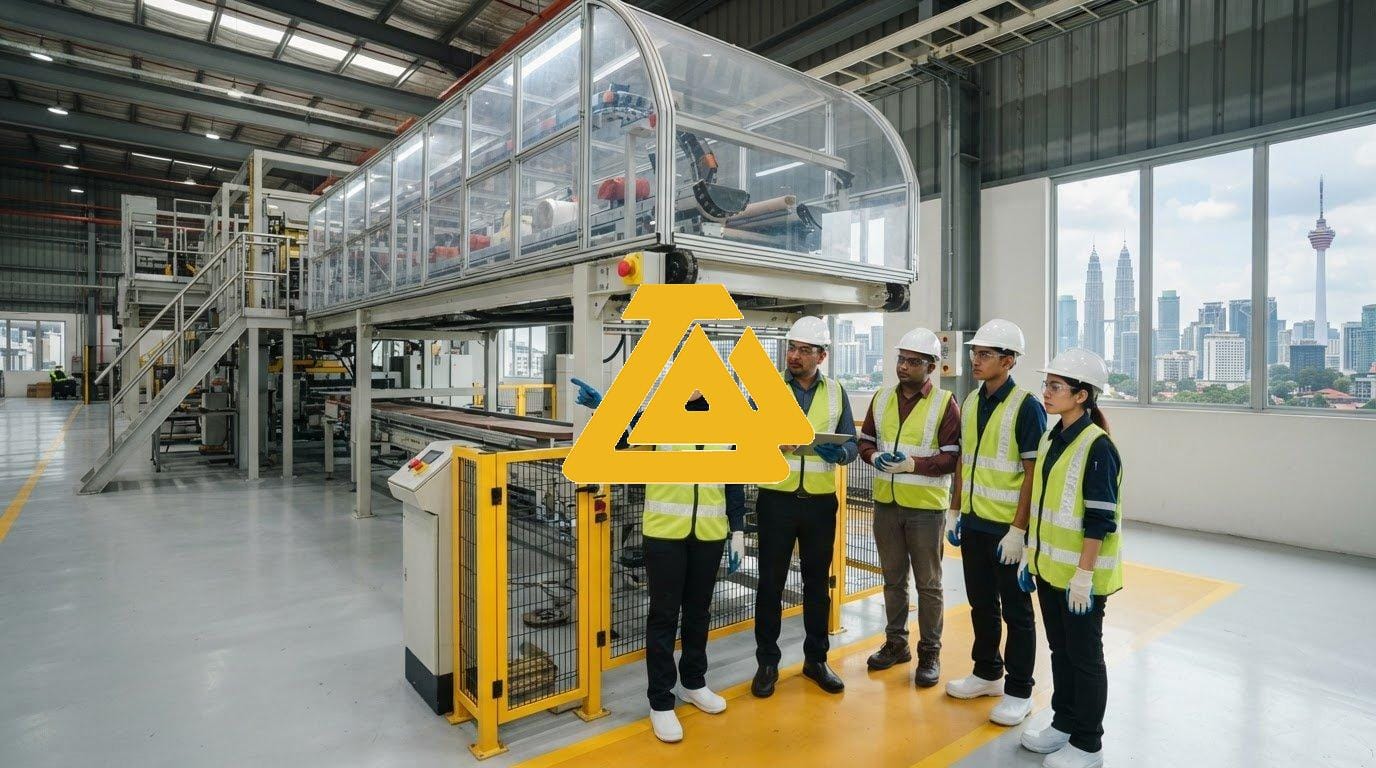
A conveyor can follow a recognised design benchmark and still leave workers exposed to hazards on site. For Malaysian factory managers, the challenge is understanding which conveyor safety standards Malaysia facilities should consider, how they relate to local requirements, and what safeguards fit the way equipment is actually used.
It’s understandable to look for one standard or checklist that settles the question. In practice, a sound approach distinguishes applicable legal requirements and DOSH guidance from voluntary international benchmarks, then assesses hazards such as moving belts, nip points, cleaning tasks, and unexpected start-up. The risks can vary considerably between palm oil mills, oil and gas operations, and manufacturing lines.
This guide explains how to identify relevant standards and authorities without treating every reference as a legal obligation. It also connects operational hazards with practical controls and outlines a structured basis for review, documentation, and improvement. Totalmas supplies Mec Handling conveyors and material-handling equipment for industrial operations in Malaysia.
Key Takeaways
- Interpret conveyor safety standards Malaysia in context: distinguish legal requirements from guidance, technical benchmarks, and site procedures.
- Assess each conveyor according to its material, layout, access, operating modes, and maintenance tasks rather than assuming one control suits every system.
- Use hazard-to-control prompts to review guarding, emergency stopping, isolation, access, spillage, and visibility for your site.
- Build a practical review record by mapping assets and tasks, documenting operating conditions and access points, then assigning and tracking follow-up actions.
- Account for sector-specific operating conditions in palm oil, oil and gas, and manufacturing when prioritising conveyor risk reviews.
What conveyor safety standards mean for Malaysian industrial sites
A technical standard is a published framework for design or assessment; it is not, by itself, proof that a site meets every legal duty. This distinction matters when interpreting conveyor safety standards Malaysia facilities may encounter. Standards can provide consistent technical criteria, while legislation sets applicable legal obligations, official guidance helps explain safety expectations, and site procedures direct how people carry out particular tasks.
In Malaysia, the Department of Occupational Safety and Health (DOSH) is a relevant authority for workplace safety and health. The applicable duties depend on the facility, its activities, and current Malaysian requirements, so managers should verify the legislation and DOSH publications relevant to their operations. Standards Malaysia is the national standards body; the Department of Standards Malaysia provides background on its role. A technical standard and a legal requirement are related only where applicable law, regulatory direction, or contractual terms make a particular standard relevant.
Standards, legislation, and site rules are not interchangeable
A standard can help engineers and facility teams apply consistent technical principles to equipment design or risk assessment. It may inform questions about machinery design, protective measures, or how a risk is evaluated. It doesn’t replace a site-specific assessment or establish, on its own, which legal duties apply to a particular operation.
Legislation and regulations establish legal requirements. Guidance explains or supports their application, while company procedures translate requirements and assessed risks into operating, cleaning, and maintenance practices. Keep these sources distinct in reviews and records: note what is legally applicable, what is used as technical guidance, and what procedure workers must follow.
Why conveyor context changes the safety assessment
A conveyor’s risk profile depends on what it carries and how people interact with it. Assess moving belts, transfer points, nip points, access routes, and areas reached during cleaning or maintenance. Also consider the layout, visibility, operating mode, and whether workers attend the conveyor continuously or approach it intermittently. These factors shape exposure; a control suitable for one arrangement may not address another.
For example, a palm oil mill may use scraper conveyors to move material as part of continuous processing. Transfer areas and access during cleaning or maintenance warrant attention. At an oil and gas facility, a conveyor used for a particular material-handling task may operate intermittently and require workers to approach it for loading or process coordination. Its layout and work pattern call for a separate assessment, not an automatic match for palm oil controls.
Record the actual tasks and conditions before selecting safeguards. Totalmas supplies Mec Handling conveyors and material-handling equipment for industrial applications. Use the equipment details as part of planning, while grounding safety decisions in each facility’s assessment and applicable requirements.
How Malaysian requirements and international conveyor standards fit together
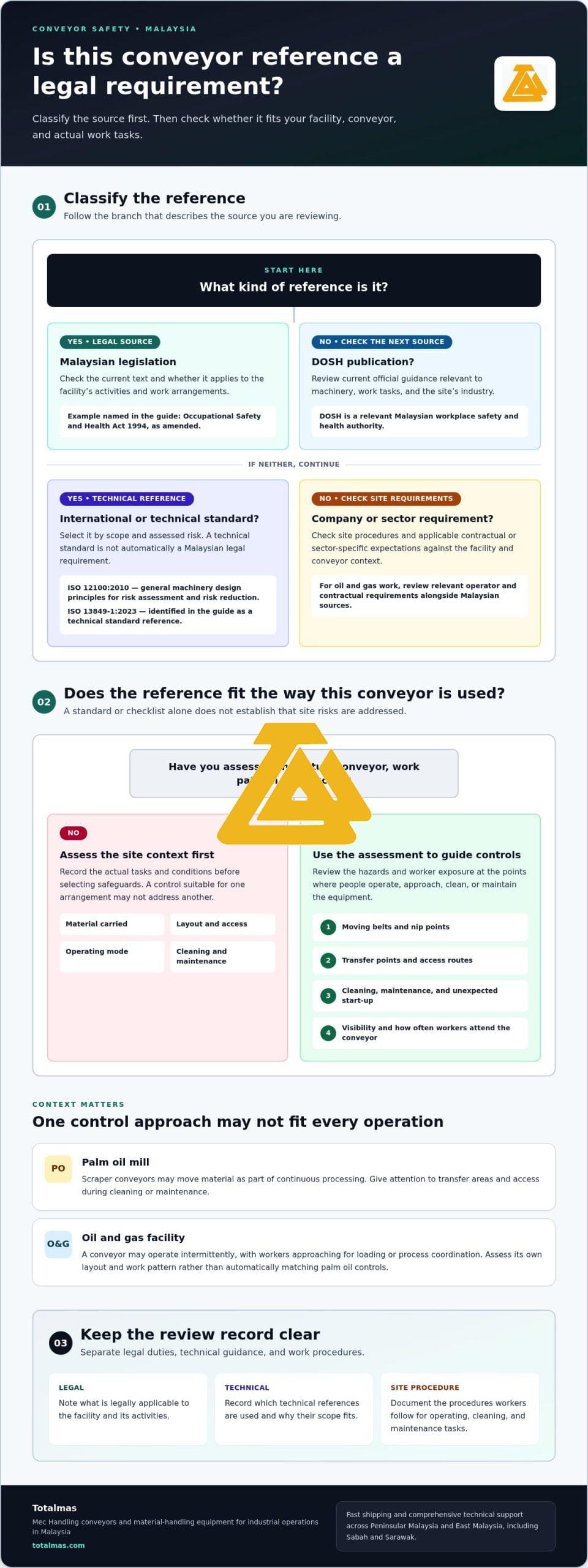
For conveyor safety standards Malaysia facilities need to distinguish legal sources from technical references. DOSH Malaysia is a relevant workplace safety and health authority, but the requirements that apply depend on the facility, its equipment, and its activities. Use the table to organise a review, then verify current legislation, DOSH publications, and any sector-specific obligations that apply to the site.
| Source type | What it contributes | How to use it |
|---|---|---|
| Malaysian legislation | Legal requirements applicable to workplace safety and health, including the Occupational Safety and Health Act 1994, as amended. | Check current text and applicability against the facility’s activities and work arrangements. |
| DOSH publications | Official guidance and information that can support workplace safety decisions. | Review current publications relevant to machinery, work tasks, and the site’s industry. |
| Technical standards | Structured engineering principles for machinery risk assessment, control systems, emergency-stop functions, or electrical equipment. | Select by scope and assessed risk. A standard is not automatically a Malaysian legal requirement. |
| Company and sector requirements | Site procedures and applicable contractual or sector-specific expectations. | Check how they apply to the facility and the conveyor’s operating context. |
Which Malaysian sources should a facility review?
Start with the legislation and official DOSH guidance relevant to the facility, then consider sector-specific requirements and company procedures. Applicability can differ according to the work being carried out, the equipment in use, and how operators, cleaners, or maintenance personnel interact with it. For oil and gas work, review relevant operator and contractual requirements alongside Malaysian sources; don’t assume one reference automatically governs every site.
What international standards can contribute
Use international standards as technical references where their scope fits the equipment and risk under review. ISO 12100:2010 sets out general machinery design principles for risk assessment and risk reduction. ISO 13849-1:2023 addresses the design of safety-related parts of control systems; ISO 13850:2015 covers emergency-stop function design principles; and IEC 60204-1:2016, including Amendment 1:2021, addresses electrical equipment of machines. Confirm current editions and scope before relying on them.
Select standards by the conveyor’s hazards and the standard’s scope; no single reference should be treated as a complete conveyor compliance certificate. A US regulation such as OSHA’s conveyor standard can offer comparative context, but it is not Malaysian legislation and doesn’t establish local compliance.
For further insight into conveyor and material-handling equipment, explore Totalmas industrial solutions.
Compare conveyor hazards with the controls your Malaysian site needs
A useful hazard review connects each exposure to a control question, not a preset solution. The prompts below help teams apply conveyor safety standards Malaysia facilities may reference to the actual equipment, tasks, and operating environment. They’re starting points for assessment, not universal prescriptions. Control selection depends on conveyor design, assessed risk, work practices, and applicable requirements.
Moving parts, transfer points, and access
Review normal operation separately from cleaning, blockage removal, inspection, and maintenance. A point that’s inaccessible during routine running may become reachable when a worker clears a transfer chute or enters an access area. Check the conveyor’s full route, including nip points, rotating components, and moving parts near walkways or workstations.
| Hazard or exposure | Assessment prompt | Operational context to consider |
|---|---|---|
| Nip points and rotating components | Could a person reach moving parts during operation or task access? Assess whether guarding or another measure is appropriate for the design and task. | Review belt rollers and drive areas along the accessible route. |
| Transfer points and chutes | Could material build-up or a blockage prompt workers to approach moving equipment? Assess safe access and the method for clearing it. | In a palm oil mill, consider scraper-conveyor transfer areas and cleaning activities. |
| Emergency stopping | Can workers identify and reach an emergency-stop device from relevant work positions? Assess its placement against the conveyor layout and visibility. | Consider long or obstructed routes and areas where workers attend the conveyor. |
| Energy isolation and restart | Are task-specific isolation, communication, and restart procedures defined for maintenance or blockage removal? | Consider how a team coordinates work on connected equipment. |
| Access, spillage, and visibility | Could restricted access, spilled material, or poor visibility increase exposure or hinder a safe response? | Review walkways, inspection points, and the surrounding work area. |
Emergency stopping, isolation, and work procedures
Emergency stopping and energy isolation address different situations. An emergency stop is intended to stop equipment during an emergency; it shouldn’t be treated as a substitute for the site’s energy-isolation process during maintenance. Review applicable procedures, including how workers communicate before work begins and how equipment is confirmed safe before restart.
In oil and gas operations, a conveyor may sit within a wider process area, so the review should consider access, visibility, and coordination with nearby work. That context differs from a palm oil mill’s material flow and cleaning routines. Assess each installation on its own terms.
For material-handling equipment insights, explore Totalmas conveyor solutions. Totalmas supplies Mec Handling conveyors and material-handling equipment for industrial operations.
Reviewing Conveyor Safety at Malaysian Facilities
A structured review turns standards and risk findings into actions the facility can track. Use the sequence below to build a clear record for each conveyor system. It supports operational planning, but it doesn’t replace a site’s assessment of applicable requirements or provide certification.
- Define the asset scope. List each conveyor section, connected equipment, transfer point, and operating mode. Record its location and the material handled so that interfaces and work areas aren’t missed.
- Map tasks and exposure points. Document how operators interact with the system during normal operation, cleaning, blockage clearing, inspection, and maintenance. Note access points and where tasks bring people near moving equipment.
- Capture operating conditions. Record relevant conditions that may affect equipment use or access, such as material characteristics, layout, and environmental factors. Where measurements are useful, use metric units and state what was measured and where.
- Document risks and actions. For each identified hazard, record the selected control, the role responsible for follow-up, unresolved actions, and their status. Set review timing through the facility’s own process rather than assuming a universal inspection interval.
- Revisit the record after change. Review the assessment when equipment is modified, an incident occurs, or operating conditions or tasks change. Confirm that documented controls and work procedures still reflect actual practice.
Relate equipment selection to operating requirements
Use the recorded material, throughput needs, layout, and operating conditions to inform equipment discussions, then consider those details alongside the facility’s risk assessment. A palm oil operation may need to account for the conveyor’s role in moving process material and the tasks performed around it. An oil and gas facility may have different material-handling duties, interfaces, and operating patterns. Neither setting should be treated as a template for the other.
For further context, see the published guide Bulk Material Handling Equipment. Totalmas supplies Mec Handling conveyors and material-handling equipment, which can be considered as part of a facility’s equipment planning. Equipment selection and supply don’t establish that a system meets site requirements or provide a safety assessment.
For further industrial solutions insights in Malaysia, explore Totalmas material-handling equipment and its range of industrial solutions.
Make Conveyor Safety a Practical, Ongoing Review
A reliable approach to conveyor safety standards Malaysia starts by separating legal requirements from technical references and site procedures. From there, assess hazards against the conveyor’s design, materials, operating conditions, and the tasks workers perform. A documented review helps teams assign follow-up actions and revisit controls when equipment or operations change.
Conditions differ across palm oil, oil and gas, and manufacturing facilities, so safeguards should reflect the actual work rather than a generic checklist. Keep equipment planning connected to the site’s risk assessment, and verify applicable Malaysian requirements using current authoritative sources.
Totalmas supplies Mec Handling conveyors and material-handling equipment for industrial operations in Malaysia. For further insights on industrial solutions, explore Totalmas material-handling solutions and discuss your equipment planning needs with the team.
Frequently Asked Questions
What conveyor safety standards apply in Malaysia?
No single standard should be assumed to cover every conveyor or facility in Malaysia. Review the current Malaysian legal requirements and DOSH guidance relevant to your workplace, alongside the equipment’s scope and your site’s risk assessment. International standards may inform design or risk-control decisions, but verify their current editions and relevance to the conveyor. Meeting a technical standard alone doesn’t prove that all applicable legal requirements have been met.
Is ISO 12100 a conveyor safety standard?
ISO 12100 is a machinery safety standard associated with risk assessment and risk reduction, not a conveyor-only checklist. It may help structure an assessment of machinery hazards, but verify its current edition, scope, and relevance to the specific conveyor. For a useful site review, relate the assessment to actual operating, cleaning, blockage-clearing, and maintenance tasks, while also considering applicable Malaysian requirements.
Does a conveyor need an emergency stop along its full length?
Not necessarily; the appropriate emergency-stop arrangement depends on the conveyor’s layout, access, visibility, operating conditions, and applicable requirements. Don’t assume a single spacing rule applies to every installation. Assess how workers can respond from their work positions and during foreseeable tasks around the equipment. Document the basis for the arrangement using current standards and local requirements relevant to the conveyor.
What are the main conveyor hazards in a palm oil mill?
Potential hazards to assess include moving parts, nip points, transfer areas, spillage, cleaning access, and maintenance exposure. The actual risks depend on conveyor design, materials handled, work practices, and site conditions. For example, review how workers approach a scraper conveyor during normal operation and cleaning, as these tasks can create different exposures. Assess the specific installation and verify selected controls against current applicable requirements.
How often should conveyor safety inspections be carried out?
Inspection frequency depends on the equipment, operating conditions, manufacturer guidance, risk assessment, and applicable requirements. Avoid applying a generic interval without evidence that it suits the installation. Establish and document a schedule based on those factors, and review the assessment after equipment or operating conditions change, an incident occurs, or a defect is identified. Support any stated interval with current authoritative guidance or site-specific requirements.
Can a conveyor be compliant if it meets an international standard?
Meeting an international standard alone doesn’t establish compliance with every Malaysian legal duty or site requirement. Confirm that the standard is current and applies to the equipment and its intended use. Separately review relevant Malaysian requirements, assess workplace risks, and retain supporting records. Avoid treating a standard or certificate as a complete compliance guarantee unless that claim is substantiated for the facility and applicable requirements.
What should a conveyor risk assessment include?
A useful conveyor risk assessment records equipment scope, materials, operating modes, worker tasks, access points, and foreseeable hazards. Include routine operation as well as cleaning, blockage removal, inspection, and maintenance. Document selected controls, responsible roles, and follow-up actions, then revisit the assessment when equipment or conditions change. Before treating any item as mandatory, check current Malaysian requirements and the scope of applicable standards.