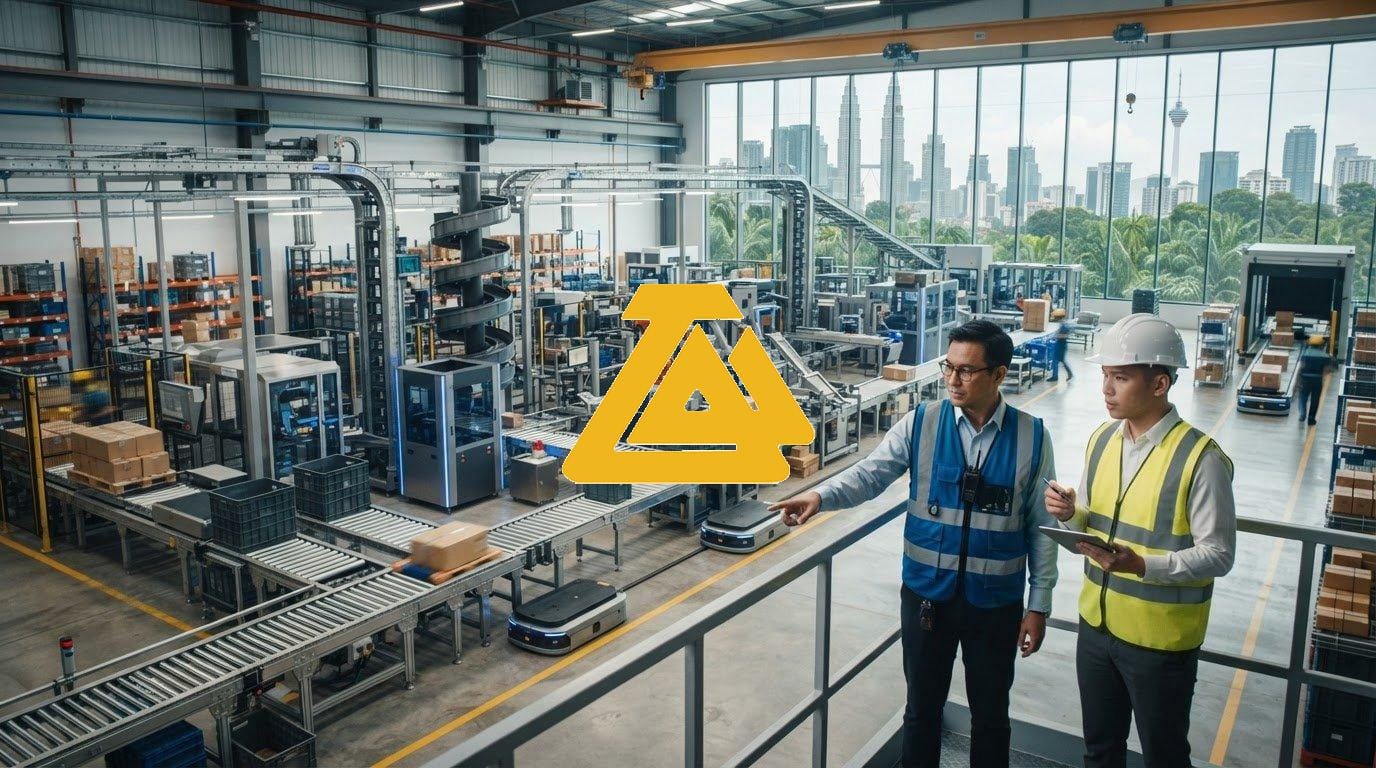
A conveyor that looks suitable on paper can still create bottlenecks when it meets your production flow. For Malaysian factory managers, choosing a custom material handling solutions provider means looking beyond equipment specifications to how materials move through the plant, from receiving and processing to storage and dispatch.
Unclear requirements make proposals difficult to compare, while equipment that does not suit the application can disrupt established workflows. In palm oil operations, handling needs depend on the material and process stage. In oil and gas, operating conditions and site requirements shape the brief. This guide explains how to define the handling task, compare equipment and support criteria, and prepare for a focused project discussion.
Totalmas Sdn Bhd is a Kuala Lumpur-based industrial supplier offering Mec Handling conveyors. It provides fast shipping and comprehensive technical support across Peninsular Malaysia and East Malaysia, including Sabah and Sarawak. Use the steps below to assess equipment fit and plan material movement around your plant’s actual requirements.
Key Takeaways
- Map the full movement process, including materials, workflow, site conditions and operating needs, before comparing equipment.
- Compare providers on application fit, equipment scope, support, logistics and documentation using the same project brief.
- Consider whether continuous conveyor movement or discrete lifting and transfer better suits each stage of your plant workflow.
- Prepare essential site and process information to make a technical discussion more focused, especially for palm oil and oil and gas operations.
- Review how Mec Handling conveyors may fit your material movement requirements through Totalmas’s industrial solutions in Malaysia.
What Should a Custom Material Handling Solution Provider Solve?
Start with the movement problem, not a preferred machine. A custom material handling solutions provider helps define equipment needs around the material, process sequence, site layout and operating conditions. The first questions are practical: What needs to move? Where does it start and finish? Where does it pause or transfer? What operating or access constraints affect the route? Answering these questions helps keep equipment selection tied to the task instead of choosing a catalogue item without considering its role in the process.
Equipment supply addresses what will move the material. Reviewing the full process also means looking at where material comes from, where it waits, how it transfers between stages and what happens at its destination. A delay blamed on one machine may begin at a transfer point or a restricted access route. The Material Handling Overview outlines the wider role of handling across manufacturing and logistics.
Start with the material flow, not a catalogue
Trace a typical operating cycle from entry to exit. Mark each movement, waiting point and hand-off, then compare the map with what operators experience during normal production. Repeated transfers can add handling steps. Bottlenecks may leave upstream work waiting or restrict supply to the next stage. Manual handling can increase operator effort and introduce risks that should be reviewed.
- Record where materials enter, move, pause, transfer and leave.
- Note recurring delays, manual transfers, access limits and observed handling risks.
- Separate measured facts from assumptions that need site assessment.
Useful facts may include the material’s form, the route it travels and how often it moves. Record measurements where available and label estimates clearly. A brief based on assumed conditions may not reflect actual operating demands.
Why Malaysian plant conditions shape the brief
A handling route must work within the real site layout, process environment and maintenance access. A route that looks simple on a process diagram may conflict with existing equipment or obstruct routine access. Describe these constraints early so the equipment discussion reflects the plant rather than an idealised layout.
Sector context helps identify the right questions without presuming the answers. At a palm oil site, identify the specific material and process stages involved. At an oil and gas facility, describe the operating conditions relevant to the task. Requirements vary by application, so avoid assuming that every site needs the same arrangement.
For each movement, clarify the source and destination, transfer points, operating pattern and known limits on access or maintenance. This gives the supplier a practical basis for discussing equipment fit and helps your team distinguish a local equipment issue from a wider flow problem. The brief should explain the operating need before it specifies a machine.
How to Match Conveyors and Handling Equipment to the Workflow
Turn the operating problem into an equipment brief before comparing options. A conveyor can provide a defined, repeatable transfer path. Lifting equipment or vehicles may suit movements that happen in separate batches, serve multiple destinations or need flexible routing. The right choice depends on the material, process interfaces, required flow and site conditions, not on a general preference for automation or a particular equipment category.
Use this sequence to make the brief specific enough for a practical technical discussion:
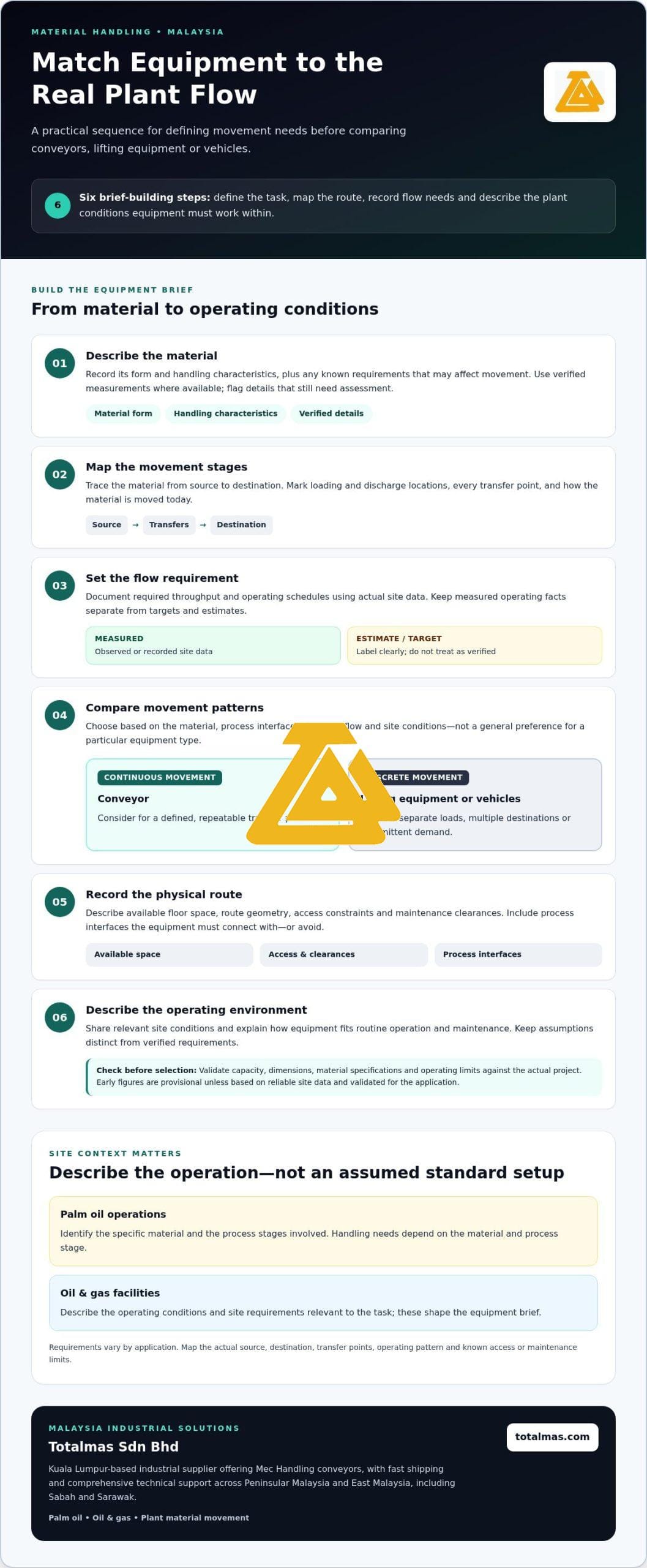
- Describe the material. Record its form, handling characteristics and any known requirements that could affect movement. Use verified measurements where available and identify details that still need assessment.
- Map the stages. Note the source and destination, each transfer point, loading and discharge locations, and how the material is moved today.
- Set the flow requirement. Document required throughput and operating schedules using actual site data. Distinguish a target or estimate from a measured operating fact.
- Compare movement patterns. Consider whether continuous conveyor movement suits a repeatable route, or whether discrete lifting, transferring or vehicle-based movement better fits separate loads, changing destinations or intermittent demand.
- Record the physical route. Describe available floor space, route geometry, access constraints and maintenance clearances. Include process interfaces that equipment must connect with or avoid.
- Describe the operating environment. Provide relevant site conditions and explain how the equipment fits into routine operation and maintenance. Keep assumptions distinct from verified requirements.
Check capacity, dimensions, material specifications and operating limits against the actual project. Treat figures in an early brief as provisional unless they come from reliable site data and have been validated for the proposed application. For broader industry context on equipment and supply-chain practice, consult Material Handling Industry Insights from MHI.
Build an equipment-selection brief
A concise brief follows the process sequence. Include the material type, handling stages, process interfaces and current transfer method, then attach available operating data and a site layout or route description. Note which details are measured, estimated or still to be assessed. This helps a custom material handling solutions provider discuss the application without treating assumptions as final specifications.
Where Mec Handling conveyors may fit
Mec Handling conveyors can be considered for a defined transfer path where material needs to move between known points in a plant. Selection still starts with the application: the route, loading and discharge points, flow demand, interfaces and available space. A conveyor is not the answer for every movement. Totalmas supplies Mec Handling conveyors as part of its industrial offering. For more context on equipment categories and their role in plant movement, explore this bulk material handling equipment guide.
Review Mec Handling conveyor options from Totalmas in relation to the transfer task and process flow.
How to Compare Custom Material Handling Providers in Malaysia
Compare proposals against the same project brief so each is assessed against your operating needs. Review application fit, equipment scope, support, logistics and documentation. Note where a proposal is specific and where it leaves questions unresolved. This gives factory managers a consistent basis for judging how recommendations relate to the plant workflow and site requirements.
| Criterion | What to assess |
|---|---|
| Application fit | Does the proposal address the material, movement route, transfer points and documented operating requirements? |
| Equipment scope | Are the equipment’s role, process interfaces and scope boundaries explained? |
| Support | Are technical support arrangements described in relation to the project’s operational needs? |
| Logistics | Does the proposal explain how the project location and delivery requirements are considered? |
| Documentation | Are specifications, assumptions, exclusions and outstanding information identified clearly? |
Compare technical fit and project communication
Read each proposal alongside the same brief. Check whether it responds to the material, route, loading and discharge points, process interfaces and site constraints you documented. A clear proposal separates defined specifications from assumptions, identifies exclusions and states what information is still needed. This makes gaps easier to resolve before procurement decisions are made. Also consider how technical questions and project coordination are handled, since clear communication helps keep decisions connected to the application.
For a palm oil operation, check whether the proposal reflects the specific process stages and transfers in the brief. At an oil and gas site, assess whether relevant operating conditions have been addressed without assuming requirements that do not apply. Focus on the reasoning and supporting details rather than unverified performance claims or guarantees.
Evaluate support and regional logistics
Include the project destination and logistics requirements in your comparison. Assess whether the proposal explains how delivery planning and technical support relate to the site’s location and operational context. Keep specific shipping timelines distinct from general descriptions of delivery, and compare timelines only when they are stated for the project. This helps procurement teams evaluate logistics using clear information rather than assumptions.
Plant integration can also affect the handling brief. If equipment must operate alongside existing process systems, compare how proposals describe those interfaces and access considerations. For background on one industrial system, Totalmas’s waste heat recovery unit guide provides relevant process context.
Use the comparison to identify which proposal best addresses the operational brief, where assumptions remain and what technical details need resolution. A sound decision rests on the connection between the documented workflow, equipment scope, project logistics and site requirements, not on claims that one solution suits every plant.
What to Prepare Before Requesting a Material Handling Proposal
A focused proposal discussion starts with a clear picture of the handling task and the site. You do not need a complete engineering package to begin. Share reliable information already available, label estimates as estimates and identify details that still need assessment. This gives the supplier a practical basis for discussing equipment in relation to your operational requirements.
Project information to assemble
Bring together a simple process description and useful site records. A marked-up layout or clear photographs can explain the route and constraints. Verified measurements provide a stronger basis than visual estimates. Include the following where available:
- Material and movement: Describe the material, its starting point and destination, each transfer stage, and how the task is performed today.
- Process requirements: Note required interfaces, operating schedule, known flow or timing requirements, and recurring interruptions.
- Site information: Provide layout drawings, photographs, verified dimensions, route geometry, access points and available maintenance space.
- Operating environment: Describe relevant site conditions and maintenance expectations. For palm oil or oil and gas operations, identify the process stage and actual operating context.
- Known constraints: Identify limits on floor space, access, movement around existing equipment or coordination with other work.
Keep measured data separate from targets, estimates and open questions. Verify capacity, dimensions, material specifications and operating limits against project requirements instead of assuming values to complete an early brief. List information that is not yet available as outstanding so it can be addressed during assessment.
Plan for installation coordination and continuity
Consider how project activity would fit around the plant’s operating needs. Identify access routes, work areas, shutdown windows if relevant, and constraints that could affect equipment movement or coordination with production. This is planning information, not an assumption that every project requires a shutdown or follows the same implementation method.
Identify the people in your team who will contribute to decisions: operations for process requirements, engineering for interfaces and site information, procurement for purchasing coordination, and maintenance for access and upkeep expectations. Assigning an internal point of coordination can help keep technical questions and revisions organised.
State the project destination clearly, whether it is in Peninsular Malaysia, Sabah or Sarawak. Include any location-specific access or delivery considerations that could affect project planning. This keeps logistics in view alongside technical requirements.
With the process description, site records and stakeholder input assembled, you can make the technical discussion more productive. Discuss your material handling requirements with Totalmas.
Working with Totalmas on Material Handling Requirements
Totalmas Sdn Bhd is a Kuala Lumpur-based Malaysian industrial equipment supplier. Its material handling offering includes Mec Handling conveyors. A productive equipment discussion starts with the movement task and conditions at your site, then considers how conveyor equipment relates to the process. This keeps decisions grounded in operational needs instead of assumptions about a standard configuration.
A practical route from requirement to equipment discussion
Bring together the project information your team has assembled: the material and movement path, current transfer method, process interfaces, site access and maintenance expectations. Include available layout information and verified measurements, along with the operating context. For palm oil and oil and gas operations, describe the relevant process stage and site conditions rather than assuming every facility has the same requirements.
This information provides a basis for discussing Mec Handling conveyors in relation to the required movement path. A defined route between process points raises different considerations from a task involving several destinations or intermittent transfers. The equipment discussion should reflect those differences rather than treating one configuration as suitable for every application.
Keep project-specific figures tied to verified requirements. Assess capacity, dimensions, material specifications and operating limits for the application rather than assuming them. If a detail is estimated or still being developed, identify it clearly. This helps operations, engineering and procurement teams distinguish established requirements from open technical questions.
A useful discussion connects the operational need with the equipment scope. Clear project information helps Totalmas consider how Mec Handling conveyors relate to the documented process, while keeping technical details grounded in the project requirements.
Regional support for Malaysian industrial operations
Project location and operating context are important parts of planning. Include the destination and any site-specific coordination considerations in the equipment discussion. Totalmas provides fast shipping and comprehensive technical support across Peninsular Malaysia and East Malaysia, including Sabah and Sarawak. Keeping the destination visible helps procurement, operations and engineering teams consider logistics alongside the technical requirements.
A clear brief gives internal teams a shared reference for the equipment discussion. It also keeps decisions connected to process and site requirements, whether the project is at a palm oil facility, an oil and gas operation or another industrial site.
To discuss requirements for your operation, contact Totalmas about your material handling needs.
Move Your Handling Project Forward with a Clear Brief
Turn your handling concern into a decision your operations, engineering and procurement teams can work through together. Agree on the movement that needs attention, identify the information your team can verify and assign responsibility for resolving open technical questions. This gives you a practical starting point for evaluating a custom material handling solutions provider against your plant’s priorities.
Keep the discussion focused on the intended operational outcome. Whether the requirement concerns a palm oil process or an oil and gas operation, a well-defined brief connects equipment decisions to production needs and site conditions. You do not need every technical detail settled before beginning. Clarifying what is known and what still needs assessment is a useful first step.
Discuss your material handling requirements with Totalmas and take the next step toward equipment suited to your operation.
Frequently Asked Questions
What does a custom material handling solutions provider do?
A custom material handling solutions provider helps match equipment choices to a plant’s movement task and operating context. This can involve reviewing how material travels between process stages, the interfaces it must connect with and any access or maintenance constraints. The result is a clearer equipment brief, not a guarantee that every challenge needs a bespoke machine. For example, a recurring delay may call for reviewing a transfer point before selecting new equipment.
How do I choose a material handling solution for a palm oil plant?
Start by identifying the palm oil process stage and the specific material movement that needs attention. Describe the material, its condition during handling, the route, transfer points and how the task is currently performed. Then compare options against the actual operating pattern and site constraints. A movement between fixed process points may call for different equipment considerations from a task serving several destinations or changing with production requirements.
Can conveyors be used in oil and gas facilities?
Conveyors may suit defined material-transfer tasks in oil and gas facilities, but selection depends on the material, route, interfaces and operating conditions at the site. Describe the intended application and environment instead of assuming all facilities have identical requirements. Include special operating constraints in the technical brief so equipment suitability can be assessed against site information and project requirements.
What information should I provide when requesting a material handling proposal?
Provide a short description of the task, the material’s origin and destination, existing transfer method, operating pattern and relevant process interfaces. A marked-up drawing or annotated photographs can help explain how the route relates to nearby equipment. Identify which figures are measured and which are estimates. If a detail is unknown, state that clearly instead of inserting an assumed capacity or dimension.
How can I compare material handling suppliers in Malaysia?
Give each supplier the same project brief, then assess how directly each proposal addresses your application and site conditions. Compare equipment scope, technical documentation, stated assumptions, unresolved questions, logistics and support arrangements. A useful proposal explains its reasoning and identifies information still needed for a decision. Avoid relying on broad performance claims alone. Check whether the proposal relates to your documented material flow and operating requirements.
Does Totalmas support material handling projects in Sabah and Sarawak?
Yes. Totalmas provides fast shipping and comprehensive technical support for material handling requirements in Sabah and Sarawak, as well as Peninsular Malaysia. Include the project destination in the equipment discussion so regional logistics and support can be considered alongside the operational brief. This keeps the delivery location visible during planning without assuming a specific shipping timeline.
What is the difference between material handling equipment and a material handling solution?
Material handling equipment is an individual machine or component used to move, lift or transfer material. A material handling solution considers how equipment fits the complete task, including the route, process connections, operating pattern and site limitations. For example, a conveyor may be one part of a movement process. The wider solution also considers how material is loaded, transferred to the next stage and accessed for maintenance.