
The Coriolis meter with the strongest accuracy claim may still be the wrong choice for your process. Selecting a coriolis flow meter for oil and gas starts with the fluid and operating conditions, not a headline specification. Composition, flow range, pressure, temperature and the presence of gas can all affect whether a proposed meter suits the application.
If you’re comparing options for an oil and gas facility or a palm oil processing operation in Malaysia, first check whether Coriolis measurement fits your measurement needs and installation constraints. This guide explains how to assess that fit and prepare a technically useful enquiry, so suppliers can evaluate your actual requirements rather than make assumptions.
We’ll cover fluid properties, operating conditions, measurement objectives and installation considerations, then outline what information to include when comparing suppliers. You’ll also find practical points for evaluating technical support and shipping arrangements for sites in Peninsular Malaysia and East Malaysia, including Sabah and Sarawak. Totalmas supplies industrial flow meters. Confirm the suitability and availability of any specific meter for your application before finalising a specification.
Key Takeaways
- Assess whether a coriolis flow meter for oil and gas suits your measurement objective, fluid composition and operating conditions before comparing performance claims.
- Review flow range, pressure, temperature, viscosity, density and entrained gas to identify the application details a supplier must verify.
- Compare measurement methods against your process constraints and priorities. No single technology is right for every application.
- Prepare a clear enquiry with process data, and ask suppliers to confirm wetted materials, connections and installation requirements for the proposed configuration.
- For projects in Peninsular Malaysia, Sabah or Sarawak, confirm shipping options and the scope of technical support. Totalmas supplies industrial flow meters and can discuss application requirements.
What a Coriolis Flow Meter Measures in Oil and Gas Applications
A Coriolis flow meter measures the mass flow of fluid through vibrating tubes. As fluid moves through the tubes, its motion changes their vibration. The meter detects this response and uses it to determine mass flow. Depending on the configuration, it may also provide density and temperature outputs. These measurements do not, by themselves, identify fluid composition or determine values such as energy content.
How the Coriolis effect supports flow measurement
Inside the meter, one or more tubes are driven to vibrate. Flowing fluid interacts with that vibration, creating a measurable shift in the tubes’ movement, often described as a phase difference between sections of the tube. The instrument uses this response to calculate mass flow. The underlying principle is outlined in this overview of the Coriolis effect in flow measurement.
Some configurations derive density from the tubes’ resonant frequency and may include temperature measurement. Treat these as configuration-dependent outputs: confirm which values are available, how they are calculated, and whether they meet the process requirement. Volumetric flow, for example, may be calculated using mass flow and density rather than measured as an independent primary value.
Where oil and gas teams may assess Coriolis technology
A coriolis flow meter for oil and gas may be considered for process control, transfer or monitoring where direct mass-flow information is useful. The right fit depends on the fluid, operating envelope, required measurement and selected meter configuration. Assess a single-phase liquid or gas duty differently from service with changing composition or multiple phases.
Entrained gas, intermittent flow or other multiphase conditions can affect the meter’s response and the reliability of readings. Don’t assume a meter suitable for a stable, single-phase stream will perform as required in a more complex duty. Provide suppliers with realistic process conditions and ask them to confirm suitability for the specific application.
Custody-transfer or fiscal measurement requires project-specific validation. Confirm the required measurement basis, performance criteria, documentation and applicable project requirements before selecting a meter. This is particularly relevant when evaluating duties across Malaysia’s oil and gas operations, including facilities in Sabah and Sarawak. Totalmas supplies industrial flow meters, but confirm the suitability and availability of a specific Coriolis meter against the application.
How Fluid and Operating Conditions Determine Coriolis Meter Suitability
A meter that works well on one stream may not suit another, even if both carry the same named fluid. Meter suitability depends on the complete process envelope, not fluid name alone. Fluid composition, phase behaviour, operating range and required outputs all shape the assessment. Review these factors together before narrowing the options.
Which process data should buyers collect?
Give suppliers normal, minimum and maximum flow rates in metric units, such as kg/h or kg/min where appropriate. Include operating and design pressure and temperature ranges in suitable metric units, such as kPa or MPa and °C. Distinguishing routine conditions from design limits helps suppliers assess the full duty rather than a single operating point.
Document fluid composition and whether the stream is expected to remain single-phase or may contain entrained gas or changing proportions of phases. Note process changes such as start-up, shutdown, batching or changes in feed. Consider viscosity and density across the expected operating range, since they help describe the fluid and may affect application fit and operating behaviour. Ask the supplier to review these conditions against the proposed configuration.
- Process envelope: Normal, minimum and maximum flow, pressure and temperature.
- Fluid condition: Composition, density, viscosity and phase behaviour.
- Variability: Expected changes in flow, feed or operating mode.
- Measurement need: Identify required outputs separately from optional ones, then verify each output is available in the proposed configuration.
For broader measurement considerations, consult Totalmas’ high-accuracy flow meter engineering guide. Use it alongside an application-specific review, not as a substitute for checking a meter’s fit against actual process data.
How Malaysian oil and gas and palm oil duties differ
In oil and gas, the assessment might involve a stable process stream, a transfer duty or a monitoring point. The relevant example depends on the actual service, including whether the fluid is single-phase or subject to changing conditions. Don’t assume a meter assessed for one duty is automatically suitable for another.
Palm oil processing also requires its own fluid and operating-condition assessment. Its process requirements should not be treated as interchangeable with oil and gas service. A coriolis flow meter for oil and gas must be evaluated against the specific stream and measurement objective, just as a meter considered for palm oil must be reviewed against that application’s process envelope.
Before finalising requirements, discuss the application with Totalmas’ industrial flow meter team. Totalmas supplies industrial flow meters. Confirm whether a suitable Coriolis meter is available and verify the proposed specifications for the project.
Compare Coriolis Meters Against Other Measurement Priorities
Choose a measurement method by starting with the required output and process constraints, not by assuming one technology is best for every duty. A Coriolis meter may suit an application where mass flow is the priority. Magnetic and ultrasonic meters may also warrant consideration, depending on the fluid, installation and measurement objective.
The right method is the one that meets the stated duty within the actual process and installation constraints. Use the comparison below to frame supplier questions, then verify the proposed meter against the project data.
| Method | Typical consideration | Process dependency | Questions to verify |
|---|---|---|---|
| Coriolis | Consider where direct mass-flow measurement is required; other outputs depend on configuration. | Fluid condition, flow range and operating conditions, including entrained gas or multiple phases. | Is mass flow required? Are density or other outputs needed and available in the proposed configuration? |
| Magnetic | Assess as a possible option for suitable conductive liquids and volumetric measurement duties. | Fluid conductivity, process conditions and installation arrangement. | Is the fluid compatible with the measurement principle? Does the installation meet the meter’s requirements? |
| Ultrasonic | Assess the specific meter type, fluid service and installation constraints. | Fluid properties, pipe arrangement and operating conditions can affect application fit. | Is the proposed type intended for this service, and what process and installation data does the supplier require? |
When mass measurement may be the priority
For a coriolis flow meter for oil and gas, first establish whether the process needs mass flow for control, monitoring or transfer. Then identify any additional required values, such as density, and have the supplier confirm their availability in the proposed configuration. If the stream may contain entrained gas, multiple phases or unstable conditions, flag this for specific technical review rather than relying on a general suitability claim.
What to compare with magnetic and ultrasonic meters
Compare fluid compatibility, required outputs, operating envelope and installation constraints for each method. A magnetic meter’s suitability depends on the fluid and its measurement requirements. An ultrasonic proposal needs review against its intended service and installation. Don’t infer accuracy or performance rankings from technology names alone.
Lifecycle and performance claims also need a like-for-like basis. Request product data for the proposed configuration, clarify operating assumptions, and compare installation and maintenance considerations relevant to your site. Without those details, headline claims may not reflect the duty your team needs to measure.
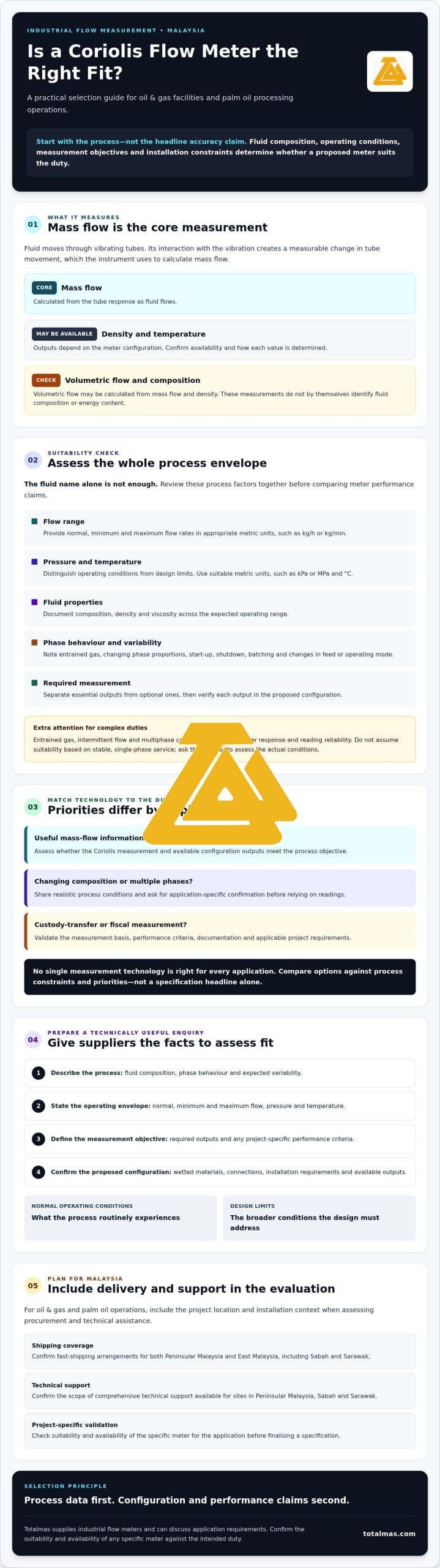
Specify and Evaluate an Oil and Gas Coriolis Flow Meter
A useful enquiry gives suppliers enough information to assess the proposed meter against the actual duty. For a coriolis flow meter for oil and gas, treat the specification as a set of verifiable process, installation and project requirements, not just a pipe size or preferred technology.
Prepare a complete technical enquiry
- Define the measurement purpose. State whether the meter is intended for process control, monitoring, transfer or another duty. Separate required outputs from optional ones.
- Describe the fluid and operating envelope. Provide fluid composition, phase behaviour, and normal, minimum and maximum flow, pressure and temperature data. Use metric units, including °C for temperature.
- Describe the installation. Include pipe size, orientation, available space and relevant site or project constraints. Share drawings or project documents where available.
- Set out the instrument interfaces. Identify required signals, communications, power and control-system interfaces. Ask the supplier to confirm compatibility with project documentation.
- List project requirements for review. Identify applicable standards, approvals and acceptance criteria specified by the project. Have the responsible engineering team confirm what applies rather than assuming a requirement.
Review supplier responses and project compatibility
Request documented confirmation against each stated requirement. In particular, ask the supplier to verify wetted materials, process connections, pressure and temperature limits, and installation requirements for the proposed configuration. Confirm that required measurement outputs and control-system interfaces are included, not merely available on another configuration.
Compare proposals using the same process data and acceptance criteria. Ask suppliers to identify exclusions and assumptions, and clarify who is responsible for commissioning activities and what technical support is included. Confirm whether the proposed equipment is suitable for the stated service; verify performance, material and other specifications with the manufacturer before approval.
For Malaysian projects, include the site location in the enquiry and confirm shipping options and technical support scope for that location. This matters when coordinating requirements across Peninsular Malaysia and East Malaysia, including Sabah and Sarawak. Treat shipping or support statements as unconfirmed until their scope is agreed for the project.
With the process data and checklist prepared, discuss your industrial instrumentation requirements with Totalmas. Totalmas supplies industrial flow meters. Confirm whether a Coriolis meter can be supplied for the specific application and verify its proposed configuration before finalising the specification.
Plan Coriolis Meter Procurement and Support in Malaysia
A sound procurement decision brings engineering, procurement, operations and maintenance into the discussion before a purchase enquiry is issued. Engineering can confirm the approved process and interface requirements. Operations can check that the proposed measurement fits the duty, while maintenance can identify access and documentation needs. Procurement can then request comparable proposals against one agreed specification.
What to confirm before placing an order
Before approval, confirm the final meter configuration, required outputs, documentation, signal interfaces and any project-specific approvals with the responsible engineering team. Check that the supplier’s offer aligns with the approved specification, including clarified assumptions or exclusions. Keep purchase records and revisions consistent with the engineering documents used to evaluate the proposal.
Agree on delivery arrangements and support responsibilities for the actual site. Ask the supplier to confirm the scope of technical support, what it covers and which project activities are included. For shipping, provide the site location and confirm the arrangements directly rather than relying on an unverified delivery estimate. These details matter for facilities in Peninsular Malaysia and East Malaysia, including Sabah and Sarawak.
Operations and maintenance teams should also review the proposed documentation and interfaces before order placement. A clear handover of the approved configuration and supplier clarifications helps prevent gaps between the purchased instrument and site requirements.
How Totalmas can support the enquiry process
Totalmas Sdn Bhd is a Kuala Lumpur-based Malaysian industrial equipment supplier that offers flow meters. For a project enquiry, share the site location and ask Totalmas to confirm shipping options and the scope of any technical support for that location. Include process data and project requirements so the proposed equipment can be assessed against the application.
For a coriolis flow meter for oil and gas, availability and application suitability still need to be checked against the process requirements. Totalmas supplies industrial flow meters, but don’t assume a particular Coriolis model, manufacturer or stock position without confirmation.
Share your process requirements, site location and project documentation with a supplier before finalising the enquiry. You can begin with Totalmas industrial flow meter expertise and confirm whether a suitable Coriolis meter can be supplied for your application.
Make Your Meter Selection With Confidence
Selecting a coriolis flow meter for oil and gas starts with the actual process duty, not a headline specification. Fluid composition, flow range, pressure, temperature and process variability help determine whether the proposed configuration is suitable. Confirm which outputs are essential, then compare alternatives against the same measurement objectives and installation constraints.
A clear supplier enquiry should include process data, site and installation details, required interfaces and project-specific criteria. Ask suppliers to document how the proposed meter meets those requirements, including any assumptions or exclusions. This gives engineering, procurement, operations and maintenance a shared basis for evaluation.
Totalmas supplies industrial flow meters. Confirm a Coriolis meter’s availability, application suitability, delivery arrangements and support scope for your project before making a commitment.
Discuss your oil and gas flow measurement requirements with Totalmas and share the process details needed to assess the enquiry. With a well-defined specification and clear supplier responses, your team can make a more informed selection.
Frequently Asked Questions
How does a Coriolis flow meter work?
A Coriolis flow meter determines mass flow by measuring how moving fluid changes the vibration of tubes inside the meter. The instrument detects this change in tube response and uses it to calculate mass flow. Depending on the meter configuration, it may also provide density or temperature outputs. Confirm which measurements are available in the proposed configuration and whether they meet your process requirements.
Is a Coriolis flow meter suitable for oil and gas applications?
A coriolis flow meter for oil and gas may suit a process, transfer or monitoring duty when its configuration matches the fluid and operating conditions. Suitability depends on factors such as composition, flow range, pressure, temperature and phase behaviour. Single-phase service and streams with entrained gas or multiple phases need separate evaluation. For custody-transfer or fiscal duties, confirm project-specific requirements and acceptance criteria before selection.
Can a Coriolis meter measure mass flow and density?
A Coriolis meter measures mass flow directly through the response of its vibrating tubes. Density may also be available, but confirm that it is included in the proposed meter configuration and suitable for the application. Other outputs, such as temperature, can also depend on configuration. Tell the supplier which measurements are essential and which are optional, then request confirmation against your process requirements.
What process information is needed to select a Coriolis meter?
Provide the fluid composition and phase behaviour, measurement purpose, and normal, minimum and maximum flow conditions. Include operating and design pressure and temperature ranges, using metric units such as °C. Also share pipe size, orientation, available installation space, process variability and site constraints. Identify required measurement outputs, power, signals and control-system interfaces so the supplier can assess the complete application.
How do I compare a Coriolis meter with magnetic or ultrasonic flow meters?
Start with the measurement objective and compare each method against fluid compatibility, required outputs, installation constraints and the operating envelope. A Coriolis meter may be considered where mass flow is required; magnetic and ultrasonic options need assessment against their intended fluid service and installation conditions. Ask suppliers to document assumptions and compare proposals using the same process data. Avoid relying on a technology name or headline claim alone.
Can Totalmas supply and support a Coriolis flow meter in Sabah or Sarawak?
Totalmas supplies industrial flow meters, but confirm whether it can supply a Coriolis meter suitable for your application. Before procurement, confirm shipping options and the scope of technical support for the specific site, along with the proposed meter’s suitability for the project. Share your process requirements with Totalmas for an application discussion.