What if a single seal failure in your chemical dosing line led to a full-scale environmental audit and weeks of production loss? For factory managers in the Malaysian oil and gas or palm oil sectors, this isn’t a hypothetical fear; it’s a constant operational risk when handling aggressive acids. Selecting the right flow meter for corrosive chemicals is no longer just a procurement task, but a critical survival strategy for 2026. With the Department of Occupational Safety and Health (DOSH) requiring detailed chemical data submissions through the CIMS portal by March 31, 2026, the margin for technical error has vanished.
You likely understand that standard equipment simply won’t survive the high humidity and harsh conditions found in industrial sites across Sarawak or Sabah. This article outlines how to protect your operations by selecting chemical-resistant technologies, such as electromagnetic meters with PFA liners, that ensure long-term reliability and precise dosing even at process temperatures exceeding 60 Celsius. We’ll explore how advanced material science and IoT integration safeguard your facility against leaks and compliance failures. By leveraging the technical expertise of Totalmas, you can secure the specialized support and fast shipping needed for remote operations across both Peninsular and East Malaysia.
Key Takeaways
- Identify the most resilient instrumentation technologies, such as electromagnetic and clamp-on ultrasonic meters, to eliminate downtime caused by acid-induced pitting and seal failure.
- Master a structured 5-step specification process for your next flow meter for corrosive chemicals by prioritizing chemical profiling and temperature analysis in Celsius.
- Ensure your facility meets 2026 DOSH reporting standards by utilizing accurate flow data for the precise management of hazardous substances in oil and gas or palm oil processing.
- Learn installation techniques that ensure grounding and flange integrity while benefiting from Totalmas’s distribution network for fast shipping to remote sites in Sabah and Sarawak.
- Optimize chemical dosing accuracy and operator safety by pairing reliable flow sensors with Murphy PowerView displays for real-time monitoring of critical plant data.
Understanding the Impact of Corrosive Media on Flow Instrumentation
Corrosive flow measurement is the strategic application of specialized, inert materials to prevent the chemical degradation of sensor components. In Malaysian industrial environments, where humidity and high ambient temperatures often accelerate chemical reactions, selecting a flow meter for corrosive chemicals isn’t just a technical preference; it’s a safety requirement. Understanding the diverse range of flow measurement technologies is the first step toward building a resilient system that can withstand aggressive media without losing accuracy or structural integrity.
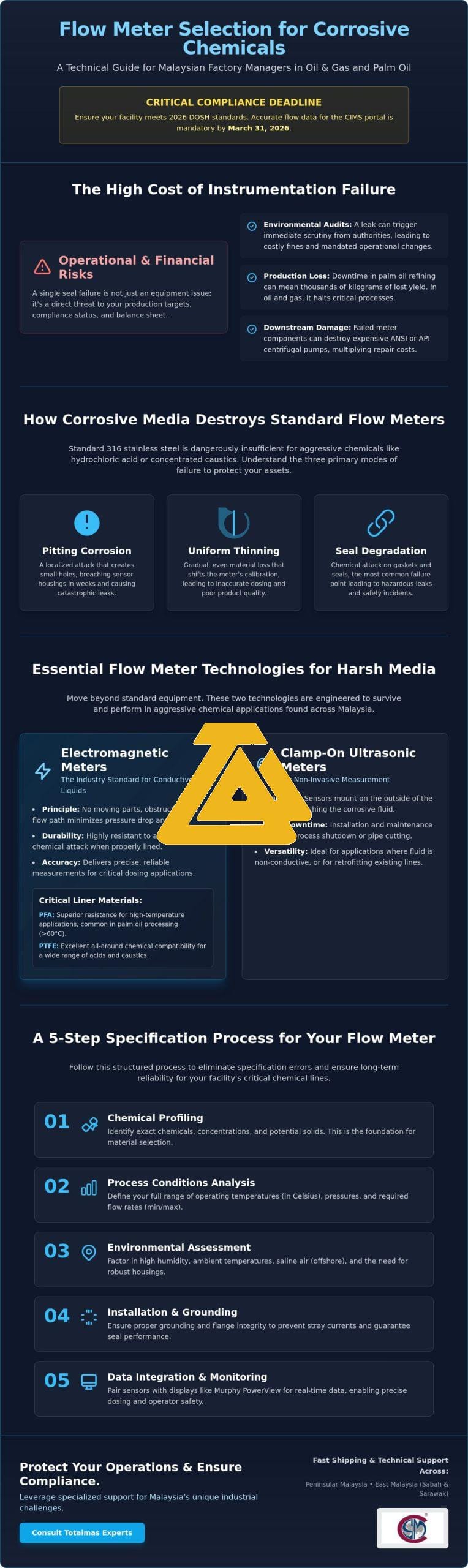
The mechanics of corrosion in flow meters often manifest through three primary failures: pitting, thinning, and seal degradation. Localized pitting can breach a sensor housing in weeks, while uniform thinning gradually shifts the meter’s calibration, leading to expensive dosing errors. While standard 316 stainless steel is a versatile material for many applications, it’s dangerously insufficient for handling hydrochloric acid or concentrated caustics. These chemicals strip the protective oxide layer from steel, causing rapid failure. Totalmas provides deep insights into these material limitations, helping plant managers avoid the hidden costs of instrument failure, which often far exceed the initial replacement price of the hardware.
The Operational Cost of Material Incompatibility
A single chemical leak caused by a failed seal can compromise worker safety and trigger immediate environmental compliance audits from local authorities. In high-output sectors like palm oil refining, even a few hours of production downtime can result in thousands of kilograms of lost yield. Beyond the immediate loss of the meter, secondary damage is a major concern. A failing flow meter for corrosive chemicals can release debris or allow air ingress that ruins downstream ANSI or API centrifugal pumps. These operational setbacks highlight why reliability must be prioritized over low-cost alternatives that aren’t rated for harsh Malaysian process conditions.
Common Corrosive Challenges in Malaysian Industry
Malaysian factory managers face unique geographical and process-specific challenges. In palm oil bleaching and processing, handling sulfuric acid at temperatures reaching 60 Celsius requires instrumentation that won’t succumb to heat-accelerated corrosion. Offshore Oil and Gas platforms in the South China Sea deal with both saline environments and aggressive injection chemicals, demanding rugged, sea-air resistant housings. Even in urban industrial zones like Kuala Lumpur, wastewater treatment plants manage a cocktail of aggressive chemicals that require precise, reliable dosing. Totalmas addresses these challenges through a robust distribution network that ensures fast shipping and technical assistance across Peninsular Malaysia and East Malaysia, including remote sites in Sabah and Sarawak.
Selecting the Right Flow Meter Technology for Harsh Media
Choosing a flow meter for corrosive chemicals requires a balance between long-term durability and the specific conductivity of your process fluid. In the palm oil and oil and gas sectors, the wrong choice leads to frequent sensor drift or catastrophic housing failure. Most industrial applications today move toward two primary technologies: electromagnetic meters for conductive liquids and ultrasonic meters for non-contact measurement. Understanding the nuances of flow meter selection for corrosive media is essential for maintaining plant uptime in high-humidity Malaysian environments.
Electromagnetic Meters with Specialized Liners
Electromagnetic meters, often called mag meters, are the industry standard for conductive corrosive liquids. Their primary advantage lies in their lack of moving parts and the ability to line the internal flow tube with chemically inert materials. PTFE and PFA liners are frequently utilized to protect the meter body from aggressive acids. In palm oil mills, where sludge-heavy corrosive flows are common, mag meters provide the necessary unobstructed flow path to prevent clogging.
Selecting the right electrode material is just as critical as the liner. While stainless steel fails in the presence of concentrated chlorides, exotic alloys such as Hastelloy C, Tantalum, or Platinum offer the resistance needed for extreme pH levels. These meters maintain high accuracy even when handling fluids at 80 Celsius, provided the liner material is rated for the thermal load. For technical guidance on matching liners to your specific chemical profile, you can consult the experts at Totalmas for proven industrial solutions. Facilities that require certified electromagnetic solutions for conductive fluids should also review the magnetic flow meter supplier Malaysia 2026 comparison guide to understand the latest regulatory requirements and available configurations.
Clamp-on Ultrasonic Solutions for Zero Contact
Clamp-on ultrasonic meters offer a different strategy by eliminating wetted parts entirely. These sensors are mounted on the exterior of the pipe, measuring flow through the wall using transit-time technology. This design removes any potential leak paths, making it a preferred choice for ultra-aggressive fluids or high-pressure chemical lines where safety is the top priority. It’s an ideal solution for retrofitting existing systems in Sarawak or Sabah, where breaking into a pressurized line might be logistically difficult.
However, ultrasonic technology has specific limitations. The pipe material must be sonic-conductive, and the fluid shouldn’t have excessive aeration or high solid concentrations, which can scatter the signal. For non-conductive liquids or corrosive gases where mag meters cannot function, Vortex or Variable Area meters remain viable alternatives, provided their wetted components are constructed from reinforced polymers or specialized alloys. Totalmas ensures that whether you require mag meters or ultrasonic systems, our distribution network provides fast shipping and technical assistance across both Peninsular and East Malaysia.
A 5-Step Guide to Specifying Your Flow Meter for Corrosive Chemicals
Specifying a flow meter for corrosive chemicals requires a methodical approach that accounts for both the internal process fluid and the external Malaysian climate. Engineers must move beyond generic data sheets to understand how specific chemical concentrations interact with material surfaces over time. This selection process is a chronological workflow designed to ensure long-term reliability and safety. For a deeper understanding of how these fluids degrade industrial hardware, refer to the API guidance on damage mechanisms, which provides a technical foundation for risk assessment.
Step 1 & 2: Profiling the Fluid and Thermal Load
The first step is identifying the exact chemical concentration and pH levels. It’s a common industry reality that a mere 10% change in chemical concentration can necessitate an entirely different liner material to prevent failure. Precision at this stage is vital; utilizing high accuracy flow meters as a baseline for your system design ensures that dosing remains within safe, predictable limits.
Temperature analysis follows closely. You must verify compatibility at the maximum operating Celsius levels, not just the nominal process temperature. In Malaysia, ambient temperatures often exceed 35 Celsius, which can significantly increase chemical reactivity inside the pipe. This tropical heat accelerates the rate of corrosion, meaning a material that works in a temperate climate might fail prematurely in a local palm oil mill or offshore platform.
Step 3: Decoding Wetted Material Charts
Selecting the right fluoropolymer is the next critical hurdle. While PTFE is a standard choice for many acids, PFA liners often provide superior temperature resistance and mechanical stability in high-vacuum or high-pressure applications. When the fluid is exceptionally aggressive, investing in exotic metals like Hastelloy C or Tantalum for the electrodes is necessary to maintain signal integrity. The specific model number of the instrument is ultimately more significant than its broad category when determining exact chemical compatibility. Working with a certified magnetic flow meter supplier Malaysia ensures that the instruments you select meet the Water Services Industry Rules 2023 SPAN standards applicable to conductive fluid measurement in industrial facilities.
Step 4 & 5: Installation and Monitoring
The final steps involve assessing the installation environment and monitoring needs. High ambient humidity in regions like Sarawak or Sabah requires meters with robust IP ratings and specialized coatings to prevent external housing corrosion. Finally, determine if your operators need local displays for immediate visibility or remote telemetry for centralized control. Totalmas supports this entire specification journey, providing the technical assistance and distribution network required for fast shipping across both Peninsular and East Malaysia.
Implementation and Maintenance in Malaysian Industrial Environments
Successful deployment of a flow meter for corrosive chemicals depends as much on physical installation as it does on initial specification. Even the most advanced PFA-lined meter will fail if grounding is neglected or if flange seals aren’t rated for the specific acid concentration. In the high-output environments of Malaysian palm oil mills and petrochemical plants, maintenance isn’t a reactive task but a scheduled necessity to ensure compliance with 2026 safety standards. Utilizing a digital flow meter for factories allows for real-time error logging, which is essential for identifying drift before it leads to a catastrophic leak.
Preventative maintenance for meters handling aggressive media must include periodic inspections for liner bulging or electrode scaling. These issues are often accelerated when process temperatures fluctuate significantly above 50 Celsius. Regular calibration intervals should be shortened for instruments in high-wear applications to maintain the dosing accuracy required for expensive chemical catalysts. Totalmas provides the technical assistance needed to establish these protocols, ensuring your instrumentation remains a reliable asset rather than a liability.
Installation Best Practices for Leak Prevention
Correct gasket selection is the first line of defense in corrosive chemical lines. Using incompatible materials can lead to flange leaks that damage the meter’s external housing or surrounding infrastructure. For electromagnetic meters, the orientation must ensure the pipe remains full at all times to prevent liner dry-out and signal loss. In heavy-duty palm oil processing plants, installers must also account for high-frequency vibrations that can loosen connections over time. Ensuring proper grounding is equally critical; without it, electrical noise can interfere with the sensitive measurements needed for precise chemical management.
Remote Support for Sabah and Sarawak
Operating a factory in East Malaysia presents unique geographical challenges for instrumentation maintenance. The distance from major industrial hubs in Peninsular Malaysia makes the availability of technical assistance and fast shipping a top priority for plant managers. Totalmas addresses these challenges through a robust distribution network that covers both Peninsular and East Malaysia, specifically highlighting Sabah and Sarawak. We recommend that remote facilities stock critical spares, such as electrodes and specialized seals, to minimize downtime. For expert guidance on commissioning or troubleshooting your system, contact Totalmas for comprehensive technical support across Malaysia.
Optimizing Chemical Processes with Totalmas Instrumentation
Achieving long-term operational success requires more than just high-quality hardware; it demands a partnership with an experienced industrial flow meter supplier Malaysia that understands the specific challenges of the local landscape. Totalmas provides comprehensive solutions that bridge the gap between technical specification and practical field performance. By selecting a flow meter for corrosive chemicals through a partner with over 33 years of technical expertise, factory managers can ensure their systems are optimized for the aggressive media and high-temperature environments characteristic of the Malaysian oil and gas and palm oil sectors.
Integrating Flow Data with Enovation Controls
Data only provides value when it is accessible and actionable for the operator on the factory floor. Linking your chemical flow rates to automated engine control panels or process safety systems is essential for preventing overflows and equipment damage. Utilizing a Murphy PowerView display Malaysia allows your team to monitor corrosive flow alerts in real-time, providing clear visibility of process health. This integration ensures that if a dosing pump fails or a line becomes restricted, the system can trigger an immediate safety shutdown. Working with a single-source provider for both flow measurement and control instrumentation simplifies the procurement process and guarantees that all components are fully compatible and rated for industrial use.
Reliable Distribution and Fast Shipping
Operational downtime is particularly costly in remote industrial sites, where a delayed part can halt production for days. Totalmas addresses this risk through a robust distribution network centered in Kuala Lumpur, designed to provide fast shipping for an urgent flow meter for corrosive chemicals or critical spare parts. Our logistics support extends across the entire nation, ensuring that facilities in Peninsular Malaysia and East Malaysia receive the same level of priority. We specifically prioritize technical assistance for complex installations in Sabah and Sarawak, where geographical challenges often complicate maintenance schedules.
This commitment to excellence ensures that whether you are managing a palm oil mill in Sandakan or an offshore platform off the coast of Terengganu, you have access to a steady hand and proven reliability. Totalmas doesn’t just sell equipment; we provide the technical foundation required to maintain safety, accuracy, and efficiency in the harshest Malaysian industrial environments. Our team remains a dependable resource for businesses seeking to optimize their chemical processes while adhering to the latest 2026 safety and reporting standards.
Securing Your Industrial Future with Precision Instrumentation
Maintaining operational integrity in 2026 requires a proactive approach to instrumentation. By matching specific wetted materials to the aggressive media and high Celsius temperatures of your plant, you eliminate the risk of catastrophic failure. Integrating a robust flow meter for corrosive chemicals with advanced monitoring systems like Murphy Displays ensures that your operators have the real-time visibility needed to prevent leaks and maintain safety standards.
Success in the Malaysian industrial landscape depends on reliable partnerships. Totalmas brings over 33 years of industrial expertise to your facility, serving as an authorized distributor for Enovation Controls and Murphy Displays. Our distribution network ensures fast shipping and technical assistance across both Peninsular Malaysia and East Malaysia, including remote sites in Sabah and Sarawak. Contact Totalmas for a Technical Consultation on Chemical Flow Solutions to optimize your facility’s performance. With the right technology and specialized support, your factory can achieve the long-term reliability and dosing accuracy required for excellence in the palm oil and oil and gas sectors.
Frequently Asked Questions
What is the best flow meter for hydrochloric acid?
An electromagnetic meter equipped with a PFA or PTFE liner and Tantalum electrodes is generally considered the most reliable solution for hydrochloric acid. These materials offer the highest resistance to the aggressive chloride ions that quickly degrade standard stainless steel components. Totalmas provides these specialized configurations to ensure long-term accuracy and housing integrity in high-concentration acid lines.
Can I use a magnetic flow meter for non-conductive chemicals?
No, magnetic flow meters require a minimum fluid conductivity, typically above 5 microsiemens per centimeter, to generate a measurable signal. For non-conductive corrosive fluids like certain hydrocarbons or pure deionized water, a clamp-on ultrasonic flow meter for corrosive chemicals is a superior choice. This technology uses transit-time signals to measure flow without requiring any electrical conductivity in the liquid itself.
How often should a flow meter for corrosive chemicals be calibrated?
Most industrial applications require calibration every 6 to 12 months, though the interval depends on the severity of the chemical’s corrosivity. Aggressive media can cause subtle electrode scaling or liner thinning that results in measurement drift over time. Regular verification ensures that your dosing remains precise, which is critical for maintaining process safety and meeting 2026 DOSH reporting requirements.
Does temperature affect the chemical resistance of a flow meter?
Yes, higher process temperatures significantly accelerate chemical reactivity and can weaken the structural integrity of internal liners. A material that is resistant at 25 Celsius may soften or become permeable when process temperatures exceed 60 Celsius. It’s vital to verify both the chemical compatibility and the thermal rating of the wetted materials before installation to prevent premature failure.
What wetted materials are best for the palm oil industry?
PTFE and PFA liners paired with Hastelloy C or Tantalum electrodes are ideal for handling the bleaching earths and acids used in palm oil refining. These materials withstand the abrasive and corrosive nature of the crude oil processing stages. Totalmas helps mill managers select specific alloys that prevent pitting and ensure the longevity of instrumentation in these heavy-duty environments.
Can clamp-on ultrasonic flow meters work on plastic pipes?
Yes, clamp-on ultrasonic sensors work effectively on most plastic pipes, including PVC, PE, and PVDF, provided the pipe is sonic-conductive. The sensors must be properly coupled to the pipe exterior with acoustic gel to ensure the signal can pass through the wall and into the fluid. This non-intrusive method is particularly useful for measuring aggressive chemicals in plastic piping systems where traditional flanged meters might be difficult to install.
What happens if a flow meter liner fails?
Liner failure typically leads to the process fluid breaching the sensor housing, which causes immediate signal loss and can lead to a hazardous external leak. If the corrosive chemical reaches the internal electronics, the meter will be permanently damaged. Furthermore, a failed liner can release debris into the line, potentially causing catastrophic damage to downstream ANSI or API centrifugal pumps.
How do I get technical support for flow meters in East Malaysia?
Totalmas provides comprehensive technical support and fast shipping through an established distribution network that covers both Peninsular and East Malaysia. We prioritize assistance for remote industrial sites in Sabah and Sarawak to ensure minimal operational downtime. Our team offers specialized guidance on troubleshooting and commissioning to help factory managers overcome the unique logistical challenges of these regions.