If your current instrumentation is off by just 1%, how many thousands of Ringgit are you losing in your palm oil refinery or offshore platform every single month? Inaccurate readings aren’t just a technical glitch; they’re a direct drain on your operational bottom line. You’ve likely realized that traditional mechanical meters can’t keep up with the demands of 2026, especially as maintenance costs climb and the need for real-time SCADA integration becomes non-negotiable. Selecting the right digital flow meter for factories is now a strategic necessity for any Malaysian plant manager looking to eliminate waste and maintain high-tier industrial performance.
This guide provides a comprehensive technical checklist designed to help you navigate the complexities of modern instrumentation, from Coriolis mass flow accuracy to the latest IoT-enabled sensors. You’ll learn how to choose hardware that meets the strict 2026 environmental standards while ensuring long-term reliability in harsh processing environments. We’ll walk through the essential selection criteria, installation protocols, and how the team at Totalmas can serve as your local partner for optimizing fluid dynamics and process control.
Key Takeaways
- Understand the operational advantages of transitioning from mechanical meters to electronic systems for superior precision and reduced maintenance in palm oil and oil and gas facilities.
- Match specific industrial fluids to the correct technology by evaluating core properties like viscosity, corrosiveness, and electrical conductivity.
- Utilize a comprehensive 2026 selection checklist to ensure your chosen digital flow meter for factories integrates seamlessly with existing SCADA and monitoring systems.
- Learn how to avoid common installation errors, including the straight pipe requirement, while shielding sensitive electronics from Malaysia’s intense heat and humidity.
- Explore how partnering with Totalmas allows for the seamless integration of flow measurement with heavy duty centrifugal pumps for enhanced plant-wide efficiency.
The Shift to Digital: Why Factories are Upgrading Flow Measurement
Malaysian industrial landscapes are evolving rapidly. Relying on aging mechanical dials in a palm oil refinery or an offshore platform creates blind spots that lead to waste. A digital flow meter for factories functions as an electronic instrument that provides real-time, high-fidelity monitoring of fluid dynamics. By converting physical flow into digital signals, these devices bridge the gap between the plant floor and the control room. This transition is a cornerstone of 2026 Industry 4.0 standards, where data is the primary driver of efficiency.
While manual logging was once the norm in local manufacturing, modern facilities now require seamless SCADA integration to maintain competitive margins. Totalmas has observed that factories moving away from manual oversight often see immediate improvements in process transparency and reporting accuracy. Moving to a digital system allows for automated data collection, which is essential for meeting the increasingly strict environmental and reporting regulations found in the Malaysian industrial sector.
Digital vs. Mechanical: The Efficiency Gap
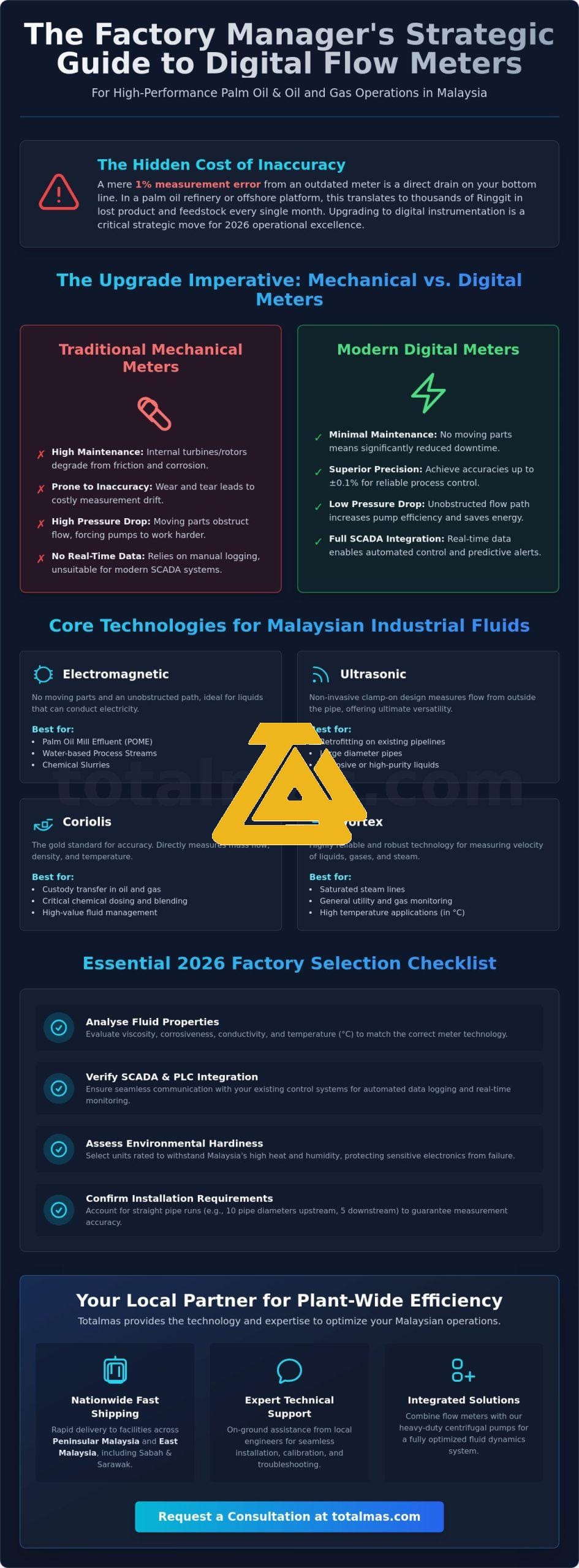
In traditional setups, mechanical meters use rotors or turbines that inevitably degrade due to friction and corrosion. Digital alternatives often utilize advanced flow measurement principles like electromagnetism or acoustics to eliminate moving parts entirely. This design choice significantly reduces the pressure drop across the line, meaning your pumps don’t have to work as hard to maintain flow. Additionally, digital units offer a superior turndown ratio. The turndown ratio represents the operational range between the maximum and minimum flow rates a meter can measure accurately, giving your facility the versatility to scale production up or down without hardware swaps.
The ROI of High-Accuracy Digital Instrumentation
High-accuracy instrumentation is often viewed as a premium cost, but the return on investment is quantifiable and immediate. In high-volume sectors like Malaysian oil and gas, even a 0.1% improvement in measurement accuracy can prevent the loss of thousands of Ringgit in feedstock or finished product. Beyond simple accuracy, a digital flow meter for factories provides predictive alerts that signal potential issues before they cause unplanned downtime. This proactive approach to maintenance keeps production lines running and avoids the high costs associated with emergency repairs. Addressing the misconception that digital is too expensive requires looking at the total cost of ownership; when you factor in reduced waste and lower maintenance, digital systems consistently outperform their mechanical counterparts. For specialized advice on selecting the right fit for your specific fluid types, Totalmas remains a trusted resource for local industrial expertise.
Core Digital Flow Meter Technologies for Industrial Use
Selecting the right digital flow meter for factories involves more than just picking a brand. You must match the measurement physics to your specific fluid properties. In 2026, four technologies dominate the industrial sector: electromagnetic, ultrasonic, Coriolis, and vortex. Each handles data differently, using sophisticated transmitters to convert raw sensor signals into stable, noise-filtered data. These transmitters act as the “brain” of the unit, performing complex algorithms to compensate for Reynolds numbers and fluid viscosity changes in real-time. This ensures that the data reaching your SCADA system is already corrected for environmental variables, providing a level of reliability that mechanical gauges simply can’t match.
Electromagnetic and Ultrasonic Solutions
Electromagnetic flow meters, or “mag meters,” are the primary choice for conductive liquids. In Malaysia’s palm oil industry, these are indispensable for managing Palm Oil Mill Effluent (POME) and other water-based process streams. Since they have no moving parts and offer an unobstructed flow path, they resist the scaling and clogging that ruin mechanical meters. For managers concerned with international regulatory benchmarks, following EPA flow measurement guidance ensures your installation meets global standards for accuracy and calibration.
Ultrasonic meters provide a versatile alternative, especially the clamp-on varieties that attach to the outside of existing pipework without a process shutdown. These instruments utilize either transit-time technology for clean liquids or Doppler methods for fluids with suspended solids or bubbles. Transit-time is preferred for high-purity water or refined fuels, while Doppler excels in “dirty” fluids where particles reflect the acoustic signal. This non-intrusive approach is ideal for retrofitting older Malaysian factories where cutting into aging pipes is risky or expensive.
Coriolis and Vortex: High Precision for Complex Fluids
When your process requires extreme precision, Coriolis meters are the undisputed leader. Unlike other technologies that measure volume, Coriolis instruments measure actual mass flow, density, and temperature simultaneously. This makes them the gold standard for custody transfer and high-value chemical dosing in the oil and gas sector. Deploying a high-performance digital flow meter for factories ensures that your mass balance calculations remain accurate even when fluid temperatures fluctuate. If you need a deeper technical breakdown of these instruments, refer to our high accuracy flow meters guide for specific engineering tolerances.
Vortex meters fill a different niche, excelling in high-velocity gas and steam applications. They work by measuring the frequency of vortices shed by a “bluff body” placed in the flow stream. This technology is robust and reliable for the high-temperature environments often found in Malaysian power generation and industrial heating systems. Choosing between these technologies can be complex, but consulting with a specialist like Totalmas ensures you select a solution tailored to your facility’s specific pressure and temperature profiles.
The Essential 2026 Factory Flow Meter Selection Checklist
Procurement officers and engineers in Malaysia face a complex landscape when upgrading instrumentation. A digital flow meter for factories isn’t a “one size fits all” component; it’s a precision tool that must be matched to your specific operational environment. This checklist provides a methodical verification process to ensure your investment delivers the expected ROI in 2026. By following these phases, you can avoid the common mistake of over-specifying hardware for simple tasks or, conversely, installing sensitive electronics in environments where they’re prone to failure.
Phase 1: Fluid and Process Parameters
The first step is a deep dive into the properties of the medium you’re measuring. In Malaysian palm oil mills, for example, crude palm oil (CPO) presents challenges with viscosity and temperature that can fluctuate during the day. You must verify the minimum and maximum flow rates, known as the flow range, to ensure the meter operates within its highest accuracy band. Check the compatibility of the fluid with all wetted materials; 316L Stainless Steel or PTFE liners are often required for corrosive or high-temperature streams. Additionally, assess the presence of particulates or entrained air bubbles. While some technologies handle “dirty” fluids well, others will produce erratic readings if the stream isn’t perfectly homogeneous. For facilities handling aggressive acids or alkalis, understanding how to properly specify a flow meter for corrosive chemicals is a critical step that goes beyond standard material compatibility checks.
Phase 2: Technical and Integration Specs
Once the fluid parameters are set, focus on how the data moves through your plant. Confirm that the required accuracy level, such as +/- 0.5% of the rate, meets your process control needs. It’s also vital to ensure the digital output matches your existing PLC or SCADA system. Most modern Malaysian facilities utilize Modbus, Profibus, or the standard 4-20mA analog signal for communication. Repeatability is a core selection metric, which refers to the meter’s ability to consistently produce the same reading under identical conditions over time. High repeatability is often more important than absolute accuracy for maintaining long-term process stability and product consistency.
Phase 3: Local Compliance and Support
Operating within the Malaysian industrial sector requires adherence to specific safety and quality standards. For those in the oil and gas sector, check for SIRIM or international explosion-proof (ATEX) certifications to ensure the digital flow meter for factories is safe for use in hazardous zones. Beyond the technical specs, evaluate the availability of local technical support. Relying on manufacturers without a local presence can lead to weeks of downtime during a failure. Working with a qualified industrial flow meter supplier Malaysia ensures that warranty and calibration service intervals are handled by experts who understand the local market, from Peninsular Malaysia to remote sites in Sabah and Sarawak. Proper local support ensures your instrumentation remains a long-term asset rather than a maintenance liability.
Installation and Maintenance: Avoiding Common Factory Pitfalls
Procuring a high-precision digital flow meter for factories is a significant investment, but the hardware is only as good as its installation. Many factory managers in Malaysia find that even the most expensive Coriolis or electromagnetic meters deliver erratic data if the physical piping layout is ignored. Unlike mechanical meters that might simply “wear out,” digital sensors are highly sensitive to flow profile disturbances. Proper commissioning requires a methodical approach to the physical environment to ensure the electronic transmitter receives a clean, stable signal from the fluid stream.
Piping Layout and Flow Profile
The most common pitfall in industrial installations is failing to provide enough straight pipe run. Most digital technologies require a “10D/5D” rule, which means ten pipe diameters of straight, unobstructed pipe upstream and five diameters downstream. If you place a meter too close to an elbow, a partially closed valve, or a high-pressure pump, the resulting turbulence creates “swirl” that confuses the sensor. In palm oil processing, where fluids can be viscous or contain air bubbles, identifying and eliminating cavitation is critical. Air entrainment or vacuum conditions in the line will cause significant measurement errors, often leading to phantom flow readings or total signal loss that disrupts your process control.
Environmental Protection for Malaysian Plants
Malaysia’s tropical climate presents unique challenges that manufacturers in temperate regions often overlook. High ambient temperatures in industrial hubs like Selangor or the intense humidity of coastal oil and gas facilities can cause condensation inside transmitter housings if they aren’t properly sealed. You should specify IP67 or IP68 ratings for any equipment in washdown zones or high-moisture areas. For outdoor transmitters in KL and other sun-drenched regions, installing dedicated sunshades is a small but vital step to prevent electronics from overheating. Protecting these units from direct UV exposure and heavy monsoon rain extends the lifespan of the LCD displays and sensitive internal circuit boards.
Beyond physical protection, the electrical environment is equally important. Digital signals are susceptible to electromagnetic interference (EMI) from nearby heavy-duty motors or variable frequency drives (VFDs). Proper grounding and the use of shielded cabling are mandatory to prevent electrical “noise” from corrupting the flow data sent to your SCADA system. Finally, remember that “digital” doesn’t mean “maintenance-free.” While there are no moving parts to grease, routine calibration is still necessary to account for sensor drift or internal scaling over time. Totalmas provides the local technical expertise needed to ensure your instrumentation is installed correctly and maintained for peak performance. Contact Totalmas for a professional site assessment and installation support.
Optimizing Factory Efficiency with Totalmas Solutions
Totalmas has spent over 33 years refining industrial processes across Malaysia. We don’t just sell hardware; we provide the technical application knowledge required to turn a digital flow meter for factories into a strategic asset. Our team understands the specific pressures of the local palm oil and oil and gas sectors, where equipment reliability directly impacts export quality and safety compliance. We offer a single point of contact for complex instrumentation needs. This ensures that your selection, installation, and after-sales calibration are handled with the professional precision that only a seasoned partner can provide.
Beyond the Meter: System-Wide Optimization
A digital flow meter provides the critical data needed to protect more expensive assets within your facility. For example, integrating real-time flow monitoring with your heavy duty centrifugal pumps is the most effective way to prevent catastrophic dry running. If the flow drops below a safe threshold, the digital signal can trigger an immediate pump shutdown via the PLC, saving you from costly impeller damage and unplanned downtime. It’s a simple integration that provides a massive layer of security for your fluid handling systems.
Similarly, precise flow measurement is essential for maximizing the efficiency of a waste heat recovery unit. In thermal energy management, knowing the exact volume of fluid moving through the heat exchanger allows for tighter control over energy recapture. This data-driven approach reduces operational costs and helps Malaysian factories meet the sustainability targets that are becoming increasingly important for international trade. When every drop of fluid represents a cost, having accurate flow data is the only way to manage your margins effectively.
Get a Professional Consultation
Choosing the right digital flow meter for factories requires a deep understanding of fluid dynamics and local environmental stressors. Our technical experts are available for site audits to help you identify the ideal installation points and technology types for your unique process. We don’t just drop off equipment; we ensure it’s calibrated and integrated correctly into your existing infrastructure. Based at our Kuala Lumpur headquarters, the Totalmas team provides localized support that international vendors often can’t match. We’re committed to building long-term partnerships through reliable service and proven technical excellence. Reach out to us today to request a customized instrumentation proposal that aligns with your factory’s production goals and budget requirements.
Securing Your Plant’s Operational Future
Precision in fluid measurement is no longer an optional upgrade; it’s a fundamental requirement for maintaining competitive margins in Malaysia’s industrial sector. Whether you’re managing complex chemical streams in oil and gas or high-viscosity crude palm oil, the right digital flow meter for factories ensures that your data is both accurate and actionable. Success depends on moving beyond basic procurement to a methodical approach that accounts for fluid properties, SCADA integration, and the unique challenges of the Malaysian tropical climate.
Totalmas brings 33+ years of industrial expertise to your facility as an authorized distributor for leading instrumentation brands. From our headquarters in Kuala Lumpur, we provide localized support that ensures your systems are calibrated for long-term reliability. We’re ready to help you navigate the technical nuances of modern flow measurement to eliminate waste and protect your high-value assets. Take the next step toward optimized performance and Request a Technical Consultation for Your Factory Flow Measurement Needs today. We look forward to supporting your factory’s growth with proven technical solutions.
Frequently Asked Questions
Do digital flow meters require regular calibration?
Digital flow meters require periodic calibration to maintain their specified accuracy and operational reliability. Even though these instruments lack moving parts, sensor drift or internal buildup can occur over time, especially in heavy-duty palm oil processing. Most manufacturers recommend a calibration check every 12 to 24 months. Totalmas provides specialized support for these maintenance intervals, ensuring your instrumentation continues to meet the strict reporting standards required in 2026.
What is the best digital flow meter for corrosive chemicals?
Electromagnetic flow meters with specialized liners, such as PTFE or PFA, are typically the best choice for corrosive chemicals. These materials provide a non-reactive barrier that protects the meter’s internal housing from aggressive acids or alkaline solutions. If mass flow measurement is required for high-value chemicals, a Coriolis meter constructed from corrosion-resistant alloys like 316L stainless steel or Hastelloy is the industry standard for maximum longevity and precision. For a detailed breakdown of selection criteria and implementation strategies, our guide on choosing a flow meter for corrosive chemicals in 2026 covers the full technical and compliance requirements for Malaysian facilities.
Can a digital flow meter handle high-temperature fluids?
Specialized digital flow meters are designed specifically to handle high-temperature fluids, including steam and thermal oils. Vortex meters are particularly robust in these environments because they can withstand temperatures exceeding 250 degrees Celsius. For high-precision mass flow in the oil and gas sector, certain Coriolis models are engineered with remote electronics to protect the sensitive transmitter from extreme heat while the sensor remains in the process line.
How do I integrate a new digital flow meter into my old SCADA system?
Integrating a modern digital flow meter for factories into an older SCADA system is usually achieved via universal 4-20mA analog signals or HART protocol gateways. Most legacy systems in Malaysia can interpret these standard signals even if they don’t support modern Ethernet/IP or Profinet. Totalmas can assist in selecting the appropriate communication modules or signal converters to ensure your new instrumentation talks seamlessly to your existing control room infrastructure without a full system overhaul.
Is an ultrasonic clamp-on meter as accurate as an inline meter?
Ultrasonic clamp-on meters are highly accurate but typically fall slightly behind high-end inline meters. While an inline Coriolis or Mag meter can achieve 0.5% accuracy, a clamp-on unit usually operates within a 1% to 2% range. The trade-off is the significant cost saving and convenience of not cutting into existing pipework. They’re excellent for site audits or retrofitting systems where a temporary shutdown for installation isn’t feasible.
What happens to a digital flow meter during a power outage?
Most digital flow meters feature non-volatile memory that preserves your totalizer data and configuration settings during a power outage. While the real-time display and signal transmission will cease, the meter won’t lose its historical flow totals once power is restored. For critical applications in Malaysian refineries, we recommend utilizing an Uninterruptible Power Supply (UPS) to maintain continuous data logging and prevent gaps in your process monitoring during local grid fluctuations.
How does humidity in Malaysia affect digital flow meter electronics?
High humidity in Malaysia can lead to moisture ingress and internal condensation, which eventually corrodes sensitive circuit boards. To combat this, a digital flow meter for factories must have a minimum IP67 or IP68 ingress protection rating. It’s also vital to ensure that cable glands are properly sealed and that housings are kept closed. Totalmas recommends using dedicated sunshades and moisture-resistant enclosures for any transmitters installed in outdoor or washdown areas.