How much revenue is your facility losing to a single millimeter of misalignment or a slight deviation in tap orientation? For factory managers across Malaysia’s oil & gas and palm oil sectors, measurement drift is a persistent threat to process efficiency and profitability. You’ve likely dealt with the daily frustration of turbulence caused by improper straight-run lengths, yet achieving consistent results remains a challenge. By implementing rigorous orifice plate installation best practices, you can secure ±1% accuracy and significantly reduce pressure loss in high-temperature environments exceeding 300 Celsius.
This guide provides the technical roadmap to master the geometric requirements essential for industrial flow precision in 2026. Whether you operate in Peninsular Malaysia or require urgent solutions in Sabah and Sarawak, Totalmas stands as your authoritative partner for instrumentation excellence. We’ll examine pipe conditioning, flange alignment, and the critical role of professional technical support in maintaining peak performance. You’ll learn how to transform your flow measurement from a source of uncertainty into a reliable pillar of your operational success, backed by fast shipping and decades of local expertise.
Key Takeaways
- Understand why installation geometry is responsible for the majority of measurement errors and how to secure ±1% accuracy in high-temperature environments.
- Determine precise upstream and downstream straight-run requirements to eliminate turbulence caused by pipe fittings and valves.
- Master fluid-specific orientation and tapping configurations to maintain measurement stability across oil & gas and palm oil applications.
- Follow standardized orifice plate installation best practices to ensure correct plate orientation and prevent common mechanical defects.
- Leverage Totalmas for expert technical guidance and fast logistics to industrial sites in Peninsular Malaysia, Sabah, and Sarawak.
The Fundamentals of Orifice Plate Measurement Accuracy
Orifice plates serve as the primary element in differential pressure (DP) flow measurement. By creating a deliberate restriction in the pipeline, they generate a pressure drop proportional to the flow rate. While the physics is straightforward, industry data suggests that installation geometry accounts for over 90% of measurement errors. Even a premium plate can’t compensate for poor positioning or incorrect alignment. Following established orifice plate measurement theory and ISO 5167 ensures your calculations remain valid under real-world conditions.
In the demanding environments of Malaysian palm oil mills and oil & gas refineries, edge sharpness and plate flatness are non-negotiable. A rounded upstream edge or a warped plate will cause the flow coefficient to drift, leading to significant volume discrepancies. Adhering to high accuracy flow meters installation protocols helps maintain these physical properties over time. Totalmas provides the technical support needed to verify these tolerances before the first bolt is tightened, ensuring long-term durability in systems reaching 300 Celsius.
Why Industrial Standards (ISO 5167) Matter
ISO 5167 provides the global framework for pressure differential devices. For Malaysian factory managers, non-compliance isn’t just a technical oversight; it’s a financial drain. In palm oil processing, inaccurate flow data leads to inefficient boiler feed or incorrect oil recovery metrics. The Beta ratio, which is the ratio of the orifice diameter to the pipe diameter, dictates how sensitive the setup is to upstream disturbances. A higher Beta ratio generally requires more stringent adherence to orifice plate installation best practices to prevent turbulence from skewing results.
Common Misconceptions in DP Flow Setup
Many engineers believe that any length of straight pipe is sufficient for accurate readings. This is a dangerous myth. High-velocity gas lines in offshore platforms often suffer from swirl and turbulence that a short pipe run cannot dampen. In high-temperature oil and gas environments, thermal expansion can also affect plate centering if not properly accounted for during the design phase. “Good enough” installation techniques fail in these scenarios. Totalmas supports operations across Peninsular Malaysia, Sabah, and Sarawak with specialized expertise to ensure your hardware survives these harsh conditions while maintaining precision.
Straight Pipe Run Requirements: Upstream and Downstream
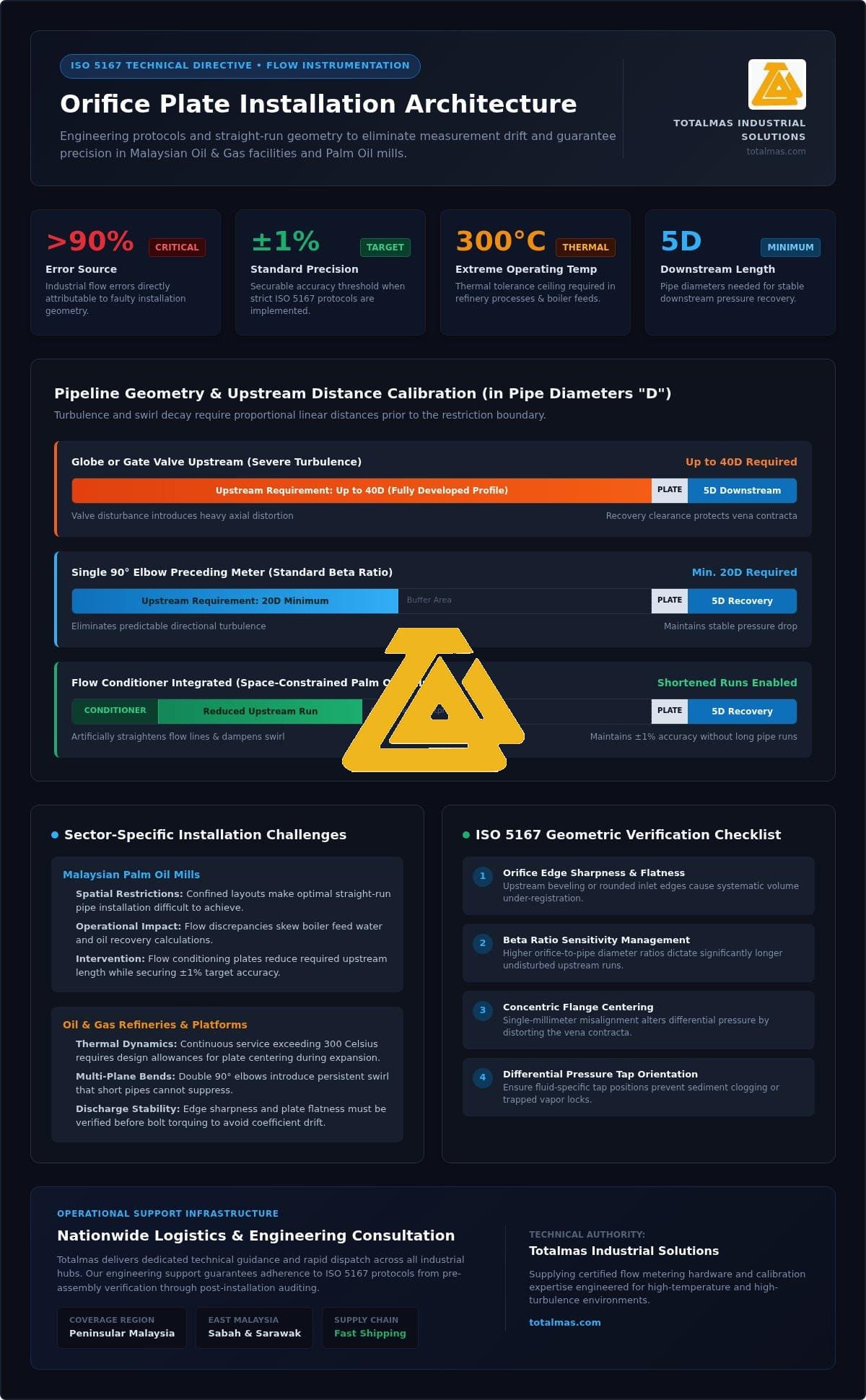
Ensuring accurate readings depends on providing the fluid enough distance to stabilize before hitting the plate. In the confined layouts of many Malaysian palm oil mills, floor space is a premium commodity. This often leads to compromised pipe runs, which directly affects the discharge coefficient and overall measurement reliability. Adhering to orifice plate installation best practices requires a careful calculation of upstream and downstream diameters (D) relative to the specific disturbances present in your line.
Pipeline architecture in refineries often involves complex routing where a single 90-degree elbow creates predictable turbulence. However, double elbows installed in different planes introduce swirl that is much harder to stabilize. Without sufficient straight pipe, this swirl persists through the orifice, leading to significant over-registration or under-registration of flow. Detailed data in the USBR Water Measurement Manual on orifice relationships highlights how these approach boundary conditions dictate the formation of the vena contracta.
Calculating Upstream Diameters (D)
Upstream requirements vary based on the type of fitting preceding the meter. For a single 90-degree bend, a minimum of 20D is often required for plates with a high Beta ratio. If your system utilizes globe valves or gate valves, these requirements can double to ensure the flow profile is fully developed. If your facility in Sabah or Sarawak cannot accommodate these lengths due to structural constraints, flow conditioners are an essential technical intervention. These devices artificially straighten the flow, allowing for shorter runs without sacrificing ±1% accuracy.
Downstream Clearances and Pressure Recovery
While the upstream run handles profile development, the downstream run is critical for stable pressure recovery. A standard minimum of 5D is typically sufficient to prevent backpressure from interfering with the differential pressure reading. You must also consider the placement of auxiliary equipment. Thermowells, for example, should be placed at least 5D to 8D downstream to avoid disrupting the flow exit. This is especially vital when integrating high temperature pressure transmitters in high-pressure steam lines where thermal gradients are extreme.
Totalmas provides the technical expertise to help you map these requirements for your specific site layout. If you’re unsure about your current pipe configuration, you can consult with our engineering team for a professional assessment of your instrumentation setup.
Orientation and Tapping Best Practices for Different Fluids
Choosing the right tapping method is a cornerstone of orifice plate installation best practices. Flange taps are the preferred choice for pipes 50mm and larger because the 25.4mm spacing is maintained by the flange manufacturer, which reduces field installation errors. For smaller lines often found in specialized chemical skids or pilot plants, corner taps or radius taps provide better accuracy by capturing the pressure profile closer to the plate. The orientation of these taps depends entirely on the state of the fluid and the pipe’s physical orientation.
The Bureau of Reclamation Water Measurement Manual provides exhaustive details on how these hydraulic relationships change based on tapping location and fluid density. While horizontal installation is the industry standard for its ease of maintenance, vertical lines are sometimes necessary. In vertical setups, liquid should always flow upward to ensure the pipe remains completely full, while gas should flow downward to prevent condensate from pooling against the orifice plate.
Liquid Flow Installation (Water and Palm Oil)
In the Malaysian palm oil sector, managing high-viscosity crude oil requires precise tap positioning. Taps should be located between 0 and 45 degrees below the horizontal centerline. This prevents air bubbles from entering the impulse lines, which would otherwise cause erratic differential pressure readings and measurement drift. Impulse piping must maintain a consistent 1:12 slope toward the transmitter to ensure any trapped gas can migrate back into the process line. For wastewater treatment plants handling sludge or solids, this slope is critical to prevent debris from settling and clogging the instrumentation. Totalmas offers technical support to ensure these configurations are optimized for your specific plant layout, whether you’re in Peninsular Malaysia or East Malaysia.
Gas and Steam Flow Installation
For gas and steam applications, the logic is reversed to protect the transmitter. Taps must be positioned above the horizontal centerline, typically at a 45-degree angle. This orientation ensures that any condensate drains back into the process line rather than accumulating in the impulse tubing. In high-pressure steam lines, condensate pots are essential technical components to protect the instrumentation from extreme temperatures, which can exceed 300 Celsius. These setups are common in refineries where orifice plates are integrated with API 610 centrifugal pumps Malaysia standards. Totalmas ensures fast shipping of all necessary flanges and plates to Sabah and Sarawak, providing a single point of contact for complex instrumentation requirements.
Step-by-Step Orifice Plate Installation Guide
Precision is a product of discipline during the assembly phase. Before the plate even touches the pipeline, you must conduct a rigorous physical audit. In the high-humidity environments typical of Malaysian industrial sites, surface integrity is paramount. Inspect the upstream edge for any nicks, burrs, or rounding. This edge must remain “knife-sharp” to ensure the pressure drop follows predictable physics. Additionally, verify the plate’s flatness using a precision straightedge. A warped plate, even by a fraction of a millimeter, will compromise the entire measurement loop. These orifice plate installation best practices form the foundation of reliable data for your facility’s energy management and process control.
Gasket and Flange Alignment
Gasket selection and positioning are where many installations fail. You must ensure that the gaskets don’t protrude into the pipe bore. Any material entering the flow stream creates localized turbulence that skews the differential pressure reading. For high-temperature applications in the oil and gas sector, often exceeding 300 Celsius, select gaskets that can withstand thermal cycling without losing their seal. Centering the plate within the flange bolt circle is equally critical. If the plate is eccentric to the pipe centerline, the flow profile becomes asymmetrical, leading to significant calculation errors. Use a star-pattern torquing sequence to apply even pressure across the flange face, preventing plate distortion and ensuring a leak-free seal in high-pressure lines.
The ‘Bevel’ and Drain/Vent Hole Placement
Correct flow orientation is the most basic yet most frequently missed step. The sharp, square edge of the orifice must always face the upstream flow, while the beveled edge faces downstream. Reversing this orientation can lead to measurement errors as high as 20%. If your process involves “wet” gas or “dirty” liquids, you must also pay attention to the drain and vent holes. In gas lines, the drain hole should be at the bottom to allow condensate to pass. In liquid lines, the vent hole stays at the top to let trapped gas escape. This is particularly important for remote operations in Sabah and Sarawak, where consistent manual venting isn’t always feasible. Before commissioning, run through a final checklist to verify plate orientation and tap alignment. Partnering with a seasoned industrial flow meter supplier Malaysia like Totalmas ensures you have access to the technical support and high-quality hardware needed for these precision tasks.
For expert guidance on selecting the right flanges and plates for your specific application, contact Totalmas today for comprehensive technical assistance and fast shipping options.
Sourcing and Support: Totalmas Industrial Solutions
Totalmas Sdn Bhd has spent over 33 years establishing itself as a cornerstone of the Malaysian industrial sector. Our comprehensive inventory of orifice plates and flanges in Kuala Lumpur ensures that factory managers don’t have to wait weeks for critical instrumentation. We understand that adhering to orifice plate installation best practices is only possible when you have access to high-quality, standardized hardware. By maintaining a steady supply of flow measurement components, we help our partners minimize downtime and maintain process accuracy across diverse sectors. Our team treats every order as a commitment to your plant’s long-term success, providing the reliability that modern industrial environments demand.
Logistics Excellence for Sabah and Sarawak
Industrial zones in East Malaysia often face logistical hurdles that delay project timelines and increase operational costs. Totalmas addresses this by utilizing direct shipping routes to Bintulu, Kuching, and Kota Kinabalu. Our logistics framework ensures that whether you need a single orifice plate or complex bulk material handling equipment, the delivery is efficient and secure. We serve both Peninsular Malaysia and the specific needs of Sarawak and Sabah with equal commitment. This localized approach reduces the risk of transit damage to precision-machined edges, which is vital for maintaining the measurement accuracy discussed in previous sections. We prioritize speed and reliability to ensure your facility in East Malaysia remains competitive and fully operational.
Expert Consultation and After-Sales Support
Hardware is only one part of the equation for industrial success. Our technical support teams provide on-site assessment services to help optimize your flow measurement loops and troubleshoot complex installation issues. We specialize in the nuances of the oil & gas and palm oil industries, where temperature extremes and fluid viscosity demand customized solutions. Our teams are trained to verify that your site follows orifice plate installation best practices to avoid the 90% of errors typically caused by geometric deviations. If you’re struggling with measurement drift or improper tap orientation, our seasoned consultants can provide a professional audit of your setup.
We’ve handled diverse requirements across Malaysia, moving from simple component supply to comprehensive technical partnership. To secure your facility’s operational success in 2026, contact Totalmas for a technical consultation. We offer a single point of contact for everything from flow meters to waste water treatment solutions, ensuring your plant remains a model of efficiency and precision. Our methodical approach to service ensures that your technical needs are met with the highest standard of professional care.
Securing Long-Term Flow Precision in 2026
Achieving ±1% measurement accuracy isn’t just about the hardware; it’s about the discipline of your setup. By mastering the geometric requirements of straight pipe runs and ensuring correct tap orientation, you protect your facility from the hidden costs of measurement drift. These orifice plate installation best practices are the foundation for operational excellence in the demanding oil & gas and palm oil sectors. Every millimeter of alignment and every degree of tap slope contributes to the overall reliability of your process data.
Totalmas Sdn Bhd provides the ISO-compliant technical solutions and specialized expertise needed to maintain these high standards. With 33+ years of experience in the Malaysian industrial landscape, we offer comprehensive technical support and fast shipping to Peninsular Malaysia, Sabah, and Sarawak. Whether you’re optimizing a refinery in Bintulu or a mill in Johor, our team is ready to assist with your instrumentation needs. Contact Totalmas Sdn Bhd for Expert Flow Instrumentation Support today to ensure your measurement systems remain reliable and precise for years to come. Your process efficiency is our priority.
Frequently Asked Questions
What is the most common mistake in orifice plate installation?
The most frequent error is installing the plate backward with the beveled edge facing the upstream flow. This mistake can lead to measurement inaccuracies of up to 20% because it alters the discharge coefficient. Other common issues include improper gasket centering and failing to follow orifice plate installation best practices regarding straight pipe lengths. Totalmas technicians often find that these mechanical oversights are the primary cause of measurement drift in Malaysian refineries.
Can I install an orifice plate in a vertical pipe?
Yes, you can install an orifice plate in vertical pipelines, provided you follow specific flow directions. For liquid applications, the flow must move upward to ensure the pipe remains completely full and free of air pockets. Conversely, gas and steam should flow downward to prevent condensate from accumulating against the plate surface. Totalmas provides technical consultation to help you determine the optimal configuration for vertical runs in your specific plant layout.
How often should an orifice plate be inspected for wear?
Inspection frequency depends on the erosive or corrosive nature of your process fluid. In the palm oil sector, where fluids may contain abrasive solids, we recommend a physical inspection every 6 to 12 months. You should check for edge rounding, surface pitting, or any loss of flatness. Even a slight rounding of the upstream square edge can cause significant measurement drift. Totalmas offers on-site assessment services to help you establish a reliable maintenance schedule.
What is the minimum straight pipe run for an orifice plate?
The minimum straight run typically ranges from 20 to 44 pipe diameters upstream, depending on the Beta ratio and the type of fittings used. Downstream requirements are generally less stringent, usually requiring at least 5 diameters of straight pipe. If your facility in Kuala Lumpur or East Malaysia has limited space, you might need flow conditioners to achieve ±1% accuracy. These orifice plate installation best practices are essential for dampening turbulence before the fluid reaches the plate.
Which way should the bevel face on an orifice plate?
The beveled edge must always face the downstream side of the flow. The upstream side must be a sharp, square edge that is perpendicular to the pipe axis. If the bevel faces the incoming fluid, the pressure drop relationship is compromised, leading to unreliable data. Totalmas ensures that all supplied plates are clearly marked to prevent this error during field assembly. Always verify the “Inlet” marking before securing the flange bolts to maintain measurement integrity.
Do I need a different installation for steam vs. water flow?
The primary difference lies in the tapping orientation and impulse line configuration. For water and other liquids, taps should be located below the horizontal centerline to prevent air bubbles from entering the transmitter lines. For steam or gas, taps are positioned above the centerline so that condensate drains back into the process pipe. Totalmas provides specialized hardware, including condensate pots for high-pressure steam lines, to ensure your instrumentation survives these different operating conditions and temperature extremes.
How does Totalmas support East Malaysian clients in Sabah and Sarawak?
Totalmas supports industrial zones in East Malaysia through direct shipping routes and specialized technical response teams. We provide fast shipping for orifice plates, flanges, and flow meters to major hubs such as Bintulu, Kuching, and Kota Kinabalu. Our 33 years of experience allow us to handle the complex logistical needs of clients in Sabah and Sarawak efficiently. We act as a single point of contact for technical support, ensuring that remote sites receive the same expertise as those in Peninsular Malaysia.
What are the benefits of using flange taps over corner taps?
Flange taps are the industry standard for pipes 50mm and larger because the 25.4mm spacing is precisely machined into the flange. This eliminates the need for field measurements and reduces the risk of tapping errors during installation. Corner taps are typically reserved for smaller pipe sizes where the pressure profile is tighter. Totalmas stocks a comprehensive inventory of both types in Kuala Lumpur, helping you choose the most reliable tapping method for your specific industrial application and fluid type.