
Did you know that implementing a boiler economizer can reduce fuel consumption by up to 10% in Malaysia’s palm oil and chemical sectors? With natural gas prices projected to reach RM50 per mmbtu by the end of 2026, the financial burden of inefficient thermal processes is becoming unsustainable for many factory managers. You’re likely facing the dual challenge of rising utility tariffs and the strict mandates of the Energy Efficiency and Conservation Act 2024. Finding a reliable partner who understands these local pressures and provides technical backing in both Peninsular and East Malaysia is often a significant hurdle.
This article explains how your facility can capture lost thermal energy, often exceeding 200 Celsius, to significantly lower monthly bills and reduce CO2 emissions through energy efficient waste heat recovery. We’ll explore how Totalmas leverages over 33 years of expertise to deliver robust waste heat recovery units tailored for the oil and gas and palm oil sectors. From Peninsular Malaysia to the specific needs of Sabah and Sarawak, we’ll preview the technical solutions and fast shipping that ensure your equipment performs reliably in 2026 and beyond.
Key Takeaways
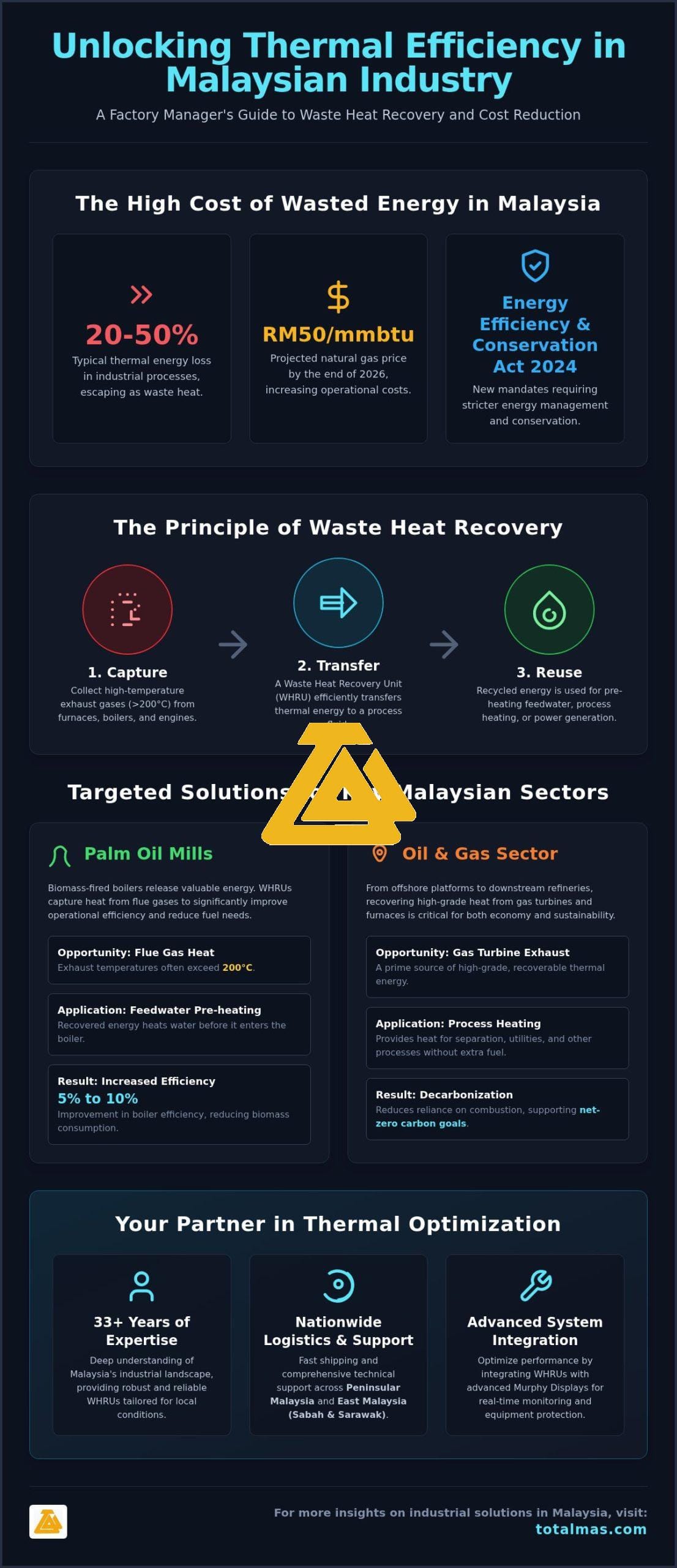
- Learn how to mitigate the financial impact of rising fuel costs by addressing the 20-50% thermal energy loss typical in Malaysian industrial refineries.
- Master the fundamental physics of energy efficient waste heat recovery to effectively capture and reuse thermal energy from high-temperature exhaust gases.
- Identify specific high-grade and low-grade heat sources in your plant, such as furnaces and internal combustion engines, to maximize recovery potential.
- Understand the importance of localized technical support and fast shipping in Sabah, Sarawak, and Peninsular Malaysia to maintain operational continuity.
- Discover how to optimize thermal performance by integrating Totalmas WHRUs with advanced Murphy Displays for real-time monitoring and equipment protection.
The Economic Case for Waste Heat Recovery in Malaysia
Industrial facilities across Malaysia currently operate with a significant thermal disadvantage. High-temperature processes typically lose between 20% and 50% of their total energy input to the environment. This Waste heat represents a direct financial loss for refineries and manufacturing plants. As natural gas prices are projected to reach RM50 per mmbtu by the end of 2026, these inefficiencies become even more costly. Adopting energy efficient waste heat recovery systems allows businesses to capture this lost energy and redirect it into their operations. This approach, known as heat integration, is a cornerstone of modern industrial strategy. It helps companies comply with the Energy Efficiency and Conservation Act 2024 while buffering against the 20% electricity tariff hike seen in Regulatory Period 3. Totalmas serves as a reliable mentor for businesses navigating these complex thermal upgrades.
Thermal Challenges in the Palm Oil Industry
Palm oil mills in Malaysia face unique thermal pressures. Biomass-fired boilers often release flue gases at temperatures well above 200 Celsius, losing energy that could be put to work. By implementing a WHRU, mills can capture this heat to improve boiler efficiency by 5% to 10%. This recovered energy is ideal for pre-heating feed water or aiding in POME treatment and drying processes. Reducing fuel consumption isn’t just about cost; it’s about optimizing the use of biomass. Totalmas provides comprehensive technical support for these systems, with a specific focus on reaching mills across Sabah and Sarawak. Our fast shipping ensures that critical components reach even the most remote locations quickly, minimizing operational disruptions.
Waste Heat Opportunities in Oil & Gas
The oil and gas sector offers some of the highest returns on thermal optimization. Offshore platforms utilize gas turbines that produce high-grade exhaust heat. Recovering this energy can provide the necessary heat for separation processes or utility heating without additional combustion. In downstream petrochemical plants, the focus shifts to precise thermal management. Integrating high temperature pressure transmitters ensures that recovery systems operate within safe parameters while maximizing energy harvest. Totalmas brings over 33 years of experience to these high-stakes environments. We provide the reliable equipment and local expertise needed to handle complex requirements in East Malaysia and beyond. By focusing on proven reliability, we help facilities achieve their net-zero carbon goals by 2050 through practical, functional success.
What is Energy Efficient Waste Heat Recovery?
At its core, energy efficient waste heat recovery is the systematic capture of thermal energy from exhaust streams, cooling water, or process waste for reuse within an industrial facility. It isn’t merely about trapping heat; it’s about the engineered transfer of energy from a high-temperature source to a medium that requires heating. While standard heat exchangers are common in many plants, a Waste Heat Recovery Unit (WHRU) is specifically designed to handle the high-stress conditions of industrial flue gases and the corrosive environments often found in Malaysian oil and gas refineries. Totalmas provides these specialized units to ensure that energy once lost to the atmosphere is repurposed to drive operational productivity.
The physics of this process involves moving energy from exhaust gases, which may exceed 300 Celsius, to process fluids like water or thermal oil. This transfer reduces the demand on primary fuel-burning equipment, such as boilers or furnaces. By lowering the fuel input required to maintain process temperatures, facilities can significantly cut their carbon footprint. Totalmas serves as a dependable mentor in this field, helping factory managers identify the most effective heat exchange configurations for their specific site conditions. You can consult with our technical team to evaluate your current thermal performance and identify recovery opportunities.
Primary Recovery Technologies: Economizers and WHBs
Selecting the appropriate technology depends on the temperature of the heat source and the intended application. Stack economizers are a primary choice for Malaysian palm oil mills. They pre-heat boiler feed water using flue gases, which directly reduces the amount of biomass fuel needed for steam production. In larger industrial settings, Waste Heat Boilers (WHB) are utilized to generate high-pressure steam from gas turbine or furnace exhaust. For sensitive downstream petrochemical processes, thermal fluid heaters provide an indirect heat transfer method. This approach ensures safety while maximizing energy harvest from high-temperature waste streams.
The Role of Precise Monitoring
Effective thermal management relies on data. For energy efficient waste heat recovery to deliver its promised ROI, precise instrumentation is mandatory. Integrating high accuracy flow meters allows your engineering team to track the exact volume of fluids moving through the recovery loop. When these measurements are combined with temperature differential data in Celsius, you can calculate the real-time energy savings and equipment efficiency.
Totalmas understands that reliable data is the foundation of industrial trust. We provide the monitoring instrumentation and the technical support necessary to keep these systems running at peak performance. Our logistics network ensures fast shipping and comprehensive service across Peninsular Malaysia and East Malaysia, including Sabah and Sarawak. With over 33 years of experience, we focus on providing the steady hand and technical expertise required for long-term functional success in the Malaysian industrial sector.
Evaluating Recovery Potential: Where to Capture Lost Energy
Maximizing the ROI of energy efficient waste heat recovery begins with a rigorous thermal audit. You must identify where energy is entering the environment and at what temperature. Engineers often look for the ‘pinch point’ in a system. This is the location where the temperature difference between the hot and cold streams is at its minimum, representing the ultimate constraint on heat exchange. By mapping these flows, Malaysian plant managers can prioritize investments based on the quality of heat available. Totalmas provides the technical expertise to conduct these evaluations, ensuring that your recovery strategy is grounded in thermodynamic reality.
High-Grade Heat Recovery Sources
High-grade waste heat is typically found in exhaust gases that exceed 400 Celsius. These sources are ideal for high-impact applications like steam generation or driving secondary turbines. In the oil and gas sector, direct combustion exhaust from industrial ovens and heaters offers a prime opportunity. Capturing kinetic energy alongside thermal energy from these streams can significantly boost overall plant efficiency. For facilities in Sabah and Sarawak, where fuel logistics can be complex, recovering this high-grade energy provides a vital hedge against supply volatility. Totalmas supports these installations with robust equipment designed for high-stress environments.
Low-to-Medium Grade Heat Applications
Low-to-medium grade heat shouldn’t be ignored. While these sources operate at lower temperatures, their volume is often substantial. Process steam condensate recovery is a common application for pre-heating boiler feed water. You can also harvest heat from air compressors and cooling jackets on internal combustion engines. This energy is frequently repurposed for space heating or hot water requirements within plant facilities. Utilizing these secondary sources ensures that no part of your thermal budget goes to waste. It’s a practical way to enhance sustainability without the need for additional fuel combustion.
Totalmas understands that every refinery and mill has a unique thermal profile. With 33 years of experience in the Malaysian industrial sector, we offer more than just equipment. We provide a partnership that includes comprehensive technical support and fast shipping to both Peninsular and East Malaysia. Whether your facility is in a major industrial hub or a remote part of Sarawak, our team ensures you have access to the reliable components needed for energy efficient waste heat recovery. We focus on functional success, helping you turn lost thermal energy into a measurable operational advantage.
Implementation in Malaysia: Logistics and Technical Support
Successfully deploying energy efficient waste heat recovery systems in Malaysia requires more than just high-quality hardware. It demands a logistics strategy that accounts for the geographic split between Peninsular and East Malaysia. Ambient temperatures often stay above 30 Celsius with humidity levels frequently exceeding 80%, placing unique stress on thermal equipment and instrumentation. Totalmas addresses these challenges by providing localized support that understands the specific environmental and operational nuances of the region. We focus on providing a sense of security to businesses seeking technical solutions that must perform reliably under tropical conditions.
Minimizing equipment downtime is a priority for any factory manager. When thermal processes are integrated, a failure in one component can disrupt the entire production line. Totalmas leverages over 33 years of experience to act as a dependable mentor, ensuring that recovery units are not just installed, but maintained for long-term functional success. Our approach prioritizes a steady and reassuring voice, linking our technical capabilities directly to your operational uptime. To learn more about our localized service capabilities, contact Totalmas for comprehensive technical support.
Serving Sabah and Sarawak
Many industrial providers struggle to bridge the ‘East Malaysia Gap,’ often leaving facilities in Sabah and Sarawak with extended wait times for specialized service. Totalmas has established a dedicated presence to serve Kota Kinabalu, Kuching, and Bintulu, ensuring that remote palm oil mills and refineries receive the same level of care as those in the Klang Valley. Consistent maintenance schedules are vital for these facilities, where a single day of downtime can result in significant production losses. Our team provides the steady hand needed to keep complex recovery systems functioning in the most challenging environments across East Malaysia.
Fast Shipping and Spare Parts Availability
Speed is critical when a component requires replacement. Totalmas utilizes Kuala Lumpur as a central logistics hub to streamline the distribution of industrial parts across the country. We maintain a robust inventory of critical WHRU components, including replacement flow meters and pressure sensors, to significantly reduce lead times. For Oil & Gas operations, where safety and continuity are paramount, we offer emergency technical assistance to resolve issues before they impact the bottom line. This commitment to fast shipping and spare parts availability ensures that your energy efficient waste heat recovery investment remains a stable asset for your facility.
Optimizing Thermal Performance with Totalmas WHRUs
Totalmas Sdn Bhd stands as a comprehensive partner for industrial facilities seeking Waste Heat Recovery Units in Malaysia. We don’t just supply hardware; we offer a consultative approach that integrates 33 years of field experience into every project. Each facility has distinct thermal constraints, requiring solutions that are customized for specific plant layouts and process requirements. Whether you’re managing a downstream petrochemical plant or a biomass-fired mill, our team ensures the recovery unit is engineered for functional success. We move beyond general optimization by focusing on energy efficient waste heat recovery that’s both measurable and sustainable under local conditions.
The Totalmas approach moves through a professional consultation phase to a reliable supply chain. We understand that Malaysian factory managers need a partner who can bridge the gap between complex engineering and operational reality. By choosing a provider with deep roots in the O&G and palm oil sectors, you gain a sense of security that your thermal upgrades will perform as promised. Our commitment to excellence is reflected in our steady and reassuring voice, ensuring you’re never navigating these technical transitions alone.
Instrumentation Integration for Maximum ROI
A WHRU is only as effective as the monitoring system that protects it. Totalmas integrates Enovation Controls and Murphy Displays to provide real-time thermal monitoring and engine protection. By pairing our units with precision pressure transmitters, you gain a robust safety monitoring layer that prevents equipment failure in environments where temperatures often exceed 300 Celsius. Centralized visualization is achieved through Murphy PowerView displays, allowing engineers to track energy data in a structured and logical sequence. To ensure fluid movement remains consistent, we utilize high-quality ANSI or API centrifugal pumps. This integration of monitoring and mechanical hardware reduces the risk of downtime and ensures your ROI is realized through optimized performance.
Taking the Next Step in Energy Efficiency
Transitioning to advanced thermal optimization doesn’t have to be a fragmented process. Totalmas acts as a single point of contact for both the recovery units and the instrumentation required to monitor them. This unified approach simplifies procurement and ensures that every component is compatible with your existing infrastructure. We provide comprehensive technical support across Peninsular Malaysia and East Malaysia, with specialized teams ready to assist in Sabah and Sarawak. Our logistics network facilitates fast shipping of critical parts, ensuring your facility remains compliant with the Energy Efficiency and Conservation Act 2024.
If you’re ready to enhance your plant’s thermal efficiency, you can Contact Totalmas for a professional waste heat recovery consultation. Our technical experts will work with you to evaluate your current energy losses and design a energy efficient waste heat recovery strategy that delivers long-term value and operational stability.
Advancing Industrial Efficiency through Thermal Optimization
Implementing energy efficient waste heat recovery is a strategic necessity for Malaysian refineries and mills facing rising fuel costs and stricter environmental mandates. By conducting thorough thermal audits and identifying high-grade exhaust sources, you can turn significant energy losses into measurable operational gains. Success in 2026 depends on more than just hardware; it requires a partner who understands the specific logistical challenges of Peninsular Malaysia, Sabah, and Sarawak.
Totalmas provides a steady hand with over 33 years of industry experience. As an authorized supplier of Murphy Displays and Enovation Controls, we ensure your recovery systems are backed by precise monitoring and local technical expertise. Our commitment to fast shipping across all regions ensures your facility maintains peak performance without unnecessary downtime. We’re here to help you navigate these complex thermal requirements with quiet confidence and proven reliability.
Ready to lower your operational costs and enhance your plant’s sustainability? Contact Totalmas for an Energy Efficient Waste Heat Recovery Consultation and secure your facility’s long-term competitive advantage.
Frequently Asked Questions
What is the typical ROI for an industrial waste heat recovery unit in Malaysia?
The typical payback period for an industrial waste heat recovery unit in Malaysia ranges between 12 and 36 months. This ROI is driven by the significant reduction in fuel costs, especially with natural gas prices projected to reach RM50 per mmbtu by late 2026. By capturing thermal energy that would otherwise be lost, facilities can offset the recent 20% electricity tariff hike. Totalmas provides the technical expertise to calculate these savings accurately for your specific plant.
Can waste heat recovery be retrofitted to existing palm oil mill boilers?
Yes, existing palm oil mill boilers can be retrofitted with stack economizers to capture heat from flue gases. This process is a highly effective form of energy efficient waste heat recovery that doesn’t require a total system overhaul. Retrofitting allows mills to improve boiler efficiency by 5% to 10%, directly reducing the consumption of biomass fuel. Totalmas supports these upgrades with fast shipping and technical assistance across Peninsular and East Malaysia.
How do high temperature pressure transmitters improve WHRU safety?
High temperature pressure transmitters improve safety by monitoring the differential pressure across the heat exchanger. This data helps engineers detect fouling or blockages in the tubes before they lead to dangerous over-pressurization. By integrating these sensors with Murphy Displays, operators receive immediate alerts if parameters deviate from safe operating standards. This proactive monitoring is essential for protecting both the WHRU and the primary process equipment from thermal stress.
Do you provide technical support for WHRU systems in Sabah and Sarawak?
Totalmas provides comprehensive technical support for WHRU systems throughout Sabah and Sarawak. We understand that remote palm oil mills and offshore platforms in East Malaysia require reliable, local backing to minimize downtime. Our teams are available in key hubs like Kota Kinabalu, Kuching, and Bintulu to ensure consistent maintenance and emergency assistance. This localized service model ensures that factory managers in East Malaysia receive the same high-quality support as those in Peninsular Malaysia.
What is the difference between high-grade and low-grade waste heat?
The distinction between high-grade and low-grade waste heat is based on the temperature of the source. High-grade heat typically exceeds 400 Celsius and is ideal for generating high-pressure steam or electricity. Low-grade heat usually falls below 250 Celsius and is better suited for pre-heating boiler feed water or space heating. Understanding these grades is critical for selecting the right energy efficient waste heat recovery technology to maximize your plant’s thermal performance.
How does a stack economizer reduce fuel consumption in kilograms per hour?
A stack economizer typically reduces fuel consumption by 5% to 10% by pre-heating feed water using exhaust gas energy. For a palm oil mill boiler consuming 5,000 kilograms of fuel per hour, this translates to a saving of approximately 250 to 500 kilograms per hour. These savings directly impact the bottom line while helping facilities meet the energy management requirements of the Energy Efficiency and Conservation Act 2024.
Why is precise flow measurement critical for heat integration?
Precise flow measurement is critical because it allows engineers to calculate the exact amount of energy being recovered and redistributed. Without accurate data from high-quality flow meters, it’s impossible to verify the efficiency of the heat integration loop or calculate the real-time ROI. Totalmas supplies the instrumentation needed to monitor these flows, ensuring that your thermal optimization strategy is based on verifiable data rather than estimates.
What are the maintenance requirements for a modern industrial WHRU?
Modern industrial WHRUs require regular cleaning of heat exchange surfaces to prevent soot buildup and maintain thermal conductivity. Maintenance also includes inspecting seals for leaks and calibrating pressure and temperature sensors to ensure data accuracy. Totalmas acts as a mentor for your maintenance teams, providing the technical support and spare parts needed to keep your system operational. Our fast shipping ensures that replacement components reach your facility quickly to prevent extended outages.