
Can a flow meter measure your process reliably without opening or modifying the pipe? Non-invasive flow meter technology can measure from outside the pipe, without direct contact between the sensor and process fluid. But an external installation alone doesn’t guarantee a dependable reading. The measurement principle must suit the fluid, pipe material and operating conditions.
That distinction matters for plant teams weighing installation constraints against measurement needs. In oil and gas operations or palm oil mills, the right approach depends on what is flowing through the line, the pipe construction and the conditions at the measurement point. This guide explains how non-invasive measurement works and how to compare relevant technologies against an application, including what information to prepare before specifying a meter.
You’ll also learn what to assess about fluid properties, pipe construction, flow conditions and access to the installation point. These details help you make a more informed selection and supplier discussion. Totalmas Sdn Bhd supplies industrial flow meters in Malaysia, alongside equipment such as pressure transmitters and Enovation Controls / Murphy Displays.
Key Takeaways
- Learn what “non-invasive” means in practice, and why external sensor placement alone doesn’t confirm a meter is suitable or accurate for your process.
- Compare transit-time and Doppler ultrasonic principles to understand which process conditions may affect their use.
- Assess fluid properties, pipe construction, measurement objectives and installation constraints before selecting non-invasive flow meter technology.
- Follow a structured review of process and site information, separating confirmed data from assumptions that need engineering assessment.
- Use the application details you gather to discuss relevant industrial flow meter options with Totalmas.
What Is Non-Invasive Flow Meter Technology, and What Does It Measure?
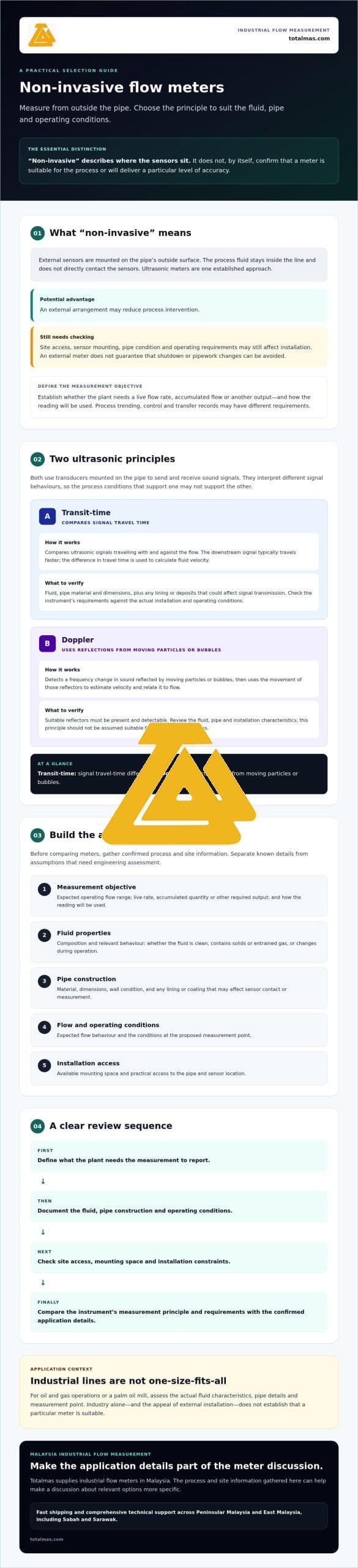
Non-invasive flow measurement measures fluid movement from outside a pipe, without placing a sensor in direct contact with the process fluid. Sensors are fitted to the pipe’s exterior and use a measurement principle, commonly ultrasonic, to determine flow. The term describes sensor placement. It doesn’t guarantee that a meter will suit every fluid, pipe or operating condition, or deliver a particular level of accuracy.
The instrument and application determine what the meter reports. A system may provide flow rate, and some instruments can also provide accumulated flow. Define what the plant needs to monitor and how the reading will be used before choosing a meter. For example, a reading used to observe a process trend may have different requirements from one used for process control or transfer records.
How external flow measurement differs from in-line measurement
With an external arrangement, sensors sit on the pipe’s outside surface while the flowing medium remains inside. In-line meters are installed within the pipe or connected through a process interface, placing their measuring element in contact with the fluid or flow path. An external installation may reduce process intervention, but it doesn’t mean shutdown or pipework changes are always avoided. Site access, sensor mounting, pipe condition and operating requirements still need to be checked.
Ultrasonic meters are one established approach to external measurement. The Ultrasonic flow meter overview describes transit-time and Doppler types, which use different signal behaviours to determine flow. Their suitability depends on the application, so a method used on one line shouldn’t automatically be assumed to work on another.
What plant teams need to know before evaluating it
Start with the measurement objective, then gather information about the process and pipe. Useful inputs include:
- Flow: the expected operating range and whether the requirement is a live rate, accumulated quantity or another output.
- Pipe: material, dimensions, wall condition and any lining or coating that may affect sensor contact or measurement.
- Fluid: composition and relevant properties, including whether it is clean, contains solids or entrained gas, or changes during operation.
- Site: available mounting space, access and operating conditions where the meter would be installed.
For example, a palm oil mill team assessing a process line should confirm the fluid characteristics and pipe details rather than select a meter based only on the industry or the appeal of external installation. Totalmas supplies industrial flow meters in Malaysia. Sharing the application details can help make a discussion about relevant options more specific.
How Non-Invasive Flow Meter Technologies Measure Flow
Ultrasonic measurement is a common external approach. Transducers mounted on a pipe send and receive sound signals, and the instrument interprets how those signals behave to estimate flow. Two widely used principles are transit-time and Doppler. They don’t measure the same signal effect, so the process conditions that support one method may not support the other. This distinction is central to selecting non-invasive flow meter technology for an industrial line.
Transit-time ultrasonic measurement
Transit-time meters compare the time taken by ultrasonic signals travelling with and against the direction of flow. A signal moving downstream typically travels faster than one moving upstream. The difference in travel time is used to calculate fluid velocity, and the meter can use the pipe’s internal dimensions to derive volumetric flow. Before considering this method, establish the fluid, pipe material and dimensions, and any lining or deposits that could affect signal transmission. Check the proposed instrument’s requirements against the actual installation and operating conditions.
Doppler ultrasonic measurement
Doppler meters use sound reflected from moving particles or bubbles within the fluid. The instrument detects a change in the reflected signal’s frequency and uses it to estimate the velocity of those reflectors, then relates that movement to flow. The method therefore depends on suitable reflectors being present and detectable. Review the fluid, pipe and installation characteristics. Don’t treat the principle as suitable for every liquid or process.
In brief: transit-time measurement calculates flow from the difference between upstream and downstream signal travel times. Doppler measurement estimates flow from frequency changes in signals reflected by moving particles or bubbles. Neither principle, by itself, establishes expected accuracy or suitability for a particular line.
For a plant team, this distinction helps identify what information to gather before specifying a meter. An oil and gas process team, for example, should confirm the fluid and pipe details for the intended line rather than assume that a method used elsewhere will transfer directly. In palm oil operations, establish the process-fluid characteristics and actual pipe conditions as well. Fluid properties, pipe material and condition, sensor mounting, and installation quality can all affect whether an approach is appropriate.
When discussing industrial flow meters with Totalmas, share the application details, including the measurement objective, fluid and pipe information, and any known installation constraints.
When Is Non-Invasive Flow Meter Technology Suitable for Malaysian Plants?
External sensing may be worth assessing when process access is restricted or an in-line installation could require intervention in the pipework. It offers a different installation approach, but sensor placement alone doesn’t establish measurement performance. Suitability depends on whether the chosen principle can provide the required reading under the actual fluid, pipe and site conditions.
Use this comparison to organise the information your process and instrumentation teams need to review:
| Assessment area | Questions to answer | Why it matters |
|---|---|---|
| Process fluid | What is the fluid, and can its composition or condition change during operation? | Fluid properties can influence whether a measurement principle is appropriate. |
| Pipe conditions | What are the pipe material, dimensions, wall condition and any lining or coating? | The pipe forms part of the measurement path and affects sensor installation. |
| Measurement objective | Do you need flow rate, accumulated quantity or a reading for a defined operational purpose? | The required output and measurement range shape the specification. |
| Installation constraints | Is there access to mount sensors, and would process continuity limit intervention? | Site access and operating requirements determine whether external installation is practical. |
Questions to assess before choosing a measurement principle
Record confirmed process information rather than relying on assumptions. Document the fluid characteristics, operating conditions, pipe material and dimensions, required measurement range, expected output and intended use. Then identify the proposed mounting location, available access and any constraints on interrupting the process. If details such as pipe lining or fluid condition are uncertain, flag them for engineering review before specifying a meter.
Match accuracy requirements to the application. A reading used for process monitoring may have different requirements from one used for control or transfer records. For broader considerations, see this high-accuracy flow meter selection guide.
Applying the assessment to oil and gas and palm oil
In an oil and gas facility, verify the fluid and pipe conditions at the specific measurement point rather than assuming one method suits every line. At a palm oil mill, apply the same checks to the process fluid and pipework being assessed. These sector examples help frame the review, but they don’t replace an application-specific assessment.
Non-invasive flow meter technology is most appropriate when its measurement principle, required output and installation conditions align. Totalmas supplies industrial flow meters for plant applications in Malaysia.
How to Evaluate a Non-Invasive Flow Meter for Your Process
A sound specification starts with the measurement task, not a preferred meter type. Use this sequence to organise the information your process and instrumentation teams have, then identify what still needs engineering confirmation. This helps keep assumptions from being mistaken for verified site data.
Build a complete application specification
- 1. Define the objective. State what the reading will be used for, such as process monitoring or control, and whether you need flow rate, accumulated quantity or another output.
- 2. Describe the medium and process. Record the fluid and known operating conditions. Note any changes in fluid composition or condition that could affect measurement.
- 3. Document the pipe. Provide its material, dimensions, known wall condition and any lining or coating. Identify the proposed measurement location and share available site information about that section.
- 4. Specify the required range and interface. Explain the expected measurement range and how the output needs to be used or connected to the plant’s control or monitoring system. Confirm interface requirements with the relevant team rather than assuming compatibility.
- 5. Mark unknowns clearly. Label unavailable or uncertain details for confirmation. Don’t estimate fluid properties or pipe dimensions; arrange for the appropriate site or engineering review.
For a palm oil mill or oil and gas facility, a useful specification refers to the actual process line and measurement point. Sector alone isn’t enough to establish whether non-invasive flow meter technology will suit an application. Review the proposed measurement principle and installation conditions against confirmed process and pipe data.
Review installation and support requirements
Before selecting a solution, discuss how the sensors will be mounted, which site conditions need checking, and whether access or process-continuity requirements affect installation. Confirm what outputs are available for the intended use and which technical details still need review.
Use this vendor-discussion checklist:
- What site and pipe information is needed to assess the application?
- What installation conditions and sensor-mounting requirements should the plant prepare for?
- Will the proposed outputs and interface meet the stated monitoring or control purpose?
- What technical information should be confirmed before the meter is specified?
For a Malaysian project, include the installation location and any site-specific requirements in the discussion. To review your application details and industrial flow measurement requirements, contact the Totalmas team.
Next Steps: Discuss Non-Invasive Flow Measurement with Totalmas
The right solution depends on more than whether a meter can be mounted outside a pipe. Match the measurement principle to the fluid, pipe conditions, required output and practical needs of the plant. A clear application brief helps the supplier discuss relevant options and identify which details still need confirmation.
What to prepare before contacting a supplier
Gather the information available for the measurement point. Include the process-fluid description and known operating conditions, pipe material and dimensions, measurement location, required flow range and intended use of the reading. Note whether you need a live flow rate, accumulated quantity or an output for monitoring or control.
Separate confirmed facts from open questions. For example, mark a pipe lining or changing fluid condition as unverified if the plant team hasn’t confirmed it. Also record installation constraints, such as access to the pipe and any limits on process intervention. This makes it easier to identify what needs further checking before a meter is selected.
Turn the technical discussion into a practical next step
Totalmas supplies industrial flow meters in Malaysia. Share the process and site information you have to discuss which options may be relevant. Confirm the proposed installation requirements, expected outputs and any remaining technical questions before proceeding.
Totalmas also supplies pressure transmitters and Enovation Controls / Murphy Displays for industrial monitoring and control applications. If your project involves more than flow measurement, include the wider instrumentation requirements in the discussion.
To review your application, contact Totalmas about flow meter requirements and share the process, pipe and site information your team has gathered. This gives the discussion a practical starting point without assuming that one non-invasive flow meter technology will suit every line.
Make Your Flow Meter Selection with Confidence
Choosing non-invasive flow meter technology starts with the process, not the installation method. Transit-time and Doppler ultrasonic meters rely on different signal behaviours, so fluid properties, pipe conditions and installation quality all matter. Define the measurement objective and required output, then confirm site details before deciding whether an external meter is suitable.
For plant teams in Malaysia, a clear application brief is a practical starting point. Record the process fluid, pipe material and dimensions, operating conditions, measurement location and installation constraints. Mark uncertain details for engineering review rather than relying on estimates.
Totalmas supplies industrial flow meters, along with pressure transmitters and Enovation Controls / Murphy Displays. Share the details of your measurement point to help focus the discussion on relevant equipment and application requirements.
Ready to discuss your application? Contact Totalmas about your industrial flow measurement requirements and share the process, pipe and site details your team has gathered.
Frequently Asked Questions
What is non-invasive flow meter technology?
Non-invasive flow meter technology measures flow from outside a pipe, without placing the sensor in direct contact with the process fluid. Ultrasonic meters commonly use sensors mounted on the pipe exterior to interpret sound signals and estimate flow. “Non-invasive” describes where the sensors are positioned, not a guarantee of suitability or accuracy. Performance depends on the measurement principle, fluid, pipe construction, operating conditions and installation quality.
How does a non-invasive flow meter measure liquid flow?
An external ultrasonic meter sends sound signals through the pipe and analyses how they travel or reflect. A transit-time instrument compares signals travelling with and against the flow; a Doppler instrument analyses signals reflected by moving particles or bubbles in the liquid. The meter uses the relevant signal behaviour to estimate flow. The process fluid and pipe conditions must support the chosen method, so application details need review before selection.
Is an ultrasonic flow meter suitable for every pipe and fluid?
No. Suitability depends on the meter’s measurement principle and the actual application. Pipe material, dimensions, wall condition, lining and sensor mounting can affect whether signals can be transmitted and interpreted. Fluid characteristics also matter, including whether particles or bubbles are present for a Doppler method. Provide the process and pipe details for engineering review, and confirm the proposed instrument’s requirements rather than assuming it will suit every line.
Can a non-invasive flow meter measure flow without stopping the process?
Sometimes, but external sensor placement doesn’t guarantee that installation can happen while the process is running. Access to the pipe, mounting requirements, site conditions and plant procedures all influence whether an interruption is needed. Confirm the installation method and process-continuity requirements for the specific site with the responsible engineering team and supplier. Don’t schedule installation on the assumption that the process can remain in operation until those details are checked.
What information is needed to select a non-invasive flow meter?
Start with the measurement purpose and required output, such as flow rate or accumulated quantity. Gather the fluid description, known operating conditions, expected flow range, pipe material and dimensions, wall condition, lining or coating, and proposed measurement location. Record installation access and any process-continuity constraints. Mark uncertain details for confirmation instead of estimating them. This application information helps the supplier and engineering team assess suitable measurement options.
How does transit-time measurement differ from Doppler measurement?
Transit-time meters compare the travel time of ultrasonic signals moving downstream and upstream through the fluid. The difference is used to estimate flow velocity. Doppler meters instead analyse changes in sound reflected by moving particles or bubbles within the fluid. The two methods therefore rely on different signal behaviours and process conditions. Neither is universally suitable; fluid properties, pipe details and installation quality must be considered for the specific application.
Can non-invasive flow meters be used in oil and gas or palm oil plants?
They may be suitable for particular measurement points, but the sector alone doesn’t determine the right meter. In an oil and gas facility or palm oil mill, engineers should check the actual fluid, operating conditions, pipe material and dimensions, measurement objective and installation access at each proposed location. Confirm whether the chosen principle fits those conditions and the required output. Treat each line as an individual application, not as a standard sector-wide case.